
The Invisible Problem: Why You Forget Everything After Closing the Book
Ever finish a whole book only to realize you can’t remember a single key lesson? You aren't alone. We treat reading like a race, trying to flip through pages as fast as we can, but that habit is the exact reason your brain forgets everything two weeks later. Let’s stop the "read and forget" cycle and turn your bookshelf into an actual asset for your brain.
It was not just this one book. It was a pattern I had ignored for a long time. I would spend hours reading, highlighting lines, and nodding along, but two weeks later, the content was gone. I felt like I was wasting my time. My desk was full of books, but my brain felt like a sieve. Every new chapter pushed the last one out.
I started to wonder if something was wrong with me. Was I losing my ability to focus? Why did I keep reading if nothing stuck? This cycle of reading and forgetting started to affect my confidence. I felt like a fraud for recommending books I could not even discuss in detail. The reality was that my reading habits were shallow. I was consuming information, but I was not processing it.
Many of us face this exact struggle. We want to be smarter and better, but we treat reading like a race. We focus on finishing the book rather than understanding it. This leads to a messy kind of mental exhaustion. We feel busy, yet we are not growing. It is a lonely frustration that kills our motivation to pick up the next book. You are not alone in this, but there is a way to stop this cycle today.
We have been taught to read for entertainment, not for retention. Our eyes move across the lines, but our brains are on autopilot. When you read this way, you are simply looking at words, not building knowledge. I had to learn the hard way that reading is not a passive activity. It requires work, focus, and a specific set of habits.
It was painful to admit that I was reading the wrong way. I had to stop counting pages and start counting ideas. This shift in mindset was the beginning of my journey toward better memory. If you are tired of the "read and forget" loop, you are in the right place. We will change how you approach your bookshelf forever.
Quick Summary: Your Retention Roadmap
- Stop Racing: Finishing a book means nothing if you can't recall the main ideas.
- Make It Ugly: Write in your books, underline, and question the author.
- Teach It: If you can't explain a concept to someone else, you don't really know it.
- One Book at a Time: Don't split your focus; extract the value and apply it before moving on.
Why Passive Reading Fails Your Brain
Most people treat reading like watching a movie. You sit back, let the words wash over you, and hope that something sticks. This is passive reading. Your brain is not engaged. It treats the text as background noise rather than active data.
Think of your brain like a sponge. If you just sprinkle water on it, it gets wet for a second and then dries out. To make the sponge hold water, you have to press it down. You have to force it to soak up the liquid. Active reading is the act of pressing your brain against the text.
The Myth of Speed Reading
You've probably come across speed-reading courses that promise you can finish an entire book in an hour. Reading faster can certainly be useful in some situations, but speed shouldn't be the main goal when you're trying to understand and remember what you read.
When you rush through a book, it's easy to focus on getting to the next page instead of thinking about the ideas you're reading. You may finish the book quickly, but that doesn't necessarily mean you'll remember much of it later.
A better approach is to focus on what you actually take away from the book. Finishing five books in a month may sound impressive, but remembering a few useful ideas and applying them can be far more valuable. Read at a pace that gives you enough time to understand, question, and remember what you're learning.
Building Your Active Reading Toolkit
If you want to remember more of what you read, you need to do more than move your eyes across the page. Get involved with the material. Ask questions, highlight important ideas, and pause to think about how each point connects to what you already know.
Think of reading as a conversation between you and the author. The author shares ideas, but your job is to question them, reflect on them, and decide what they mean to you. When you actively engage with a book instead of simply absorbing its words, reading becomes more meaningful—and what you learn is easier to recall later.
Active vs. Passive Reading: What's the Difference?
1. The Pre-Flight Check (Scan Before You Dive)
My 60-Second Scan Checklist:
Before I commit to a chapter, I run this simple check:
- Headings: Do I know what the big arguments are?
- Visuals: Did I glance at any charts or diagrams?
- Closing: Did I read the chapter summary first?
- If I can't answer these, I haven't "scanned" properly. Try this before you read another word.
Never open a book and start at the first word of the first chapter. That is a mistake. Before you commit to reading a section, take five minutes to survey the landscape.
- Read the Table of Contents: See how the author structured their argument.
- Flip through the headers: Get a sense of the flow.
- Read the introduction and conclusion of chapters: This gives you the map.
When you know where the author is going, your brain acts like a GPS. It knows what to look for, and it recognizes when it arrives at a destination. This simple act drastically improves comprehension.
2. Annotation: Make the Book Ugly
I used to keep my books looking brand new. I thought it was a sign of respect. I was wrong. A pristine book is a book you did not engage with. Start writing in your books.
- Underline key ideas: Do not highlight full sentences. Highlight just the "nuggets" that matter.
- Talk in the margins: Write your reactions. Agree, disagree, or write "I do this too!"
- Summarize at the end of the chapter: Use the blank space at the end of the chapter to write three bullet points.
If you write it down, you own it. Writing uses a different part of your brain than reading. This connection solidifies the memory.
3. The Feynman Technique for Readers

Named after physicist Richard Feynman, this method is simple but powerful. After you read a difficult section, close the book. Ask yourself: "Can I explain this to a 10-year-old?"
If you cannot explain it in simple terms, you do not understand it yet. You likely just memorized the jargon. Try to speak it out loud. If you stumble, go back and re-read that part. This forces your brain to bridge the gap between "I recognize these words" and "I understand this concept."
Pro Tip: My "One-Book" Realization
For years, I tried to read three books at once. I thought it made me productive. I realized that my retention was abysmal because my focus was split. Now, I focus on one book at a time until I have fully "extracted" its value. I stop when I have applied at least one idea to my life. My retention rate has doubled since I stopped treating reading like a buffet and started treating it like a meal I need to digest.
Improving Retention Through Review
Reading is only half the battle. The other half is memory recall. If you never look at your notes again, you will eventually lose the information.
The Power of Spaced Repetition
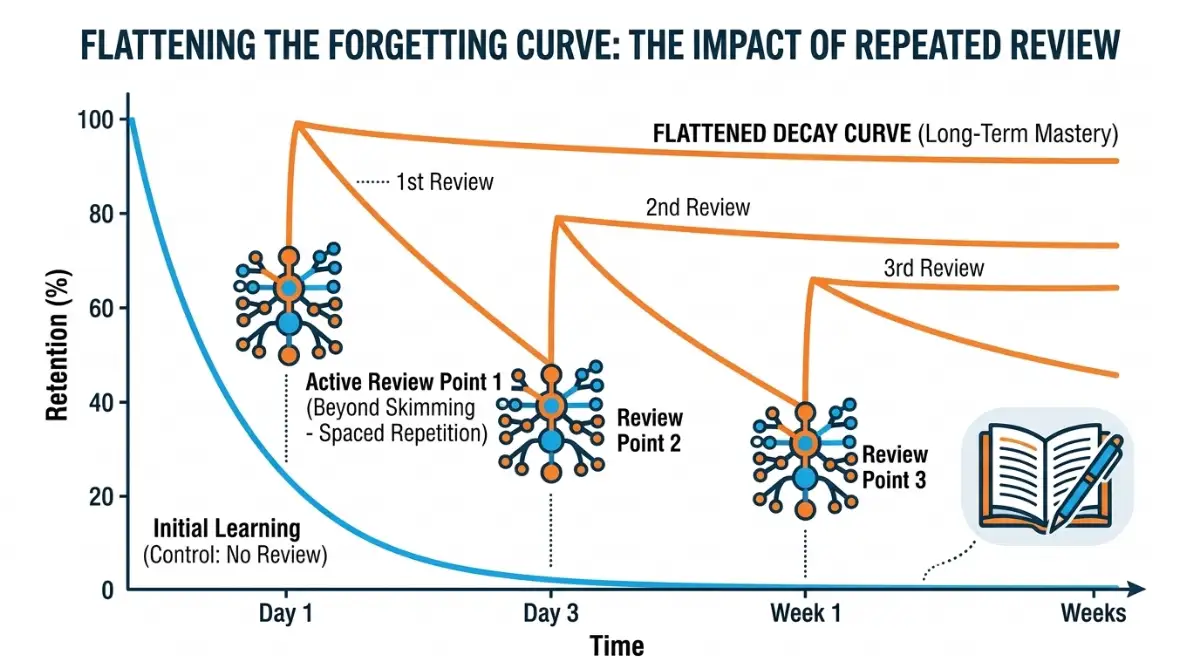
Do not try to remember everything in one go. Instead, create a review schedule.
- One day later: Read your margin notes.
- One week later: Flip through the book and look at what you underlined.
- One month later: Try to explain the main concept to a friend.
This spacing triggers your brain to move information from short-term memory to long-term storage. It sounds like extra work, but it saves you time in the long run. You won't have to re-read the whole book three years later to remember what was in it.
Transform Content into Action
The best way to remember information is to use it. If you are reading a book on health, try one new habit the next day. If you are reading about communication, use a new technique in your next meeting.
Action creates an emotional anchor. When you connect a book's idea to your real-life success or failure, your brain locks it in. You will never forget a lesson that you have personally experienced.
Want to see these techniques in action? Watch this video to learn how to set up your reading environment for maximum focus.
Organize Your Digital Notes
If you prefer reading ebooks, use digital tools to capture your thoughts. Apps like Notion or simple note-taking software work great. Create a "Book Library" folde