
Quick Takeaways:
-
ML vs. Code: Code is for math and rules; ML is for patterns and behavior.
-
Data is Key: If your ML model isn't working, fix your data, not your code.
-
Insurance Truth: Ignore the "big number" on your policy; focus on the "Exclusions" page.
-
Real-Time Reporting: Never wait until you get home to report a medical issue; tell them immediately.
The Frustration of Writing the "Perfect" Instruction
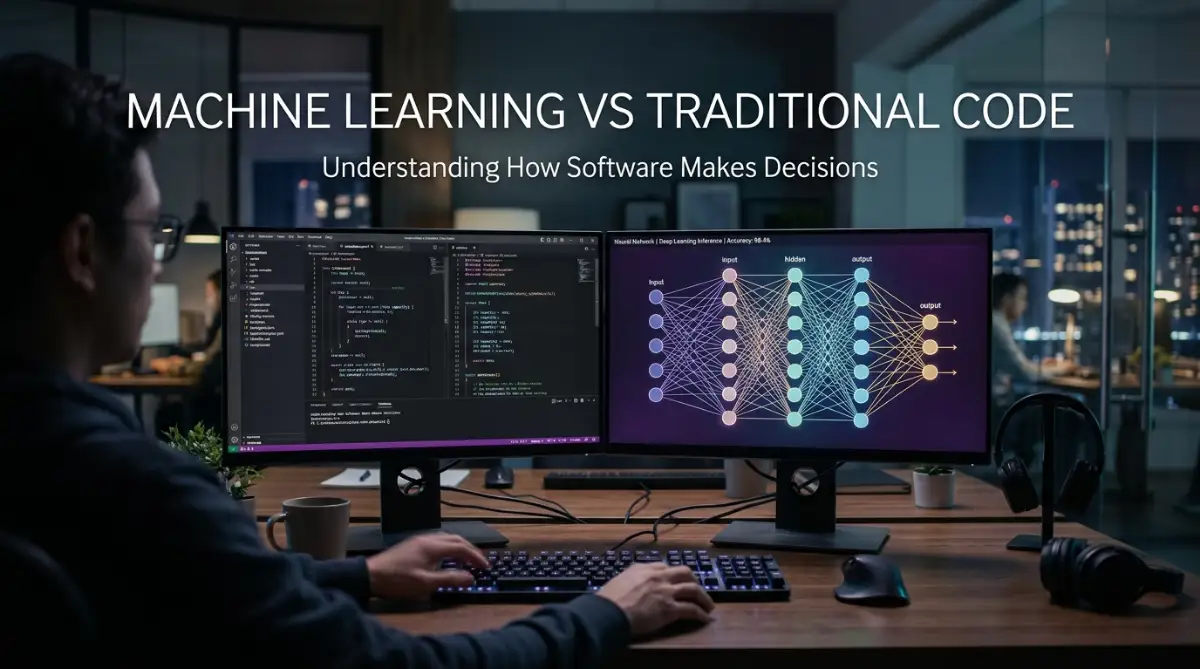
If you are building software today, you are likely stuck between two worlds: telling a computer exactly what to do, or letting it figure out the patterns on its own. Most people think they are the same thing, but they are completely different beasts. Let’s clear up the confusion between traditional code and machine learning so you can stop guessing which tool to use.
"If the subject contains 'discount', put it in the Promotions folder."
"If the sender is 'newsletter@example.com', put it in the Junk folder."
"If it mentions 'urgent', put it in the Priority folder."
It worked like a charm for the first three days. Then, the real world happened. A customer sent an email with the subject "Quick update, NOT a discount, please read."
My program saw the word “discount” and immediately sent the message to the Promotions folder, where it sat unnoticed for a week. The client was understandably frustrated, and I felt pretty foolish. I had tried to account for every possible situation, but human language turned out to be far more complicated than the rules I'd written.
I had built a piece of traditional, rule-based software. It did exactly what I had instructed it to do—even when those instructions didn't make sense in that particular situation. The problem wasn't that the program had failed to follow the rules. It had followed them perfectly. What it couldn't do was recognize that the rule itself didn't fit the context.
That experience changed the way I thought about programming. For simple, predictable tasks, clearly defined rules can work extremely well. But when a problem involves language, context, or patterns that change over time, a fixed set of instructions can become difficult to maintain and surprisingly easy to get wrong.
In many ways, we interact with rule-based systems every day without thinking about what's happening behind the scenes. We expect our devices and software to understand what we mean, but much of the underlying logic may still depend on instructions created by people.
This is where machine learning introduces a different approach. Instead of relying entirely on manually written rules, a machine-learning system can learn patterns from data and use those patterns to make predictions or classifications. It's not magic, and it isn't always correct—but it changes the way software can handle problems that are difficult to describe with a simple list of rules.
Understanding the "Recipe" World of Traditional Software
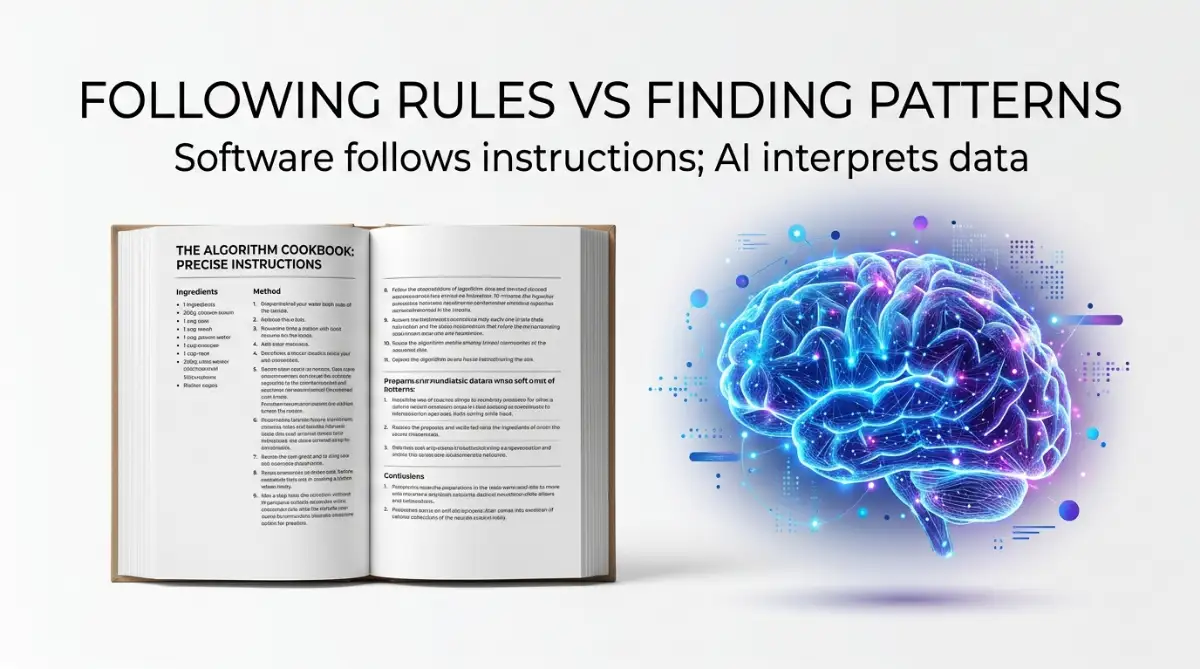
To get how these two worlds differ, think about traditional software as a massive collection of recipes. A chef follows a recipe step-by-step. If the recipe says "add two eggs," the chef adds two eggs.
If the recipe forgets to mention the salt, the chef doesn't add salt. The chef doesn't say, "Wait, this usually tastes better with salt." The chef follows the instructions to the letter.
Traditional software is built exactly this way. It relies on explicit, pre-defined logic. A programmer sits down and imagines every single possibility that could occur.
They write "If this happens, do that." They define the inputs, they define the processing, and they define the outputs. The computer is just a fast machine that executes these instructions without ever questioning them.
Why Rigid Rules Fail in the Real World
This approach is perfect for things like calculators or inventory systems where the math never changes. Two plus two will always be four. You don't need an AI to figure that out.
But what happens when the world changes? Imagine you are building a system to spot fraudulent credit card charges. If you use traditional rules, you might say, "If a transaction is over $5,000, flag it as fraud."
A thief quickly learns this rule and starts making purchases of $4,999. Your rule-based system is now useless. It cannot adapt to the new behavior of the thief.
To fix this, the programmer would have to constantly update the rules. They would spend their lives chasing shadows. This is why traditional software is often described as "brittle."
It is strong until the moment it encounters something the programmer didn't foresee. Then, it shatters. It doesn't gracefully handle the unexpected; it just stops working or gives the wrong answer.
The "Pattern Recognition" Shift: What is Machine Learning?
If traditional software is a chef following a recipe, Machine Learning is a toddler learning to identify a dog. You don't give the toddler a list of rules like "If it has four legs, and fur, and a tail, and barks, it is a dog."
Even if you did, the toddler would be confused by a cat, which has almost all those features. Instead, you show the toddler hundreds of pictures. You point and say, "Dog." You show them a cat and say, "Not a dog."
Eventually, the toddler stops needing you. They have seen enough examples to build their own internal model of what a dog looks like. They can identify a dog breed they have never seen before, simply because they recognize the pattern.
Machine Learning works the same way. We feed a computer massive amounts of data. We don't tell the computer exactly how to spot the dog (or the fraud, or the spam email).
We tell the computer, "Here is the data, and here is the result we want." The computer then iterates through the data millions of times, looking for correlations and patterns that a human might never notice.
The Power of Probabilities Over Certainties
In traditional software, the result is binary. It is either "True" or "False." A transaction is either fraudulent or it is not.
In Machine Learning, the result is a probability. The system might say, "I am 94% sure this transaction is fraudulent." This shift from certainty to probability is what makes AI so powerful.
Because it operates on probabilities, it can handle "messy" data. It doesn't crash if the input is slightly weird. It just adjusts its confidence score.