
The Moment Your Traffic Vanishes: A Personal Wake-Up Call
I remember the exact morning it happened. I sat down with my coffee, feeling great about the brand-new version of my website I had launched just a few days prior. I opened Google Search Console, expecting to see a fresh surge of interest in the new design. Instead, I saw a cliff. My organic traffic had plummeted, and it felt like my hard work had evaporated into thin air.
My heart sank into my stomach as I clicked through the reports. Every single page that used to rank in the top spots was missing. I felt nauseous, realizing that in my excitement to upgrade the site, I had completely ignored the technical backbone that kept the search engines happy. I spent the next week in a state of panic, trying to fix errors that I should have addressed before I even hit the "publish" button.
This experience changed how I look at website projects forever. I learned the hard way that a website migration is not just about making things look pretty or adding new features. It is a surgery on the digital identity of your business. If you do not perform that surgery with extreme care, the patient—your traffic and rankings—will suffer.
You might be thinking that a migration is too risky, but it is often necessary for growth. The key is to manage the change so that Google barely notices the difference, except to see that your site is now faster and better. If you have ever felt that cold sweat of seeing your rankings drop, you know exactly why we need to talk about this. Let’s make sure you never have to feel that panic again.
Preparing Your Site for a Smooth Transition
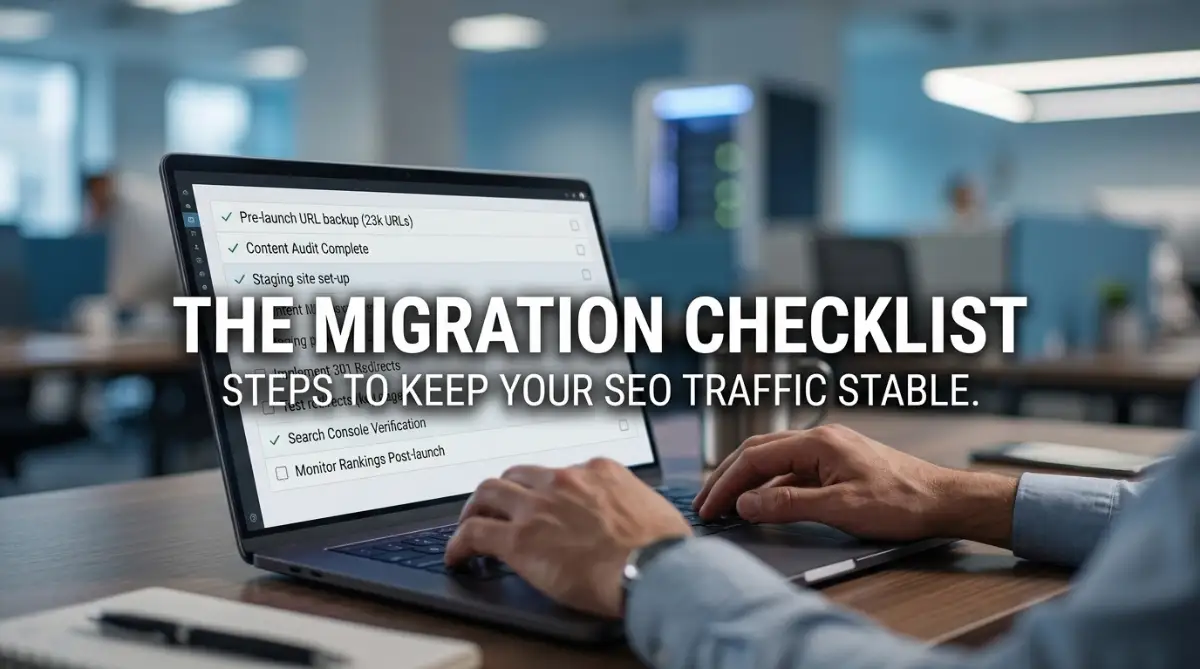
Before you change a single file or move a database, you need to prepare. Many people jump straight into the technical side, but the first step is actually documentation. You need a complete list of every URL your site currently has. If you do not know exactly what exists on your site, you cannot protect it.
Start by crawling your current website using an SEO tool. Export the list of all active URLs. This spreadsheet will become your map. It is the reference point for everything you will do during the transition. If you do not have this list, you are flying blind in the dark.
The Power of the URL Inventory
Think of this inventory as your master list. You need to identify which pages are getting traffic and which ones are not. High-traffic pages are your priority. If you lose the ranking for your best-performing page, you lose revenue.
Create a separate column in your spreadsheet to mark these high-value pages. You want to make sure these specific URLs get special attention. You will use this list later to set up your redirects. Do not skip this step, no matter how much you want to speed up the process.
Backing Up Like Your Business Depends On It
Never, ever start a migration without a full backup. I have seen developers who thought they were safe skip this, only to lose everything when a server configuration went wrong. A backup is your safety net. It allows you to hit the "reset" button if things go sideways.
Keep this backup in a safe place, disconnected from the server you are working on. You want to be sure that if the new site crashes, you can restore the old one in minutes. This peace of mind allows you to work with more confidence. It is the single most effective way to avoid a total disaster.
Technical Execution: Managing the URL Structure
Once you are ready to move, the way you handle the URLs is the most important factor in keeping your rankings. When you change a URL, Google needs to know where the old content went. If you do not tell Google, they treat the new URL as a brand-new page. This means you lose all the history and authority the old page had built up.
To prevent this, you use 301 redirects. A 301 redirect is a permanent signal that says, "This page has moved to a new address." It passes the SEO value from the old page to the new one. If your URL structure is changing, you need to map every old URL to the most relevant new URL.
Avoiding the Redirect Loop Trap
One common mistake I see often is creating redirect chains. This happens when you redirect Page A to Page B, and then Page B to Page C. This confuses the search engine crawlers and slows down your site. It creates a poor experience for your users as well.
Always map your old URLs directly to their new destination. If Page A has moved, send it directly to its new location. Do not chain them together. A clean, direct redirect is much faster and easier for Google to process.
If you want to see exactly how to map these redirects without breaking your site structure, watch this short breakdown. It simplifies the technical process so you can handle the move like a pro.
Handling the Staging Environment
Never build or test the new version of your site on your live domain. You need a staging environment. This is a private, password-protected area where you can test everything. You want to make sure all your links work and your content looks right before the public sees it.
The biggest danger here is Google indexing your staging site. If Google finds your staging site and then finds the same content on your live site, they might think you are duplicating content. This can hurt your rankings significantly.
Keep the Bots Out
Use a "no-index" tag or a robots.txt file to block search engines from your staging site. This is a very simple step that prevents a world of trouble. You only want Google to see your site when it is live and ready. Check this setting three times if you have to.
I once forgot to block a staging site and saw it pop up in search results instead of my actual site. It was a nightmare to fix. Do not rely on your memory; double-check the settings. It takes five seconds to verify and saves you hours of clean-up work.
Post-Migration Monitoring: The First Few Days
When you finally go live, your work is not done. You need to watch your site like a hawk. The first 48 hours are the most intense. Check your server logs and your Search Console data frequently.
Look for 404 errors. These happen when a page does not exist anymore. If you see a spike in 404 errors, it means your redirects are not working correctly. You need to fix these immediately. The longer they stay, the more likely a user is to leave your site and never come back.
The Pro Tip: My "Realization" Moment
I realized years ago that I was obsessing over every single internal link, but I forgot about my external backlinks. Even if you have perfect redirects, some external sites might link to a broken page on your new site. I started reaching out to major sites linking to me to update those links directly. It was a game-changer for maintaining my authority. Now, I always keep a list of my top-tier backlinks and check them personally after any move.
Why Speed and Performance Matter During the Move
When you move your site, your server configuration changes. This is often when people accidentally slow down their site. If your new site is slower than the old one, Google will notice. They prefer sites that offer a fast, smooth experience to the user.
Test your site speed immediately after the migration. Use free tools to see how your loading times have changed. If you notice a slowdown, look for large images or inefficient scripts that might be causing the lag. It is much easier to fix these performance issues early than to try and recover rankings after Google has penalized you for a slow site.
Keeping Your Content Consistent
Sometimes, we get the urge to rewrite our content while we move it. This is a bad idea. If you change your content significantly during a migration, you create too many variables. Google might not understand why your page changed so drastically.
Keep your content as close to the original as possible during the move. If you want to rewrite or update your content, do it before or after the migration. Let the search engines see that the move was just a transition, not a complete overhaul of the information. Consistency builds trust with the search algorithms.
Final Checks for Ongoing Stability
Once you are past the first week, you should feel more relaxed. However, keep checking your search reports for a full month. You might find "hidden" errors that do not appear right away. Sometimes, a specific category or a set of old tags might have been missed by your redirect map.
The Value of Patience
SEO is a long game. Even if you do everything perfectly, you might see a tiny dip in traffic. This is often just Google re-indexing your site. Do not panic if you see small changes. It takes time for the system to understand the new layout and trust that the move was successful.
Keep focusing on creating great content. Your goal is to make the new site even better than the old one. If you keep delivering value to your readers, the rankings will follow. Remember that the migration is just a tool to help you serve your audience better. If you keep the user experience at the center of your work, you will always come out on top.
This process might seem intense, but it is entirely manageable if you take it one step at a time. Treat your website like the valuable asset it is. Protect it, monitor it, and treat the migration process with the respect it deserves. Your traffic will thank you, and your rankings will remain exactly where they should be.
Mastering Your Digital Transition: Pro-Level Tactics
Moving a website is not just about moving files. It is about preserving the trust you have built with your readers and the search engines. Once you have handled the basics like redirects and backups, you enter the arena of advanced optimization. This is where most site owners leave money on the table, assuming that the hard work is done. It is not.
One of the most effective ways to ensure your move succeeds is through server log file analysis. While tools like Search Console are helpful, they provide summarized data. Log files tell you exactly what the search engine spiders are doing on your server in real-time. If you see bots crawling broken links or failing to find your new structure, you can act immediately.
Another secret that pros often keep is the preservation of structured data or Schema markup. When you migrate, it is very common for developers to forget to map your product data, reviews, or article markup to the new pages. If you lose this, you lose your rich snippets in search results, which can crater your click-through rate. Take the time to audit your JSON-LD code against your old version.
You should also look into the guidelines for site moves provided by Google Search Central to ensure your status codes are perfectly aligned with their recommendations. Small changes in how a server handles a request can lead to massive differences in how your pages are indexed. Being precise here is the difference between a smooth transition and a long recovery.
The Reality of Content Maintenance
I often see site owners ignore their content once the site is live, thinking the traffic will just bounce back. This is known as the passive income fallacy, where people believe money just grows without tending to the underlying system. You need to be active. Check your most popular pages every single day for the first two weeks.
If you notice a specific topic has lost its standing, do not just hope it comes back. Update that content. Add new insights, fix broken internal links, and ensure the user experience is as good as it was on the old site. Think of it like a mental health check-up; you cannot just wait for a crisis to decide to care about your site's well-being. Proactive maintenance is always cheaper and easier than damage control.
Managing Market Volatility During the Move
It is normal to feel anxious when numbers fluctuate. The market, both in business and in SEO, is rarely a straight line upward. When you move your site, you are bound to see some small dips. If you start panic-editing your site because of minor daily changes, you might actually do more harm than good.
Learn to stay calm and invest wisely during market volatility. Your website's performance is similar to an investment portfolio. If you react to every single day's movement, you will make poor decisions. Wait for the trends to emerge over a longer period before you make any drastic changes.

The Hidden Traps That Sabotage Your Rankings
Most people fail their migration because they let their guard down. They get the site live, the home page loads, and they think, "We did it." Then they walk away. This is exactly when the problems start.
One of the biggest mistakes is the "Set it and forget it" trap. You might have redirected your main pages, but what about the thousands of images or attachment pages? If those return a 404 error, Google interprets that as a lack of quality. Over time, that "404 bloat" can drag down the authority of your entire domain.
Another common pitfall is ignoring the mobile usability standards of your new design. Sometimes a theme looks great on a desktop but forces users to scroll horizontally or breaks the touch targets on a phone. Search engines now grade you primarily on your mobile version. If your migration made the site even slightly harder to use on a phone, your rankings will suffer.
The Danger of Changing Your URL Structure Unnecessarily
I have worked with clients who decided that a migration was the "perfect time" to rename all their blog post URLs to be "cleaner." This is a massive mistake. Unless you have a very strong reason, keep your URL slugs exactly the same. When you change the slug, you break the connection to the history of that page.
Even with a perfect redirect, the search engine still has to process the change. Why add friction to a system that is already undergoing a stress test? If you must change URLs, do it as a separate project, long after the migration has stabilized.
Failing to Secure Your Assets
A migration often involves moving databases and changing permissions. This can leave your site open to unauthorized domain transfers if your security settings are reset to default. I have seen sites get hijacked because the developer left a staging login active or kept a vulnerable plugin enabled during the move.
Always treat your site security as a layer of your architecture, just like professional solar placement matters for energy efficiency. If the foundation is exposed, the whole structure is at risk. Audit your administrative users and plugin permissions the moment the site goes live.
The "Slow Performance" Oversight
Many new themes or platforms come with heavy code that looks beautiful but slows down the page. If your site speed drops from two seconds to five seconds, you are going to lose traffic. Users do not wait for slow sites, and search engines prioritize speed as a ranking factor.
Use web performance tools to benchmark your new site against the old one. If you notice a lag, compress your images, minify your scripts, and reduce the number of third-party trackers. You are competing for attention, and speed is your first impression.
Your Path Forward: Building Long-Term Stability
You have put in the work, and the storm of the migration is behind you. Now is the time to stabilize and grow. Remember that a migration is not a project with an end date; it is the beginning of a new chapter for your digital presence. Keep monitoring your data and keep talking to your users.
Do not worry about being perfect. Every single expert I know has broken a site at least once. The difference between a success and a failure is how you respond to the errors when they pop up. If you see a dip, investigate it calmly. If you see a win, learn what you did right and repeat it.
I have found that the most successful site owners are the ones who treat their website like a living, breathing project. My biggest piece of advice is to stay curious about your data. Don't just look at the traffic numbers; look at what your users are actually clicking on. If you keep serving their needs, the search engines will reward you.
Start your morning tomorrow by checking your crawl error report. Make one small improvement to your site structure. Just doing one productive thing a day will keep your site moving in the right direction. You have the skills to handle this, so keep pushing forward with confidence.
Frequently Asked Questions
Do I need to tell Google I moved my site?
Yes, using the "Change of Address" tool in Search Console is a must. It acts as a formal notification to the search engine that your content has moved to a new home. This speeds up the processing of your redirects significantly.
Is it normal to see a temporary traffic drop?
It is very common. Search engines need time to re-crawl your new pages and verify that the redirects are working. As long as your redirects are correct and your content remains high quality, this dip usually recovers within a few weeks.
Should I remove my old site immediately?
No, keep your old site or the server response active for as long as possible. You need the redirects to function, and if you kill the old server too quickly, every redirect will fail. Keep the old environment running until you are certain your traffic has stabilized on the new domain.
Can I change my content during the move?
It is better to avoid it. If you change content, URLs, and the design all at once, you make it very hard to diagnose the cause if something goes wrong. Keep the content identical to the old site during the move, then make updates later.
What if my site is not mobile-friendly?
This is a huge issue. If your new design struggles on mobile, you should fix this before you even launch. Prioritize a responsive layout that works on all screen sizes to satisfy current search ranking requirements.
Disclaimer: This guide is for educational purposes only. Website migration involves complex technical processes that can impact your site's data and visibility. Always perform a full, verified backup of your website before attempting any technical changes. I am not responsible for any data loss, traffic drops, or technical failures that may occur while following these suggestions. Proceed with caution and consult with a professional developer if you are unsure about any steps.