The Morning Loop: Why My Screen Was Stealing My Joy
I remember waking up on a Tuesday that felt like every other day. My alarm went off, and my hand instinctively shot out from under the covers to grab my phone before my eyes were even fully open. I wasn't checking the time. I was checking emails, social media feeds, and the news, all in a daze. Within five minutes, my heart rate was up, my brain was spinning with other people's problems, and I felt behind on things that hadn't even happened yet.
That was my "morning routine." It wasn't really a routine; it was a surrender. I was letting the digital world dictate my mood, my pace, and my energy levels for the entire day. I felt like I was constantly running, yet I was standing perfectly still in my bed. My mind felt like a browser with fifty tabs open at once, and honestly, the "not responding" error message was starting to show.
I was exhausted, and I wasn't even out of bed. I knew something had to change. I looked at the sleek glass rectangle in my hand and wondered why I gave it so much power over my peace of mind. It was supposed to be a tool, a servant to my life, but it had become the master of my morning. I realized I was suffering from a classic case of "digital overload," and I knew I was far from the only one.
Does this feel familiar to you? You probably recognize that same sensation of being "always on." It is a heavy feeling. It is the weight of hundreds of notifications, the constant pressure to respond, and the subtle anxiety that comes from seeing everyone else’s "perfect" lives on your screen. You might feel like you are doing more, but you are likely just getting more distracted.
This isn't about throwing your phone in the trash or moving to a cabin in the woods. That is not realistic for most of us in this day and age. It is about taking back your attention. It is about understanding that your attention is your most valuable resource, and you have been spending it like it is free.
The struggle is real because our technology is designed to be addictive. Every app, every ping, and every red badge on an icon is engineered to pull you in. When you fight against that, you are fighting against some of the smartest engineers in the world. It is no wonder you feel drained. But you can win this battle by making small, intentional choices.
The Strategy of Less: A Path to Mental Freedom
To fix this, we need to move away from the idea that we must consume everything the internet offers. We need to shift our mindset from "being connected" to "being intentional." This isn't a complex, heavy project. It is simply about editing your digital environment to serve your actual needs.
Step 1: The Great Digital Purge
You need to start by looking at what is on your screen. Most of us have dozens of apps that we haven't touched in months. They are digital clutter that takes up space in your phone and, more importantly, in your head.
Start by going through every single app on your device. Ask yourself one simple question: Does this app add value to my life? If it is a news app that just makes you angry, delete it. If it is a social media app that makes you feel bad about your own progress, remove it.
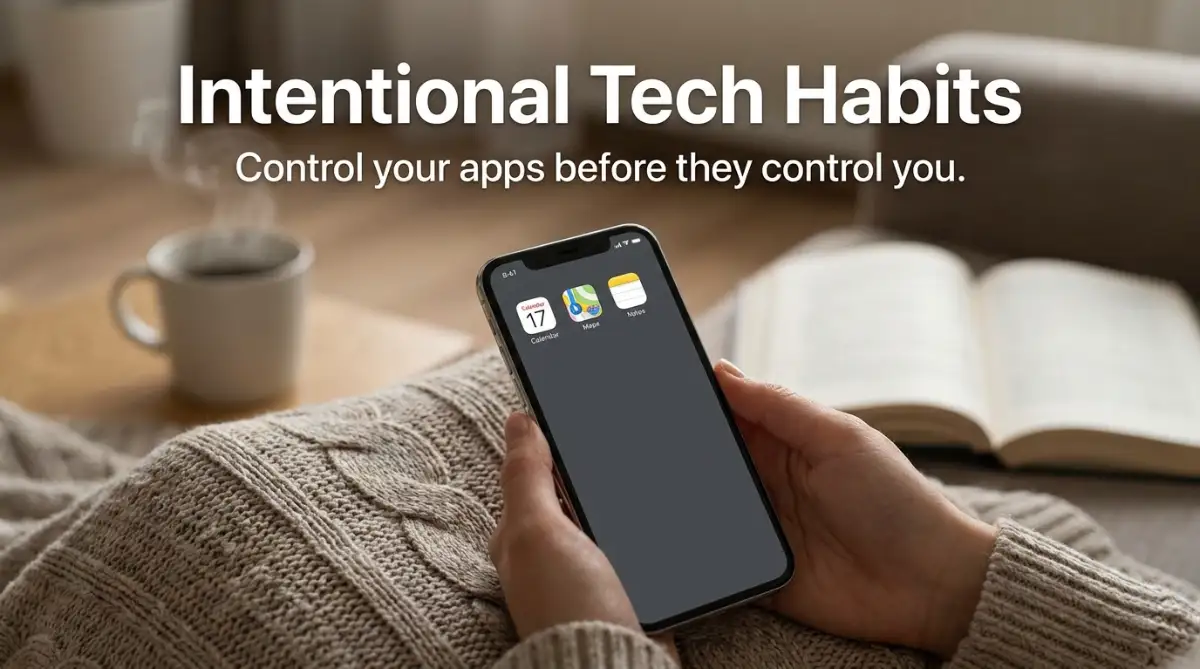
You don't need five different weather apps or three separate email clients. Keep the tools you use for work and the ones that bring you genuine joy or connection. Everything else is just noise. The goal is to make your home screen look clean, manageable, and purposeful.
Step 2: Taming the Notification Monster
Notifications are interruptions disguised as updates. Think about it. Do you really need to know that someone liked your photo at 2:00 PM on a Wednesday? Probably not.
Go into your settings and turn off non-essential notifications. Only allow pings for things that are time-sensitive and truly important. This usually means phone calls, text messages from close friends or family, and calendar reminders.
Everything else—the news alerts, the "people you might know" suggestions, the game updates—needs to go. When you stop the constant buzzing, you will notice something incredible: your focus returns. You start to control when you check your phone, rather than letting your phone dictate when you look at it.
Step 3: Setting Digital Boundaries
Even with a clean phone, you can still fall into the trap of mindless scrolling. This happens when you don't have boundaries. You need to create "tech-free zones" and "tech-free times."
Try keeping your phone out of the bedroom. Buy a real alarm clock and leave your phone in another room or on the kitchen counter at night. This small change stops the morning scroll and helps you actually sleep better.
Also, try having a "no-phone" rule at the dinner table or during family time. Being present in the moment is the greatest gift you can give the people around you. When you are with them, be all there. Don't split your attention between the conversation and a screen.
Step 4: The One-In, One-Out Rule
This is a great habit for long-term maintenance. If you decide to add a new app to your phone, you must remove an old one. This forces you to evaluate if the new tool is really worth the space.
It prevents your device from becoming a graveyard of forgotten apps. It also helps you stay mindful about what you are installing. If you have to give something up, you become much more selective about what you keep. This simple rule keeps your digital space lean and efficient over time.
Step 5: Batching Your Digital Tasks
Instead of checking your email every ten minutes, try batching it. Give yourself two or three times a day to process your messages. Reply to everything at once and then close the app.
This saves you from the constant "switching cost" of jumping between tasks. Your brain hates switching back and forth; it wears you out. When you focus on one thing at a time, you get more done in less time. You will feel a sense of relief when you see your inbox under control, and you won't be haunted by the "ping" of new mail all day long.
Pro Tip: One thing I learned the hard way was that I kept checking social media "just in case" I missed something. I realized I was missing my actual life for the sake of digital updates. My realization was simple: if something is truly important, I will hear about it from a real person. I turned off all social media notifications, and it was like a weight lifted off my shoulders. I still check them, but on my terms, not on the terms of the algorithm.
Watch this video to learn more about how to set up your phone for better focus and less distraction:
If you feel like your phone is constantly demanding your attention, this guide will show you exactly how to regain control of your time and stop the endless cycle of mindless scrolling.
This video covers the specific settings that most people ignore. Many users think they have to be tech-savvy to manage these tools, but this video proves it is easy. Once you see these steps, you will wonder why you didn't do it sooner.
Why This Matters: The Mental Cost of Clutter
We often talk about physical clutter, like a messy desk or an unorganized closet. We know that physical mess makes it hard to work. But we ignore digital clutter, even though it impacts our brains in the exact same way.
When you have a thousand unread emails, five hundred unorganized photos, and a home screen filled with useless apps, you are carrying that weight with you. It is a constant, low-level stressor. Your brain knows that it is unfinished work, even if you try to ignore it.
Streamlining your online presence is not about being "boring" or "unplugged." It is about clearing the path so you can focus on what actually makes you happy. When you clear the digital junk, you find space for your hobbies, your family, and your own thoughts.
Imagine sitting down at your computer or picking up your phone and seeing only what you need. No distractions, no junk, no stress. That is the promise of digital minimalism. It is not about deprivation; it is about subtraction for the sake of addition. You subtract the noise so you can add more clarity, more time, and more peace.
How to Handle the "Fear of Missing Out"
One of the biggest hurdles people face is the fear that if they unplug, they will miss out on something big. They worry that they won't know the latest news or that their friends will think they are ignoring them. This is a common trap.
First, realize that most of what happens online is not "big news." It is noise. If something truly major happens in the world or in your circle, you will find out. You don't need to know about it the exact second it occurs.
Second, real friends understand. If you tell people, "Hey, I'm taking some time away from my phone to focus on being present," they will likely respect you for it. They might even feel inspired to do the same. You aren't closing yourself off; you are opening yourself up to a different kind of connection—the real, face-to-face kind.
Think about the quality of your interactions. Is it better to send a quick, mindless emoji response to a friend's post, or to actually call them and hear their voice? The answer is obvious, but we choose the easy, digital path every day. Minimalism encourages you to choose the harder, better path.
Tracking Your Progress: It’s Not About Perfection
You don't have to be perfect at this. Some days, you will find yourself back in the habit of mindless scrolling. That is okay. It doesn't mean you failed; it just means you are human.
The key is to track how you feel, not just how much time you spend on your device. Do you feel calmer? Are you sleeping better? Do you find it easier to concentrate on a book or a project? Those are the real metrics of success.
Use the built-in "screen time" trackers on your phone to keep an eye on your usage. Don't treat it as a source of guilt, but as a source of information. If you see your hours going up, ask yourself why. Were you stressed? Bored? Loneliness is a common driver of digital usage.
When you identify why you are reaching for the phone, you can find a better way to satisfy that need. Bored? Take a walk. Stressed? Write down your thoughts or talk to someone. Loneliness? Call a friend. The phone is rarely the best solution to those problems, but we use it as a crutch anyway.
Embracing a Calmer Future
Your digital life is a tool, not a lifestyle. You are the user, and you have the power to define how that tool fits into your day. It might take a few weeks to really feel the difference, but the shift in your mental clarity will be worth it.
Start small. You don't have to delete everything today. Just try one thing. Turn off one annoying notification. Clear one screen of apps. Set one boundary for your bedtime. Those small wins add up to a big change in your quality of life.
You deserve to have a mind that feels clear and calm. You deserve to focus on the things that really matter to you. By taking these steps, you are telling yourself that your peace of mind is more important than the endless, buzzing stream of the internet. That is a powerful and necessary declaration in the modern world.
As you begin this journey, remember to be kind to yourself. You are unlearning habits that you have likely spent years building. Change takes time, and that is perfectly fine. Keep your focus on the goal of clarity, and let the rest fade into the background where it belongs.
A Note on Consistency
The beauty of digital minimalism is that it is flexible. You can adjust it as your needs change. Maybe you need to be very connected during a busy work week, but you can go almost entirely "offline" on the weekend.
Find the balance that works for your life. There is no one-size-fits-all approach here. The goal is not to have a completely empty screen, but to have a screen that serves you well. If you have an app that helps you learn a language, keep it. If you have a tool that helps you manage your finances, hold onto it.
Keep the things that help you grow, and get rid of the things that just consume your time. This filter will naturally lead you toward a more focused and meaningful existence. It is about curation, not just deletion.
The Cumulative Effect of Small Changes
When you look back after a few months of practicing this, you will see the impact. You will have more time, less anxiety, and a better ability to engage with the world around you. You will notice that you are not constantly reacting to every little ping.
Instead, you will be acting with intention. You will be choosing how to spend your time rather than having it stolen from you. This is a level of freedom that many people never experience because they are too busy being tethered to their devices.
You have the power to change this. It starts with your next decision. Will you open that app to kill time, or will you take a deep breath and look around you? The choice is yours, and it is a choice you can make a hundred times a day.
Every time you choose to step away from the noise, you are strengthening your ability to focus and find calm. You are building a stronger, more resilient version of yourself. And that, in the long run, is what will make all the difference in your life.
How to Sustain Your New Habits
Maintaining these changes is just as important as starting them. Life will always try to pull you back into the current of digital noise. Advertisers, developers, and social pressures will always be there, pushing you to pay attention.
Stay grounded by remembering why you started this. Whenever you feel the urge to slip back into old habits, remind yourself of the clarity you are working toward. You might want to create a small "check-in" ritual once a week to review your digital life.
Ask yourself: "Is my phone working for me, or am I working for my phone?" If the answer feels like the latter, gently course-correct. You don't need a total reset every time you drift off track. Just make a small adjustment and move forward.
Building a Supportive Environment
Tell your friends or family about what you are doing. If they know you aren't ignoring them, but are just being more intentional with your tech, they will support you. Some might even ask to join you.
Creating a support system—even if it is just one other person—can make a huge difference. You can share tips, keep each other accountable, and talk about the changes you are noticing in your mental state. It makes the journey more enjoyable and less isolating.
You are not alone in wanting a simpler, clearer life. Many people are realizing the same things you are. By stepping away from the digital noise, you are joining a growing movement of people who value real life over virtual life.
Final Thoughts: Ownership Over Tech
Ultimately, this is about reclaiming ownership. You own your time, you own your attention, and you own your mental space. Don't give it away cheaply to things that don't matter.
Take charge of your online presence. Curate it, shape it, and make it fit the life you actually want to live. You have the ability to create a digital environment that supports your goals instead of sabotaging them.
I am excited for you to experience this. The sense of freedom you get from a decluttered digital life is unlike anything else. It is the feeling of coming home to yourself. Start today, start small, and watch how much better your world becomes.
Mastering the Art of Digital Balance
You have already taken the first steps toward a clearer mind. Now, it is time to move from "cleaning up" to "optimizing" how you use your devices. Most people think minimalism is about removing things, but it is actually about adding focus. You want to keep the tools that help you and remove the ones that just drain your energy.
The Strategy of Batch Processing Your Life
One of the most effective habits I picked up is "batch processing" my digital interactions. Instead of checking email throughout the day, I set two specific times to handle everything. This allows me to avoid the constant context switching that kills productivity. Your brain works better when you focus on one type of task for a block of time.
If you are a student or a worker, you might find that why traditional study habits often fail to retain complex information is because of these constant interruptions. By batching, you create a "deep work" space where you can actually get things done. You don't have to be a tech expert to set this up; you just need to be a bit disciplined with your time.
Building a Digital Garden
Think of your digital life as a garden. If you let it grow wild, the weeds take over. If you prune it regularly, the plants you want to see will flourish. Every week, I take ten minutes to "prune" my digital space.
I unsubscribe from newsletters I never read. I clear out my desktop icons. I delete the screenshots I don't need anymore. This is not about being obsessive; it is about keeping the environment clean so you can think clearly. When your digital space is cluttered, your mind often feels cluttered, too.
You can learn more about how to manage your privacy and security, which is another form of digital care, by reading the home network security guide to protect your privacy at home. A secure home network is a peaceful home network, as it removes the worry of unauthorized access.
Pro Tip: My Realization on "Digital Triggers"
I used to think my phone was just "there," waiting for me to use it. Then, I realized that every time I felt a tiny bit of boredom or anxiety, I reached for my phone as a reflex. I decided to make a new rule: Every time I feel the urge to check my phone for no reason, I have to take three deep breaths first. It was shocking how often the urge faded away after those breaths. I wasn't bored; I was just looking for an easy distraction.
The Power of Offline Hobbies
If you want to maintain digital minimalism, you need something to fill the time you used to spend scrolling. This is the secret that most people miss. You cannot just "delete" your screen time; you have to replace it.
Pick up a book, go for a walk without music, or try a hobby that doesn't involve a screen. I started drawing, and even though I am not great at it, the focus it requires is a great reset for my brain. When you find joy in the real world, you naturally spend less time in the digital one.
The Center for Humane Technology has a lot of resources on how apps are designed to keep us hooked. Knowing how they do it makes it much easier to step away. It is not about willpower; it is about knowing the game and choosing not to play it.
The Common Traps That Derail Your Progress
It is very common to start this journey with a lot of energy and then lose steam. We often fall into patterns that make minimalism feel like a burden instead of a relief. Recognizing these traps is the first step to avoiding them.
The "All or Nothing" Trap
Many people try to quit all their digital habits overnight. They delete every social media account, throw away their tablet, and try to live like it is the last century. This almost always leads to a "binge" where they return to their old habits within a week.
You do not need to be a digital hermit to benefit from minimalism. Start with the apps that annoy you the most. If you keep the ones that genuinely bring value, you will be much more likely to stick with the plan.
Treating Minimalism Like a Punishment
If you tell yourself, "I am not allowed to use my phone," you will spend all your time thinking about using your phone. It becomes a forbidden fruit. Instead, frame it as a positive choice.
Say, "I am choosing to do this so I can focus on my work," or "I am putting my phone away so I can enjoy this meal." When you choose your freedom, you don't feel deprived. You feel empowered.
Ignoring the "Why" Behind Your Usage
We often use our devices to escape from feelings. Maybe you are stressed at work, or you feel lonely at home. If you don't address those root causes, you will just find another way to escape.
If you don't check your mental health, you might just swap one bad habit for another. Sometimes, why mental health check-ups are just as essential as physical screenings is a great reminder that our minds need care that isn't found in an app. Take care of the person behind the screen, and the screen will become less of a crutch.
The Trap of Endless Optimization
Some people spend more time setting up "productivity systems" than actually working. They download every focus app and buy every planner. This is just another form of digital procrastination.
You don't need complex systems to stay focused. You need to close the tabs you aren't using and put the phone in a drawer. Keep it simple. The most powerful tool for focus is your own intention, not a piece of software.
Forgetting to Update Your Privacy
In the quest for minimalism, we often forget that security matters. If you are streamlining your presence, make sure you aren't leaving old accounts active that could be hacked. The silent threat preventing unauthorized domain transfers is something to consider if you have old websites or accounts sitting around. Clean up the old stuff so it doesn't come back to haunt you.
A Journey Toward Greater Clarity
If you look back at your day, would you be happy with how you spent your attention? If the answer is no, you have the power to change it. You don't need a massive life overhaul to start seeing results.
Start with one small thing. Turn off the notifications for one app. Move your phone to another room while you work. Take a walk without checking your emails. These small actions are the building blocks of a quieter, more focused life.
Minimalism isn't about having less; it's about making room for more of what matters. It is about choosing to be present in your own life. You are the architect of your digital environment, so start building a space that helps you feel your best.
Remember that productivity isn't just about doing more. According to research from Harvard Business Review, it is about managing your attention. When you protect your attention, you protect your ability to succeed and to find joy.
You have all the resources you need to start this today. Don't worry about being perfect. Just focus on being a little more intentional than you were yesterday. You will be surprised by how much more space you find in your day and your mind.
Action Plan for Tomorrow
- The 5-Minute Cleanup: Spend five minutes deleting apps you don't use.
- Set a Bedtime: Charge your phone outside the bedroom.
- Be Present: Eat one meal today without any screens at all.
- Reflect: Ask yourself how it felt to be disconnected for that time.
You might be tempted to jump into complex automation tools to "fix" your workflow, but take a moment to read how to bridge the professional skill gap by mastering basic automation tools first. Sometimes, the best automation is just doing the task efficiently and moving on. Don't overcomplicate your digital life just to save a few seconds.
And if you ever feel like your digital revenue streams are stalling or you are caught in the passive income fallacy: why your online revenue is stalled, take a break. Sometimes, the best way to move forward is to stop and clear your head. Your output will improve when your input is intentional.
I have spent years experimenting with these habits. My life didn't change overnight, but it did change for the better. I am more present with my family, I am more focused on my goals, and I am far less anxious about what is happening on the web. I know you can find that same balance. My best advice is to start today. Don't wait for the "perfect" time—that time doesn't exist. Just take one small step, and then another. You have got this.
Common Questions About Digital Minimalism
Is digital minimalism the same as deleting all my social media?
Not at all. Digital minimalism is about being intentional. It means keeping the parts of technology that add value to your life and cutting out the parts that just waste your time or make you feel stressed.
Will I fall behind if I stop checking my phone so often?
Usually, no. Most of what we check on our phones is not urgent. If something truly matters, people will find a way to reach you. Setting boundaries often makes you more productive because you can focus on your work without interruptions.
How do I handle the boredom when I'm not on my phone?
Boredom is actually a great place for creativity. When you don't have a screen to distract you, your mind starts to wander, which is when you often come up with your best ideas. Try to sit with that boredom instead of running from it; you might be surprised by what you discover.
Does this mean I can't play games or watch videos on my phone?
Not at all! You can still enjoy these things. The goal is to do them on purpose. Decide, "I will play this game for 30 minutes after dinner," rather than mindlessly scrolling until you realize an hour has passed.
What if I need my phone for work?
That is common. You can still practice minimalism by turning off non-work notifications during work hours. Keep your phone clean and organized so that when you do need it for work, you aren't getting distracted by non-work apps.
Disclaimer: The content provided here is for informational purposes only. It is not intended to be a substitute for professional mental health advice or therapy. If you are experiencing symptoms of excessive anxiety, depression, or technology addiction that impact your daily functioning, please consult with a licensed mental health professional. By applying the tips mentioned, you take full responsibility for your own well-being and digital habits.