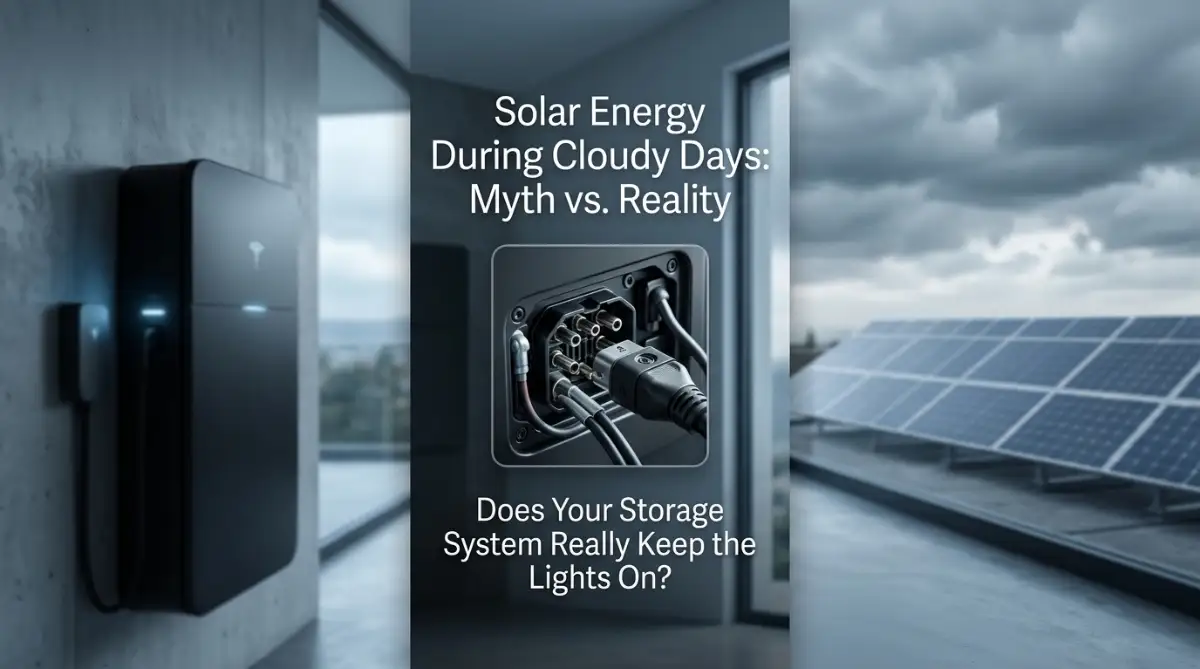
The Truth About Solar Energy Storage During Cloudy Weather
When the Clouds Roll In: My Personal Wake-Up Call
I remember staring out my living room window on a Tuesday morning, watching the sky turn a deep, gloomy gray. It had been raining for three days straight, and for the first time since installing my solar setup, I felt a knot of anxiety tighten in my stomach. I looked at my phone, checking the energy app, half-expecting to see my battery percentage at zero. I was terrified that the power would cut out right when I needed to finish some work.
My mind immediately jumped to the worst-case scenario. Was this entire investment a mistake? I had spent hours researching, saving money, and planning this setup, and now, with the sun hidden behind a thick blanket of clouds, I felt vulnerable. I paced around the house, turning off lights and unplugging chargers, acting as if I were preparing for a blackout.
The silence of the house made the situation feel heavier. I felt foolish for assuming that "solar" meant "sunshine all the time." I had clearly missed something important during the planning phase. I realized then that my understanding of how my home energy storage worked was entirely based on assumptions, not facts. I needed to stop guessing and start understanding the reality of what my system could actually handle.
This experience changed how I look at energy independence forever. It wasn't about relying on a perfect weather forecast; it was about understanding the machine I had installed. I realized that millions of homeowners face this same silent anxiety every time the weather takes a turn for the worse. You aren't alone in this fear, and that is exactly why we need to separate the myths from the reality of battery storage today.
It is exhausting to feel like you are walking on eggshells with your own appliances. That constant mental math—can I run the dishwasher? Will the fridge stay cold?—drains your energy faster than your battery ever could. You deserve peace of mind, not a constant worry about the next storm. Let’s dig into the facts and fix this uncertainty for good.
Understanding the "Cloudy Day" Myth
There is a massive misconception that solar power shuts down the moment a cloud passes over the sun. People often think the system acts like a light switch—on when it’s bright, and off when it’s dark. This is simply not true.
Solar panels are designed to capture more than just direct, beaming sunlight. They also collect diffuse light, which is the light that filters through clouds and atmospheric particles. While your panels will not produce at 100% efficiency on a gray, overcast day, they are still generating electricity. It might be 10%, 20%, or 30% of their peak capacity, but it is rarely zero.
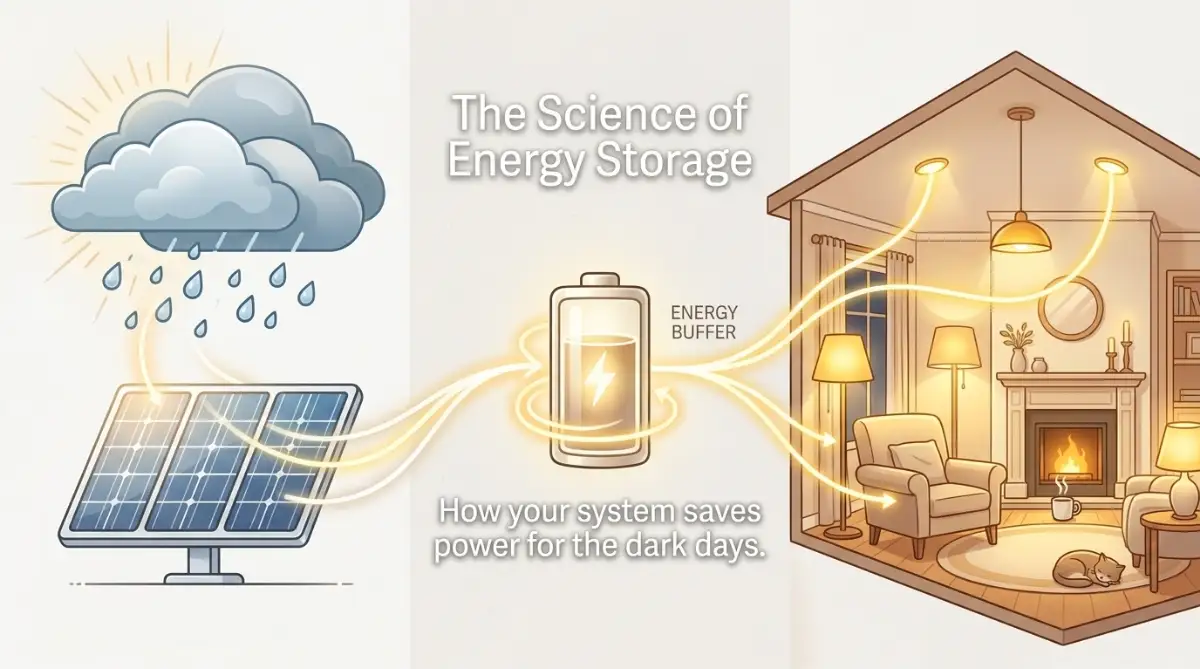
The real "magic" happens in the storage system, which is your battery bank. Think of your battery as a digital water tank. When the sun is shining brightly, your panels fill this tank to the brim. When the clouds roll in, your house stops pulling water from the sky and starts pulling it from the tank.
As long as your battery was charged up before the weather turned bad, your lights will stay on. The issue rarely lies with the panels' ability to capture light; it usually lies with the sizing of the battery relative to your home’s energy consumption. If your tank is too small, you will run out of "water" during a long cloudy spell. If your tank is sized correctly, you can ride out the storm without even noticing it.
The Reality of Energy Autonomy
Many people assume that going solar means they must be 100% off-grid to be successful. That is another myth that causes unnecessary stress. Being "solar-ready" does not always mean being disconnected from the power grid.
Most modern home energy storage systems are grid-tied. This means that if your battery runs low because of a week of non-stop rain, your home simply draws a little power from the utility grid to keep things running. You aren't "failing" if you do this; you are using the grid as a smart backup, just like you would use a generator.
However, if your goal is full independence, the math changes. To survive extended cloudy periods without grid help, you need a larger battery capacity. You also need to adjust your usage habits. This is what experts call Load Management.
The Math Behind Your Battery
Every battery has a specific capacity measured in kilowatt-hours (kWh). This is the "size" of your energy tank. You need to know how much energy your home uses on an average day.
- Step 1: Audit your usage. Write down the energy consumption of your main appliances—fridge, freezer, internet router, and charging stations.
- Step 2: Compare to capacity. If your home uses 15kWh per day, and your battery holds 10kWh, you are already at a deficit.
- Step 3: Account for weather. During cloudy weeks, your solar production drops. You must account for this by either increasing your battery storage or decreasing your energy consumption during those days.
It is simple physics, not rocket science. Once you know your numbers, the anxiety of "what if" disappears.
Pro Tip: My Realization on "Vampire" Loads
After my panic-filled week of rain, I sat down and looked at my usage data. I realized that my biggest mistake wasn't the weather; it was my appliances. I had an old mini-fridge in the garage and a gaming setup that pulled power even when I wasn't using them. These are called "vampire loads." I cut these off, and my battery lasted 30% longer during the next cloudy stretch. Don't underestimate how much power these hidden devices drain from your backup.
How to Handle Extended Cloudy Weather Like a Pro
To stay powered up, you need a strategy. You don't need to be a solar expert, but you do need to be a smart manager of your home's energy.
1. Shift Your High-Energy Tasks
The most effective way to protect your battery during cloudy periods is to move your heavy energy usage to the "bright hours." If you know a cloudy week is coming, do your laundry, run the dishwasher, and heat up the house before the weather turns. Don't wait until the sky is gray to run the heavy appliances.
2. Monitor and Adjust
Most systems come with an app. Check it every morning. If the forecast says clouds, set your battery to "Reserve Mode" or "Backup Mode" if your system allows it. This tells the system to stop feeding energy back to the grid and instead hold onto every bit of charge it has.
3. The "Load Shedding" Strategy
If you are running low, be ruthless about what stays on. You don't need the garage lights, the secondary TV, or the fancy coffee machine during a storm. Prioritize the "must-haves": refrigeration, Wi-Fi, and critical lighting.
Watch this video to understand how to optimize your home energy settings for maximum efficiency during bad weather:
This video breaks down the settings that many homeowners overlook. Most people install their system and forget about it. However, adjusting your settings based on the season or weather forecast is what separates a novice user from a pro.
Myth vs. Reality: A Quick Reference
The Science of Storage: It’s About Chemistry
Why does the battery sometimes feel like it drains faster than expected? It is often about the depth of discharge and the surrounding temperature.
Cold weather, which often accompanies heavy cloud cover, can actually affect battery chemistry. Lithium-ion batteries (the most common type) perform best at moderate temperatures. When it gets freezing, the battery has to work harder to maintain its output, which can slightly reduce its efficiency.
This is why indoor installation or temperature-controlled cabinets are often recommended. If your battery is sitting in a freezing garage, it is effectively "fighting" two battles: the lack of solar input and the cold temperature. Understanding this helps you manage expectations.
Why Your "Backup" Plan Matters
When you invest in a home energy system, you are buying peace of mind. But you are also taking on the responsibility of a manager. Treat your solar energy system like a bank account.
You wouldn't spend your entire savings account in one day, right? You budget. Your battery is your energy savings account. Treat your kilowatt-hours like currency. When the "income" (solar production) is low due to clouds, you simply spend less.
It is a straightforward concept, yet so few people approach it this way. By shifting your mindset from "passive consumer" to "active energy manager," you gain a level of control that most people never experience.
Building Your Strategy for Long-Term Success
You don't need to panic when the clouds roll in. By now, you know that the system is built to handle variability. The key is preparation.
Look at your historical data. How many cloudy days in a row have you experienced in the past? If your system struggled during a three-day period, you have a baseline. You know exactly what your "stress test" looks like.
If you find yourself constantly struggling, it might be time to expand your storage capacity. Sometimes, a simple add-on battery module is all it takes to bridge the gap between "worrying" and "relaxing." Consult with a professional to see if your inverter can handle the extra capacity.
The Future of Your Energy Independence
Living with solar energy is a journey. It requires a bit of learning and a bit of patience. But the result—a home that generates its own power and keeps the lights on regardless of the sky above—is worth every bit of effort.
Don't let the fear of a cloudy day stop you from enjoying the benefits of your system. You have the tools, you have the knowledge, and now you have the strategy. The next time you see those gray clouds rolling in, don't reach for the panic button. Just check your app, manage your loads, and let your system do the work it was designed to do.
You are not just a homeowner anymore; you are a steward of your own power. And that is a powerful feeling indeed. Stay informed, keep an eye on your usage, and enjoy the independence that comes with smart, intentional energy management. You’ve got this.
Mastering Your Energy Grid: The Pro-Level Strategy
Now that we have covered the basics of how your storage system reacts to gray skies, it is time to move beyond simple monitoring. You have already learned that a cloudy week is not a disaster, provided you know how to "read" your system. To truly master your home energy, you need to think like a power plant operator. This means looking at your energy flows in real-time, anticipating shifts, and making micro-adjustments before a storm ever arrives.
When you look at your solar app, most people only see a simple "charging" or "discharging" status. You need to look closer. Pay attention to your inverter efficiency logs. If you notice that your system is drawing from the grid more often than the solar production stats suggest it should, you might have an efficiency gap.
The Art of Load Shifting During Overcast Spells
Load shifting is the single most effective way to extend your battery life when solar production is low. It is not just about turning off lights; it is about when you choose to use your high-energy appliances. If you have an electric water heater, a dishwasher, or an electric vehicle, these are massive energy sinks.
Schedule these heavy tasks for the middle of the day, even if it is cloudy. Why? Because even under cloud cover, there is usually a peak period of light—often between 11:00 AM and 2:00 PM. By running your high-consumption machines during this window, you use the incoming solar power directly.
This prevents your battery from draining unnecessarily just to power your dryer. If you leave these tasks for the evening, your battery has to bear the full brunt of the load. This is a common trap that many homeowners fall into. You can learn more about how professional solar placement matters in ensuring your panels catch as much of that diffuse light as possible.
Optimizing Your Inverter Settings for Efficiency
Many homeowners never touch their inverter settings after the initial installation. This is a missed opportunity. Depending on your brand, you might be able to set "Time-of-Use" tariffs or "Self-Consumption" modes.
During a predicted week of clouds, switch your system to a high-priority "Self-Consumption" mode. This tells your battery to hold onto its charge for your home's needs rather than selling power back to the grid for pennies. You are essentially telling the system to "batten down the hatches."
If you are unfamiliar with the technical side, do not be afraid to dig into the manual or contact your installer for a quick walkthrough. Understanding your equipment is part of the investment you made. For those interested in the longevity of battery chemistry, looking at resources from the National Renewable Energy Laboratory (NREL) regarding battery performance in varying conditions can provide you with deep, science-backed confidence.
Building an Energy Emergency Fund
Think of your battery state-of-charge as a financial savings account. You would not empty your savings on a whim, so why empty your battery? I personally keep a "reserve" of 20% in my battery settings that never gets touched unless the power actually goes out.
This gives me a buffer for unexpected grid failures that can happen during storms. It is a simple setting in most management apps. By keeping this reserve, you ensure that you are never starting from zero when a real emergency strikes.
This level of control changes your relationship with the weather. Instead of checking the window for sunshine, you are checking your app for reserves. You are prepared, and that confidence is worth more than the electricity itself.

The Common Traps That Drain Your Battery and Peace of Mind
We often focus so much on the "tech" that we forget the human side of things. It is easy to assume that because a system is automated, it will always do the right thing. Unfortunately, I have seen many people fall into patterns that actually hurt their system's performance and their own bank account.
The "Set It and Forget It" Trap
The most dangerous mindset is believing that your solar installation is a passive asset that requires zero attention. It is not like a roof shingle; it is a complex electronic machine. When you ignore your system for months, you might miss small errors.
For instance, a simple communication error between your inverter and your battery can result in your system not charging properly. You might think it is a cloudy day, but it is actually a software glitch. If you do not monitor your app, you will not know until you have a real power issue.
This is exactly why why you should stop granting unnecessary permissions to newly installed android apps is a good mindset to apply to your home energy apps too; keep them secure, updated, and reviewed regularly. Ignoring these updates leaves you blind to your own power usage.
Ignoring "Vampire" Energy Leaks
I have mentioned "vampire" loads before, but they deserve a deeper look because they are the silent killers of your battery capacity. These are devices that draw power even when they are "off." Examples include coffee makers, printers, and gaming consoles on standby mode.
When the sun is shining, you do not notice them. But when you are living off your battery during a cloudy week, these devices are essentially stealing power you might need for your fridge. I once found that my home theater system was pulling 50 watts just being plugged in. Over 24 hours, that is over a kilowatt-hour of energy wasted.
It is a small drain, but it adds up fast when you are rationing your reserves. Taking five minutes to unplug these devices before a storm hits is a habit that saves money and stress.
Not Reviewing Your Insurance Coverage
Many people assume that home insurance automatically covers solar batteries, but that is not always the case. If a storm causes a surge that fries your inverter or your battery, you need to know if you are protected.
I highly recommend that you read why home insurance companies deny claims and how to stay protected. Do not wait for a lightning strike or a grid surge to find out that your policy has a gap. It is a boring task, but it is one that will save your finances if the worst happens.
Failing to Prepare for Seasonal Transitions
Your solar output changes with the seasons, not just the weather. In the winter months, the sun sits lower in the sky. If you are basing your expectations on the high production you got in the summer, you will be disappointed.
Understand your seasonal production curves. Acknowledge that your system is simply going to produce less in the winter. Accepting this reality allows you to budget your energy usage accordingly. Don't compare your rainy winter week to your sunny summer week.
Empowering Yourself Through Smart Energy Management
You have the power to make your home more resilient. It does not happen by magic; it happens by making small, consistent changes to how you interact with your home’s technology. When you take the time to learn your system, you stop being a victim of the weather and start becoming a manager of your resources.
I remember how stressed I was during that first rainy week I mentioned earlier. I felt helpless. But once I understood the numbers, learned about my loads, and set my battery reserves, that feeling disappeared. I realized that my home was perfectly capable of handling the weather if I just did my part.
You have all the information you need now to do the same. Start by checking your inverter settings this week. Look for those phantom energy drains. If you feel like your system is just not cutting it, consider the long-term benefits of how to build wealth through smart dividend investing to potentially fund future battery upgrades.
It is a great feeling to know that even when the sky is gray, you are still in control. Your solar system is an incredible tool for independence. Treat it with care, keep an eye on the data, and you will enjoy the benefits for years to come.
Take a look at the real truth about ev battery life to understand how similar technology works. The more you know, the better decisions you will make. You are doing a great job by simply reading this and seeking to understand your setup.
I am confident that with these tips, you will sail through the next cloudy spell without even thinking about it. Stay curious, stay observant, and most importantly, enjoy the peace of mind that comes with being energy independent.
Frequently Asked Questions (Common Queries)
Does cleaning solar panels really help on cloudy days?
Yes, it does. While clouds block the sun, dust and debris on your panels make it harder for the "diffuse" light to reach the cells. Keeping your panels clean ensures that every available photon of light is captured, which is helpful when production is already low.
Can I leave my solar battery running at 100% all the time?
It is not recommended to keep lithium-ion batteries at 100% capacity for extremely long periods, as it can accelerate chemical degradation. Most modern systems have built-in management to prevent this, but it is worth checking your manufacturer’s guidelines.
Will my solar system work if the grid goes down?
Only if you have a "grid-forming" inverter or an appropriate hybrid setup. Not all grid-tied solar systems automatically provide backup power during a grid outage. Check your specific system specifications to be sure of what happens when the power cuts.
How long should a home solar battery typically last?
Most modern home batteries are designed to last between ten to fifteen years before their capacity significantly drops. This depends heavily on how deeply you discharge them and the temperature conditions of where they are installed.
Is it worth adding more battery capacity later?
If you find that your current setup frequently runs out of power during cloudy stretches, adding capacity is a valid strategy. However, first ensure that your current inverter can handle the increased storage, as this might require additional hardware upgrades.
Disclaimer: The information provided in this article is for educational purposes only and does not constitute financial, legal, or technical advice. Solar energy system performance varies based on individual equipment, location, and environmental factors. Always consult with a certified professional installer or manufacturer regarding specific safety, maintenance, or warranty questions. By choosing to implement any of the strategies mentioned, you assume full responsibility for your system's performance and safety.