
When The Ink Dries Too Fast: My First Big Mistake
Ever signed a business contract, felt that brief rush of "I'm official," and then realized three months later that you just handed away your profits? It is a gut-wrenching feeling that keeps business owners awake at night. You don't need a law degree to protect your livelihood, you just need to know which lines to read twice before you sign your name on the bottom line.
The client decided they wanted twice as much work for the same price, and when I tried to say no, they pointed to a specific sentence buried in the middle of the document. That sentence essentially gave them the right to demand anything they wanted, whenever they wanted, at no extra cost to them. I had signed my time away, and because I had given them my signature, there was no legal ground for me to stand on.
That moment was a painful lesson in reality. I realized that for every business owner, a contract is not just a piece of paper; it is the map of your future relationship with a partner, client, or vendor. If you do not read the map, you cannot complain when you get lost or end up in a ditch. Since that day, I have made it a personal rule to never sign anything until I know exactly what every single clause means.
They think that reading a contract is for lawyers and that if they ask too many questions, they might lose the deal. The truth is the opposite; a professional partner will respect you more when you show that you take your business seriously. You do not need to be a lawyer to stay safe, but you do need to know the basic rules of the game.
When you sign a contract blindly, you are not just risking a bad project; you are risking your peace of mind and the health of your company. I have seen talented people lose their hard-earned money and their confidence simply because they skipped the boring parts. It is time to change that pattern. Let’s break down these documents so you can stand your ground and keep your business safe.
The Contract Negotiation Cheat Sheet:
-
The "Vague" Fix: If a task isn't listed, it shouldn't exist. Add: "Any work outside this list will be billed separately at my hourly rate."
-
The "Out" Clause: Never sign a deal that you cannot end. Always ask for: "This agreement may be terminated by either party with 30 days written notice."
-
The Price Protection: Avoid "Net-60" payment terms. Always counter with: "Payment due upon receipt or within 15 days of invoice."
The Business Owner’s Contract Survival Guide:
-
Be Specific: If it isn't in writing, it isn't promised. Define deliverables clearly.
-
Protect Your Cash: Always negotiate for "Due upon receipt" payments.
-
Control Your Exit: Never sign a contract without a "Termination for Convenience" clause.
-
Trust But Verify: "Standard templates" are designed to protect the drafter—not you. Always question them.
Breaking Down the Fine Print: What You Need to Look For
Contracts are not meant to be confusing, even though they often are. They are simply a list of promises. However, some of those promises are hidden in language that is designed to protect the other person more than it protects you. To stay safe, you need to recognize the specific clauses that define your risk.
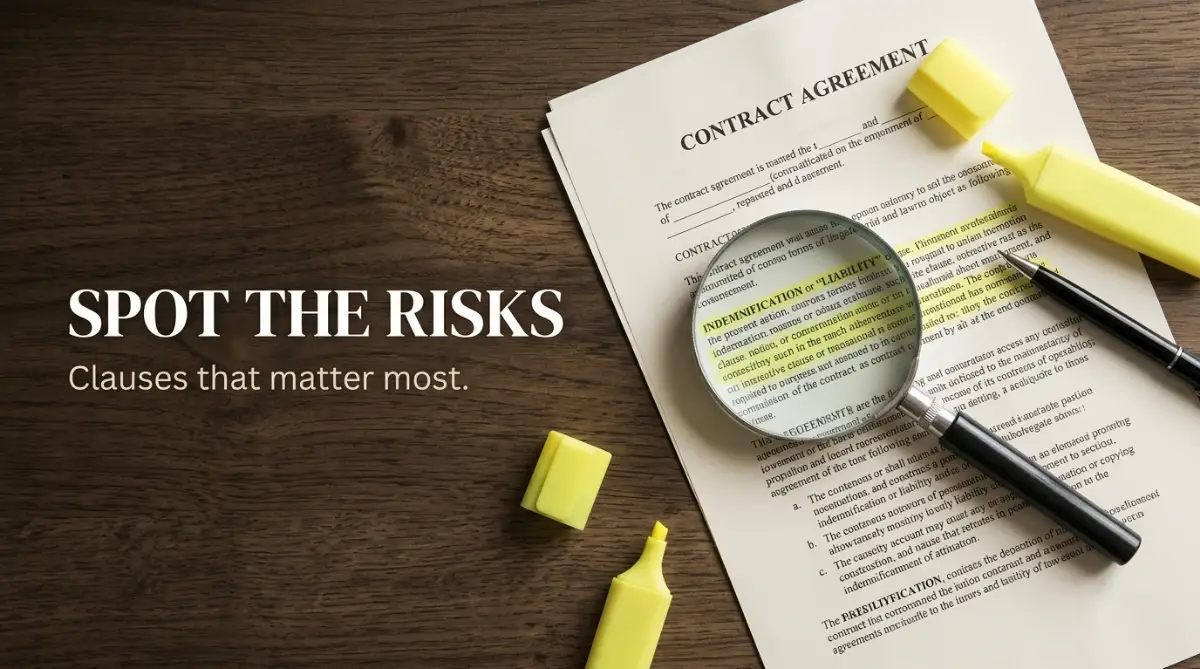 The Scope of Work: Define the Finish Line
The most dangerous part of any contract is the part that is not clearly defined. If the document says you will provide "general marketing help," you are asking for trouble. What does "general" mean? Does it mean two hours a week or forty?
Always look for a specific list of deliverables. You want to know exactly what the start and end of the project looks like. If the contract is fuzzy, the other side will naturally assume that "everything" is included in the price. Being specific keeps the project on track and stops "scope creep" before it happens.
 Indemnity: The Liability Trap
You will often see a clause that talks about "Indemnification." In plain English, this means you are agreeing to pay for the other party's losses if something goes wrong. If you are not careful, you could be on the hook for their legal fees or damages that were not even your fault.
You should always aim for "mutual" indemnity. This means that if you break something, you pay for it, but if they break something, they pay for it. If a contract forces you to pay for everything, you need to push back. For a deeper look at how this impacts your own personal wealth, you can check out this guide on small business liability to understand why your personal assets might be at risk.
Termination: Your Exit Strategy
Life happens, and sometimes a business relationship just does not work out. You need to know how to get out of the agreement without getting sued. Look for a "Termination for Convenience" clause. This allows you to walk away as long as you give enough notice, usually thirty days.
Without this, you might be legally stuck in a bad relationship for a year or more. Always check the notice period and make sure it is something you can actually do. If a contract says you can only terminate for "material breach," that means you have to prove they did something wrong before you can leave, which is very hard to do.
Pro Tip: Why Your Payment Terms Matter
I learned the hard way that finishing the work doesn't always mean you'll get paid quickly. I once agreed to a contract with Net-60 payment terms, which meant waiting up to 60 days for payment. That long wait put real pressure on my cash flow and made it harder to manage everyday business expenses.
Since then, I've paid much closer attention to payment deadlines before signing a contract. If possible, I try to negotiate terms like Due Upon Receipt or Net-15, which can help me get paid sooner. Of course, the client still needs to agree to those terms, and the exact payment date should be clearly stated in the contract.
The lesson is simple: don't focus only on how much a project pays. Make sure you understand when the money will actually arrive. A profitable project can still create financial stress if you have to wait too long for payment. Discussing payment terms upfront can help you avoid unnecessary cash flow problems later.
Governing Law and Dispute Resolution
 If you have a fight with the other party, where will it happen? This section tells you the location of the court. If your business is in New York and the contract says disputes will be settled in California, you are in trouble. You would have to pay thousands of dollars just to travel and hire lawyers in a different state.
Try to ensure that any legal action happens in your home state. It is also good to look for "Mediation" or "Arbitration" clauses. These are usually much cheaper and faster than going to court. Dealing with these matters is often just as important as managing your personal estate planning, so if you ever get confused about the big picture, this guide on