
Quick Takeaways: Build Your Remote Career
-
Ownership: You are the manager of your own time; use tools to stay organized.
-
Transparency: Make your work visible by updating your team before they ask.
-
Communication: Write clear, concise messages that save your team time.
-
Proof: Build a project portfolio to show what you can do, not just what you say.
The Reality of Searching for Your First Remote Job
You are staring at a job board, feeling like your lack of office experience is a giant "Keep Out" sign. I have been there, and I am here to tell you that the rules of the modern workplace have shifted. You don’t need a traditional office history to land a remote role; you just need to prove you can get the job done. Let’s stop waiting for permission and start building your career from scratch, right from your own space.
It was frustrating. My days turned into a blur of refreshing job boards and sending applications that never got a reply. I felt like I was shouting into a void. I started to doubt if I was cut out for the professional world at all. My confidence took a massive hit. I wanted freedom, but all I found was rejection and silence.
I know that feeling of isolation all too well. It keeps you up at night, wondering if you are just not good enough. You see people on social media talking about their amazing remote lifestyles, and here you are, stuck in a loop of uncertainty. It is not just about the money; it is about the feeling of being left behind. You have the drive and the talent, but the traditional door seems locked tight.
The problem is that the rules have changed, but our approach often stays the same. We try to copy-paste the traditional office resume into a digital space, and it simply does not fit. Many people think remote work is just about "owning a laptop." But that is a myth. Without the right mindset, remote work becomes stressful and disorganized.
This frustration is exactly what we are going to fix today. We are going to stop looking for permission to start and begin building the reality we want. If you are tired of the gatekeeping and ready to take control, you are in the right place. Let’s break down the barriers together.
Rethinking Your Skillset for a Remote Environment
| Office Skill | Remote Equivalent Skill | Why It Matters |
| Clocking in/out | Time Blocking | Shows you own your schedule. |
| In-person Meetings | Asynchronous Updates | Respects your team's focus time. |
| Asking for help | Documenting Problems | Proves you tried to solve it first. |
| Office presence | Digital Transparency | Makes your work visible to managers. |
To move forward, you have to realize that remote companies do not hire "years of experience" as much as they hire "proven reliability." A hiring manager in a remote company wants to know one thing: can you handle your business without someone looking over your shoulder?
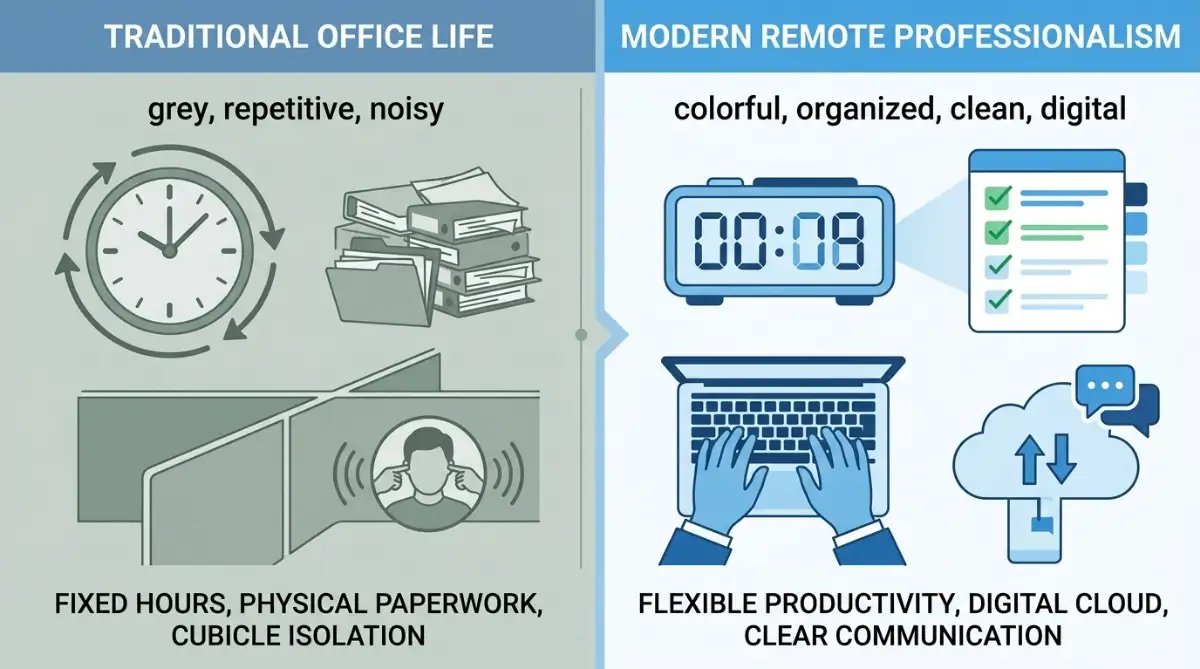 Forget your lack of a formal office history for a moment. Instead, focus on your ability to self-manage. This is the biggest skill gap for most beginners. In an office, your boss sets the pace. At home, you are your own boss, your own IT department, and your own scheduler.
The Power of Asynchronous Communication
Most beginners get this wrong. They think being a good communicator means being fast at replying to chat messages. It is actually the opposite. Remote work thrives on "asynchronous communication." This means writing so clearly that a teammate can understand your request at 2:00 AM while you are asleep.
You need to practice writing concise, action-oriented messages. Stop sending "Hi, can we talk?" emails. Instead, send a message that states: "Here is the issue, here is what I have tried, and here is what I need from you." This saves time for everyone. It shows you respect your team's schedule.
 Digital Hygiene and Tool Mastery
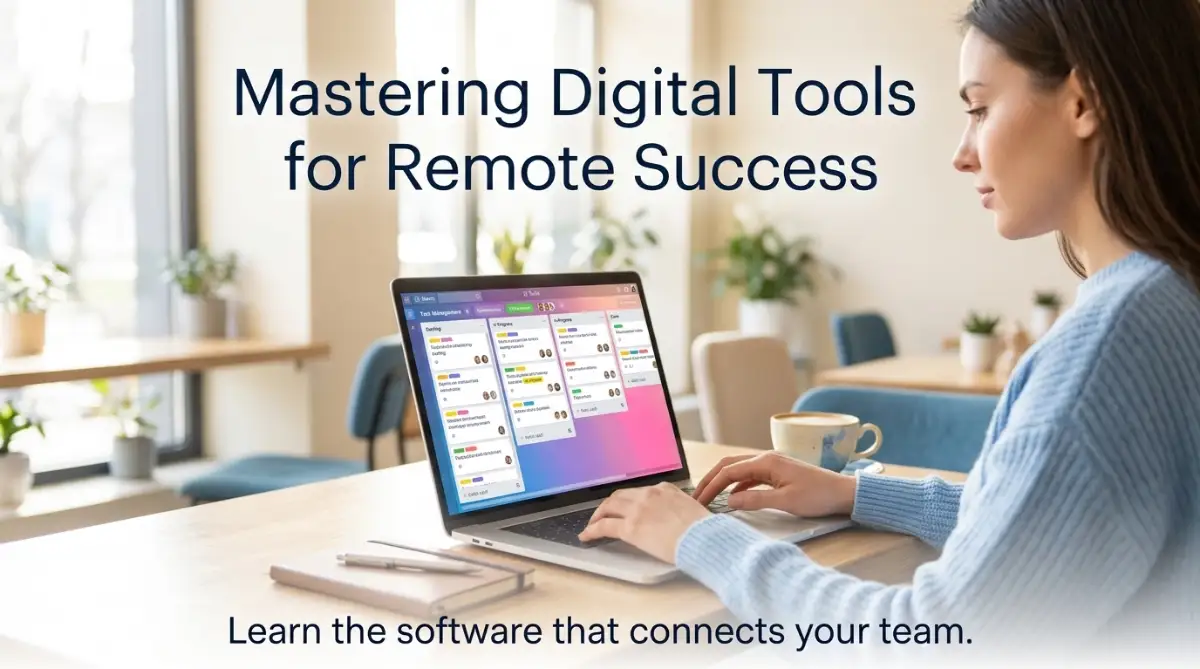
You do not need an office to learn the tools of the trade. Every company uses specific software stacks. You can learn these for free. If you want to work in marketing, get a free account on tools like Trello, Asana, or ClickUp. Create a mock project for yourself.
Document your process. Show that you can track tasks, set deadlines, and manage a project from start to finish. When you interview, you won't say, "I have no experience." You will say, "I have managed personal projects using Asana, and I understand how to track workflows."
The Art of Self-Management
Managing your time is the most difficult challenge in a remote setting. Distractions are everywhere. Your bed is close, the kitchen is calling, and your phone is a constant temptation. You need to build a system that creates a clear boundary between "work mode" and "home mode."
I used to struggle with this constantly. I would work for 12 hours straight because I felt I had to prove I was working. My back hurt, my eyes were tired, and I was burning out. I realized that working longer does not mean working better. I started using the Pomodoro technique to break my work into chunks. My productivity soared, and my stress levels dropped.
Pro Tip: My biggest realization was that "visible work" is often more important than "actual work" when you are starting out. Since you are not in the office, you need to communicate your progress often. Do not wait for your manager to ask, "How is it going?" Send a quick update at the end of every day. This creates trust, and trust is the currency of the remote world.