
The Hidden Trap: Why Your Hard Work Isn’t Sticking
I remember sitting at my desk at 3 AM, surrounded by stacks of highlighters and half-finished coffee cups. I had been reading the same textbook chapter for hours, my eyes burning, convinced that if I just went over the text one more time, the information would finally lock into my brain. I felt productive because I was "doing the work." But the next morning, when I sat down for the exam, everything vanished.
It felt like pouring water into a bucket full of holes. I was putting in the effort, and I was spending the time, yet the results were nowhere to be found. It was heartbreaking to realize that all those late nights were essentially wasted. You might be feeling this right now, too. You study for hours, you highlight every important sentence, and you read your notes until they look familiar.
Then, life happens. You get asked a question, and your mind goes blank. This cycle of effort without results is not just annoying; it is genuinely draining. It chips away at your confidence and makes you feel like you are not smart enough to handle the material. The reality is that you are probably working harder, not smarter.
Most people believe that reading and re-reading is the gold standard of studying. We were taught to do this in school from a very young age. We assume that if we look at something enough times, our brain will eventually absorb it. But the human brain does not work like a camera recording a video. It is a processor that needs to be challenged to create lasting memories.
When you just read, you are consuming information, not engaging with it. This is why you feel like you know the material when you are looking at the page, but fail to recall it when the page is closed. This is called the "illusion of fluency." You recognize the words, so you assume you know the concept. In reality, you are just familiar with the text, not the underlying ideas.
This cycle creates a massive amount of mental stress. You start to doubt your ability to learn. You lose sleep, you skip meals, and you sacrifice your free time, all for grades or knowledge that keeps slipping through your fingers. It is a heavy burden to carry, and it is entirely unnecessary.
Breaking the Cycle: Why Conventional Methods Let You Down
The main reason traditional study habits fail is that they are passive. Think about it. When you re-read a textbook or highlight paragraphs, you are basically asking your brain to do the bare minimum. Your eyes see the words, your brain processes them for a split second, and then they disappear. There is no struggle involved.
Science tells us that memory is a byproduct of thinking. If you aren't thinking hard about the material, you aren't creating a strong memory trace. When you highlight a sentence, you are telling your brain, "This is important." But you aren't doing anything to force your brain to retrieve that information later.
This brings us to the "Passive Learning Trap." When you are in this state, you are essentially a spectator of your own learning process. You are watching the information go by, but you aren't participating in it. It’s like watching a professional athlete play basketball and assuming that makes you good at basketball. You have watched the action, but you haven't moved a muscle.
Another massive issue is the lack of context. Traditional methods often treat every piece of information as equal. You spend as much time highlighting a minor date as you do understanding a complex theory. Your brain doesn't know what to prioritize because you haven't given it a specific task to solve.
Complex information requires active manipulation. You need to break it down, move it around, and reconstruct it in your own words. If you aren't doing this, you are just memorizing, not understanding. And memorization is fleeting. It fades the moment the pressure is off or the exam is over.
This is why cramming doesn't work long-term. You might get the information into your head for a few hours, but it isn't stored in your long-term memory. It is sitting in your "working memory," which has very limited capacity. As soon as you stop feeding it new information, the old information gets pushed out to make room for the next thing.
The Science Behind Retention and Recall
To fix this, we have to look at how our brains actually function. The brain is designed to filter out information that it deems "unnecessary." If you don't show your brain that a piece of information is useful, it will delete it to save energy. This is a survival mechanism, but it is a nightmare for students.
Active Recall is the antidote to this problem. Instead of putting information into your brain, you should be trying to get it out. This is the act of testing yourself, closing the book, and trying to explain a concept from memory. It feels difficult. It feels frustrating. And that difficulty is exactly why it works.
When you struggle to remember, your brain is forced to rebuild the neural pathway. This effort is what strengthens the memory. If it’s easy, you aren't learning. If it’s hard, your brain is building connections. This is the most important lesson you can learn about studying.
Pro Tip: I used to think I was failing because I wasn't "smart" enough, but my biggest realization came when I started testing myself before I even felt ready. I would read one paragraph, close the book, and try to summarize it out loud. It felt like I was failing every single time I opened my mouth, but within a week, I realized I could recall almost anything I studied. Don't wait until you are "ready." Start testing yourself the moment you begin reading.
Why You Must Stop Re-Reading
Re-reading is the enemy of progress. It gives you a false sense of security. Because the text looks familiar, you convince yourself that you have mastered it. But familiarity is not the same as understanding. If you can't explain the concept without looking at the book, you don't know it.
You need to shift from a "consumer" mindset to a "producer" mindset. Instead of reading to collect information, read to answer a specific question. Before you open your book, write down three questions you want to be able to answer by the end of your study session. This changes your entire focus.
Now, you are hunting for answers. You aren't just scrolling through pages. You are actively filtering the text for relevant information. This puts you in control. It keeps your brain awake and alert, because you have a mission.
Check out this video to understand how active recall can change your study life:
To see how the most effective students structure their learning sessions, watch this breakdown of active recall and spaced repetition in action.
A Step-by-Step Educational Approach to Retaining Information
If you want to stop the cycle of forgetting, you need a system. This isn't about working more hours. It’s about using the time you have more effectively. Here is a practical framework you can start using today.
Step 1: The Pre-Game Setup
Don't just open your book and start on page one. Spend five minutes looking at the headings, the summary, and the chapter questions. This provides a "mental map" of what you are about to learn. It gives your brain hooks to hang the new information on. If you don't have this map, the information has nowhere to land.
Step 2: Question-Based Reading
Turn every heading into a question. If the heading is "The Causes of the Industrial Revolution," change it to "What were the causes of the Industrial Revolution?" Now, as you read the paragraph, your goal is not to memorize, but to find the answer. You are essentially interviewing the textbook. This keeps you engaged and prevents your mind from wandering.
Step 3: The "Close-Book" Test
This is the most powerful part of the system. After every section, close your eyes or look away from the page. Try to summarize what you just learned in your own words. Don't worry about being perfect. If you get stuck, that is a good thing. It shows you exactly where your knowledge gap is. You can then go back and check only that specific part.
Step 4: Spaced Repetition Cycles
Your brain is designed to forget. The "forgetting curve" is a scientific fact. To fight this, you need to revisit the information at specific intervals. Review what you learned today, then again tomorrow, then three days later, and finally a week later. Each time you revisit, it takes less effort to remember, and the memory becomes stronger.
Step 5: Teach It to Someone Else
The ultimate test of knowledge is the Feynman Technique. Try to explain the concept as if you were teaching a ten-year-old. If you use big words or complex jargon, you don't fully understand it yet. Simplifying a complex idea forces you to break it down to its core components. If you can explain it simply, you own the knowledge.
Step 6: Optimize Your Environment
Your environment dictates your focus. If you study in bed, your brain will try to sleep. If you study in front of the TV, your brain will try to be entertained. Create a dedicated workspace that is only for studying. When you sit there, your brain should know it is time to work. Remove all distractions, including your phone.
Step 7: The Sleep Connection
Never sacrifice sleep for study. Sleep is when your brain consolidates memories. It takes the information you learned during the day and moves it from short-term to long-term storage. If you stay up all night, you are effectively deleting the very things you were trying to learn. A good night's sleep is more productive than an extra hour of cramming.
Moving Toward Sustainable Learning
The transition from passive to active learning will feel uncomfortable at first. You will feel slower. You will feel like you aren't getting through as much material. This is normal. You are building a foundation rather than just painting over a crumbling wall.
In the long run, you will actually save time. Because you are learning it correctly the first time, you won't need to re-learn it before the exam. You won't need to spend hours reviewing the same notes over and over. You will have a clear, deep understanding of the subject matter.
This method also reduces your anxiety. You won't panic the night before an exam because you already know the material. You aren't guessing; you have tested yourself repeatedly. You have proof of your knowledge.
Remember, the goal is not to be a perfect student who never forgets. The goal is to be a learner who knows how to acquire and retain information efficiently. Your brain is a muscle. If you treat it like one, it will grow stronger and more capable.
Stop looking for shortcuts. Stop trying to find the "magic hack" that lets you memorize an entire book in ten minutes. There isn't one. The process of learning is inherently challenging, and it is that challenge that makes it stick. Embrace the difficulty.
Take one subject you are struggling with right now. Pick one chapter. Apply the "Question-Based Reading" and the "Close-Book Test" today. Do not read the whole thing at once. Break it into pieces. You will be amazed at how much you remember after just one session.
You have the power to change how you learn. It starts with a simple decision to close the book and speak to yourself. It starts by taking control of your own mind. You are capable of mastering complex information, but you have to give your brain the right tools to do the job.
Keep testing yourself. Keep simplifying. Keep connecting new ideas to things you already know. These are the habits of high achievers. They aren't smarter than you; they are just using better methods. Now, you have those methods too. Start using them, and watch your ability to retain information transform.
Mastering Deep Retention: Secrets Beyond the Basics
Now that you have grasped the fundamental shift from passive to active learning, it is time to upgrade your toolkit. Many students stop at the first layer of improvement, but true mastery requires a more nuanced approach. You have to train your brain to handle complexity without getting overwhelmed.
The Power of Interleaving Your Subjects
Most people study one topic for hours until they feel "done" with it. This is called "blocking," and it is actually one of the least effective ways to learn long-term. Your brain gets bored and creates a false sense of familiarity because the information is all the same.
Instead, try Interleaving. This means mixing up your topics during a single study session. For example, if you are studying physics, math, and chemistry, do not spend three hours on just one. Spend 45 minutes on each, rotating between them.
This forces your brain to constantly "reload" the context for each subject. It keeps your mind sharp because it has to work harder to distinguish between different types of problems. According to research from the University of California, San Diego, this switching method leads to much better long-term retention.
Think of it like exercising different muscle groups. If you only do bicep curls for an hour, your arms will tire out, but you won't get a full-body workout. If you rotate between cardio, strength, and flexibility, your whole body gets stronger. Your brain works exactly the same way.
Using Dual Coding for Complex Concepts
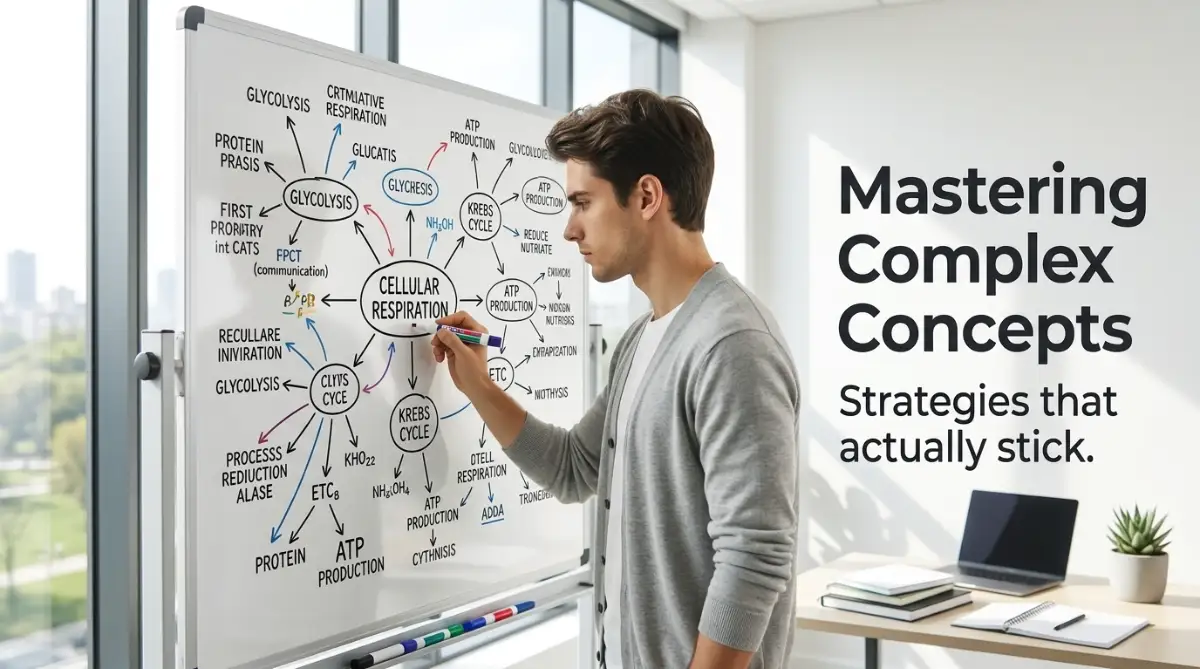
When you are dealing with abstract ideas, words alone are often not enough. You need to combine text with visuals. This is known as Dual Coding. Whenever you learn a new theory or a complicated process, try to draw a diagram, a flowchart, or even a simple doodle.
You do not need to be an artist. The act of turning a sentence into a picture forces you to process the information in a different way. You are translating language into spatial understanding. This creates two separate memory traces in your brain—one for the text and one for the image.
If you are curious about how complex systems work, you can see how professionals break down big ideas into smaller, manageable parts by reading this guide on blockchain explained. The principle remains the same: simplify the complex to understand it.
Metacognition: Thinking About Your Thinking
The secret weapon of top performers is Metacognition. This is simply the act of being aware of how you learn. Ask yourself questions while you study. "Why is this paragraph hard to understand?" or "Do I really know this, or do I just recognize the words?"
If you struggle with a specific topic, do not just push through. Stop. Analyze why it is hard. Is it because you lack a foundational definition? Is it because the logic is confusing? Identifying the gap is halfway to fixing the problem.
Many people treat their learning process like a "black box." They put hours in and hope for grades to come out. Instead, you should be like a technician looking under the hood. If your system is slow, you need to tweak the settings just like you would when you access Android developer mode to optimize performance.
Practical Time Management and Automation
You have a limited amount of energy every day. Do not waste it on administrative tasks. If you find yourself spending more time organizing notes than actually studying, look for ways to streamline your workflow.
Using basic tools can save you hours. Learning how to manage your digital environment is just as important as reading the textbook. For instance, bridging the skill gap by mastering basic automation tools can give you the extra time you need to focus on deep work.
When you automate the small stuff, you keep your mental capacity high for the "heavy lifting" of learning. Treat your study time as a premium asset. Protect it from distractions, much like you would protect your personal information by avoiding mistakes when configuring privacy settings.

Avoiding the Traps That Sabotage Your Progress
We have all fallen into these patterns at some point. You feel like you are working hard, but the results just do not show up on the test. Let’s look at the pitfalls that hold you back.
The Illusion of Productivity
This is the most dangerous trap of all. You spend four hours highlighting, color-coding, and rewriting your notes. You finish the session feeling "busy" and "productive." But did you actually learn anything?
Usually, the answer is no. You were just busy moving information from the book to your paper. You weren't engaging with the concepts. This is "fake work." It feels safe, but it keeps you from the real work of testing yourself.
If you ever feel this way, remind yourself that the goal is not to have beautiful notes. The goal is to have the information stored in your long-term memory. If your notes look messy but your brain is active, you are doing it right.
The Multitasking Myth
Many of us believe we can study while checking messages, listening to a podcast, and browsing the web. We think our brains are wired for this. The science, however, says the exact opposite.
Every time you switch your attention, your brain has to pay a "switching cost." It takes time to refocus on the complex material. You might think you are doing five things, but you are actually doing all of them poorly.
When you study, go into a "monotasking" mode. Turn your phone off or put it in another room. If you find your mind wandering to the stress of your schedule, take a breath. It is often helpful to stay calm and invest wisely during market volatility in your life—which means keeping a steady hand on your focus, regardless of the chaos around you.
Ignoring the "Forgetting Curve"
The biggest mistake is studying something once and assuming you will remember it. Your brain is designed to filter out information it doesn't use. If you study a chapter on Monday and don't look at it again until the exam, you have wasted most of that effort.
You must accept that forgetting is part of the process. You are not "bad at learning" because you forgot. You are simply human. The fix is not to study more at once, but to study more often in short bursts.
Review the material a few hours after learning it. Review it again the next day. Then three days later. Then a week later. This "spaced repetition" is what moves the data from your temporary memory into your long-term storage.
Your Path to Smarter Learning
The journey to better retention is not about being a genius. It is about being a strategist. You have the tools, the methods, and the understanding of how your brain works. Now, it is just about showing up and doing the work.
Turning Knowledge into Action
Don't try to change everything overnight. Pick one technique from this guide—maybe Interleaving or the "Close-Book Test"—and apply it to your very next study session. Notice how it feels. Notice the frustration, and recognize that the frustration is actually the feeling of your brain growing stronger.
Consistency will beat intensity every single time. A 30-minute study session done with full focus and active recall is worth more than a 4-hour marathon of passive reading. Trust the process. Your memory is not a fixed trait; it is a skill that you sharpen every single day.
I used to believe that some people were just born with a "better memory." Once I realized that memory is just a result of how you handle information, everything changed for me. I stopped blaming my genetics and started fixing my methods. I want you to know that you can do the same. Start today, be patient with yourself, and enjoy the process of actually knowing what you study.
Common Questions About Study Retention
Why do I forget everything right after an exam?
This usually happens because you relied on "cramming," which stores information in your short-term memory. Since you didn't use "spaced repetition" or "active recall," your brain didn't see the information as useful for the long term and deleted it to save space.
Is it better to study in the morning or at night?
There is no "one size fits all" answer, as it depends on your biology. However, the most effective time is when your focus is highest and distractions are lowest. What matters more than the time of day is the consistency of your routine.
How many hours should I study each day?
Do not aim for a specific number of hours. Instead, aim for "deep work" sessions. It is better to have two 90-minute sessions of high-intensity, active study than 6 hours of distracted, passive reading.
What if I get frustrated while testing myself?
That frustration is actually a sign that learning is happening. If it feels easy, you are likely just reviewing things you already know. Embrace the struggle, as it is building the neural pathways you need to remember the information later.
Can I use music while I study?
For most people, music with lyrics is a distraction because your brain tries to process the language. If you must have sound, try instrumental tracks or "white noise" to mask background distractions without pulling your focus away from the material.
Disclaimer: This blog post is for educational and informational purposes only. It does not provide medical or psychological advice. While these study methods are based on general learning science principles, individual results may vary. Always consult with academic advisors or professionals if you are experiencing severe learning difficulties or academic distress.