When Your Safety Net Disappears: My Expensive Lesson Abroad
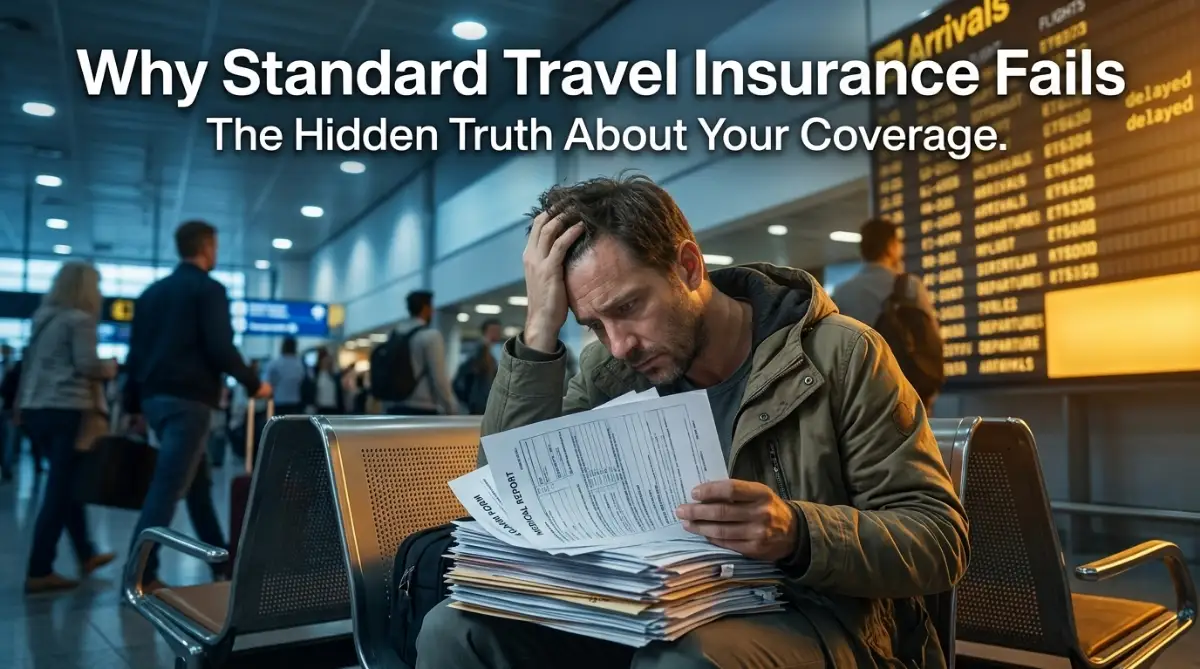
I still remember the cold, sinking feeling in my gut when the hospital receptionist in a foreign city shook her head. I had been hiking a simple trail when I slipped, resulting in a twisted ankle and a deep gash that required stitches. I was confident, smiling, and ready to hand over my insurance card, thinking I was completely protected by the premium policy I had bought online.
But then, the words hit me like a physical blow. The receptionist told me, "I am sorry, but your insurance provider does not cover this type of injury under your current plan." My heart dropped, and for a moment, I could not even speak. I had paid good money for peace of mind, yet in that specific moment, my paper protection felt useless.
I had assumed that "medical emergency" meant anything that required a doctor. I was wrong. I spent the next three hours on the phone with my provider, listening to hold music, trying to explain that a fall is an accident, not a pre-existing condition. It was a nightmare.
I left the hospital with a bill that wiped out my vacation budget and a realization that changed how I travel forever. I realized that the words printed on the glossy brochures are not the same as the words written in the fine print. You might think you are safe, but often, the reality is far more complicated.
This happens to travelers every single day, and it ruins the entire experience. It turns a dream trip into a stressful struggle to find funds, fight bureaucracy, and worry about health. Nobody wants to be stranded in a foreign land wondering how they will pay for stitches or X-rays.
The Hidden Complexity of Medical Coverage
You might be wondering why insurance companies make things so difficult. It often boils down to how they categorize what constitutes an "emergency." When you buy a standard policy, you are buying a product with specific boundaries.
Many people assume that if they get sick or hurt, the bill is handled. The truth is, insurers look for any reason to define your situation as outside their rules. For example, if you were intoxicated when an accident happened, many policies immediately void coverage.
Think about the "High-Risk" clauses that people often skip over. Did you rent a scooter? Did you go paragliding? If these activities are not explicitly listed in your policy, you are likely on your own.
The mental strain of being denied coverage is often worse than the physical pain of the injury itself. You are not just dealing with doctors; you are dealing with a company that wants to save money. This creates a feeling of helplessness that no traveler should ever have to face.
Your peace of mind is directly linked to understanding exactly what you are paying for. When that is taken away, you feel vulnerable and exposed in a place where you are supposed to be having fun. It is time we stop relying on blind faith and start looking at the details.
Decoding the Fine Print: Why Coverage Gaps Exist
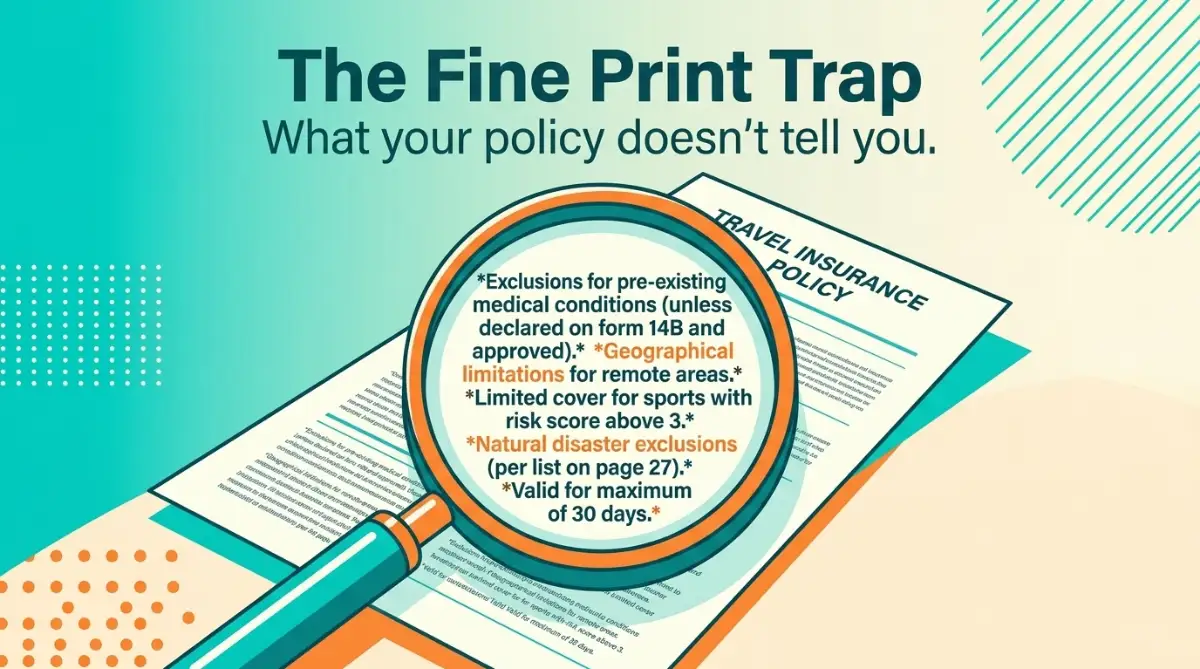
The biggest mistake travelers make is looking at the "Total Coverage Limit" and thinking they are done. That big number—like "100,000 in medical coverage"—is actually the least important part of your policy. It is a marketing tool meant to make you feel safe.
The real story is in the exclusions section, which is usually written in tiny, confusing fonts. Insurers use specific legal language to define what they will and will not cover. This language is designed to protect their profit margins, not your health.
The Pre-Existing Condition Trap
Many standard policies automatically exclude any illness or injury you have visited a doctor for in the last few months. Even if you felt perfectly fine when you bought the insurance, if you had a checkup for a minor cough three months ago, they might link your current lung issue to that.
You must be honest during the buying process, even if it feels tedious. If you do not declare your health history, they will use it as a reason to deny your claim later.
The Adventure Sport Limitation
Most "standard" travel plans are meant for city trips and relaxing resorts. If you decide to go scuba diving, skiing, or even rent a motorcycle, you are often entering a territory that is not covered.
Always check if your plan has a "Sports and Activities" add-on. If you do not pay extra for this, a simple skiing accident can cost you thousands.
The Alcohol and Substance Clause
This is a silent killer for claims. If a medical report indicates that you had alcohol in your system when an accident occurred, your claim is almost guaranteed to be denied. This applies even if you had just one glass of wine with dinner.
The insurance company does not care if you were drunk or not; they only care about the presence of the substance. It is a harsh rule, but it is one you must know.
Proactive Strategies for Medical Security
You do not have to be a legal expert to protect yourself, but you do have to be a smart consumer. Before you spend a single dollar, you need to change how you approach buying insurance.
Start by treating your insurance purchase like you are signing a major contract. Do not just click "Buy Now" because the website looks nice or the price is low. You need to investigate what is actually offered.
Read the PDS (Product Disclosure Statement)
This document is boring, long, and full of legal jargon, but it is the only thing that matters. Download the PDS for any policy you are considering. Search the document for keywords like "Exclusions," "Activities," "Pre-existing," and "Sports."
If you cannot find these sections, do not buy that plan. The best plans make this information easy to find.
The "Pro Tip" for Your Next Trip
Here is something I learned the hard way: I always save a digital copy of my exact policy wording on my phone and in the cloud. When I was in the hospital, I could not remember the specific name of my plan, but having the PDF file saved meant I could search for the policy number and coverage details in seconds. My advice? Create a folder in your email or phone named "Travel Docs" and put your insurance certificate, the PDS, and emergency contact numbers inside it before you even pack your bags.
Understand the "Immediate Payment" Policy
Does your insurance company pay the hospital directly, or do you have to pay upfront and claim it back later? This is a huge distinction.
If you have to pay a ten-thousand-dollar surgery bill out of your own pocket, it does not matter if the insurance company "covers" it. You might not have that kind of cash available. Prioritize policies that offer "Direct Billing" to hospitals.
Watch this video to understand more about how to navigate these insurance hurdles:
To get the best out of your coverage, you need to understand the claims process before you travel.
Once you understand the basics, you can handle any emergency with much more confidence.
Navigating the Claims Process Like a Pro
Even with the best planning, emergencies happen. If you find yourself in a medical situation, knowing how to handle the documentation is just as important as the insurance itself.
Keep Every Single Piece of Paper
The moment you see a doctor, start a paper trail. Ask for copies of the medical report, the diagnostic test results, and the itemized bill. If you are in a country where English is not the main language, try to get these documents in English if possible.
If that is not possible, keep the originals and make sure they are clearly stamped by the facility. Do not leave the hospital without these.
Communication is Your Best Tool
As soon as you are stable, call your insurance company's emergency assistance line. Do not wait until you are home to tell them what happened.
They often have a network of preferred hospitals. If you go to one of their partners, they are much more likely to handle the payment directly.
The Importance of Proof
Insurance companies are skeptical by nature. They need proof that you were not doing something dangerous or illegal.
If you get injured, take photos of the area where it happened. If there were witnesses, get their contact information. This might seem extreme, but it can be the difference between a paid claim and a rejected one.
Myth vs. Reality: Clearing Up Insurance Confusion
There is so much misinformation out there regarding what travel insurance actually covers. Let’s break down a few common myths that cost travelers money every year.
- Myth: "My credit card insurance covers everything."
- Reality: Credit card travel insurance is usually supplemental. It often has very low limits and will only pay out after your primary insurance has been exhausted.
- Myth: "I don't need insurance for local trips."
- Reality: Even if you are just a few hundred miles from home, your regular health insurance might not cover out-of-network care or emergency transport. Always double-check your domestic coverage.
- Myth: "Emergency evacuation is always included."
- Reality: Medical evacuation (like a helicopter flight from a mountain) is extremely expensive and is often an "add-on" feature. Never assume it is automatic.
Preparing for the Unexpected
Taking these steps might feel like extra work, but the payoff is absolute peace of mind. When you travel, you want to focus on the sights, the food, and the experiences.
You do not want to be stuck in a foreign medical clinic, fighting over bills. By taking the time to read the PDS, understanding your exclusions, and keeping your documentation organized, you remove the biggest risks.
Check your credit card policy, see if it is enough, and if it is not, buy a comprehensive travel insurance plan. Compare at least three different providers. Look at the "Emergency Medical" limit, not the "Trip Cancellation" limit.
Your safety and financial well-being are in your hands. Do not leave them to chance.
The next time you book a trip, take an extra hour to read the fine print. It might just save you a fortune. Travel smart, stay prepared, and enjoy your journey without the fear of unexpected medical bills hanging over your head.
You have the power to make your travels worry-free. It just takes a little bit of effort before you leave home. Go out there, see the world, but make sure you are truly protected.
Beyond the Basics: Strategies for Total Protection
You have already taken the first step by acknowledging that not all travel insurance is created equal. Now, let’s talk about how to move from a passive buyer to an empowered traveler who understands the system inside and out. True security comes from knowing the mechanics of your coverage before you ever leave your front door.
Understanding the Definition of "Medical Necessity"
One of the most complex hurdles in the world of travel insurance is the term "medical necessity." Insurance companies often use this specific legal phrasing to determine if they will pay for a procedure. They argue that if a doctor performs a surgery that could have waited until you returned home, it is not "necessary."
Always ask your provider what their specific definition of this term is. If you are in a remote region, it might be safer to fly home for treatment, but if you are in a major city, the insurer might demand you stay there for care. You can find more detail on how these financial barriers work by understanding the gap between deductibles and out-of-pocket limits before you choose a plan. Knowing these numbers keeps you from being surprised by hidden costs later.
The "Activity Clause" Check
Most travelers make the mistake of assuming their policy covers "everything." In the insurance world, everything usually means sitting at a cafe or walking through a museum. The moment you engage in any physical activity, the rules shift entirely.
Check your policy for an "Excluded Activities" list. If you plan on doing anything more physical than walking—like renting a bicycle, swimming in the ocean, or hiking—make sure that specific activity is listed as "Included." If it is not, you are personally liable for any injury that occurs while doing that activity.
The Importance of "Emergency Medical Evacuation"
This is the single most expensive part of any travel policy. If you are in a remote area and need to be transported to a hospital by helicopter or specialized plane, the cost can easily exceed fifty thousand dollars. Standard plans often cap this amount too low.
Always aim for a policy that offers high-limit coverage for medical evacuation. You can read up on the latest standards for international travel health advice from the CDC to see why certain regions require higher levels of preparation. A policy that looks cheap might be saving you money by cutting this specific benefit, which is a risk you should never take.
Building Your Own Safety Buffer
Even with the best insurance, you might face upfront costs that you have to pay and claim back later. This happens more often than you would think, especially in countries with private healthcare systems that do not bill insurance companies directly.
I personally recommend keeping a dedicated "Emergency Buffer" in your bank account that you do not touch for regular trip expenses. If you have to pay a deposit for a hospital stay, having that liquidity means you can get care immediately without waiting for insurance approval. It is a smarter way to manage your finances, much like learning how to stay calm and invest wisely during market volatility by keeping a healthy cash reserve.
The Honest Health Declaration
If you have any history of medical issues, be honest when you buy your policy. Some insurers offer "Pre-existing Condition Waivers" if you purchase the plan within a certain window after your first trip deposit.
If you hide a condition, you risk the insurer denying your entire claim. They will review your medical records, and if they find a mention of that condition in your history, they will use it to void the contract. Never gamble with your medical history; it is never worth the risk.
The Documentation Routine
When you arrive at your destination, create a simple folder on your phone. Put your policy, your emergency assistance number, and a copy of your identification in this folder. When I travel, I also make sure I have the contact information for my home country’s embassy in the destination country.
Taking care of your mental well-being is also part of being prepared. Many people ignore this, but why mental health check-ups are just as essential as physical screenings applies to your travel planning, too. If you are not in the right headspace, you are more prone to accidents, so travel with peace of mind.
The Pitfalls That Cost Travelers Their Savings
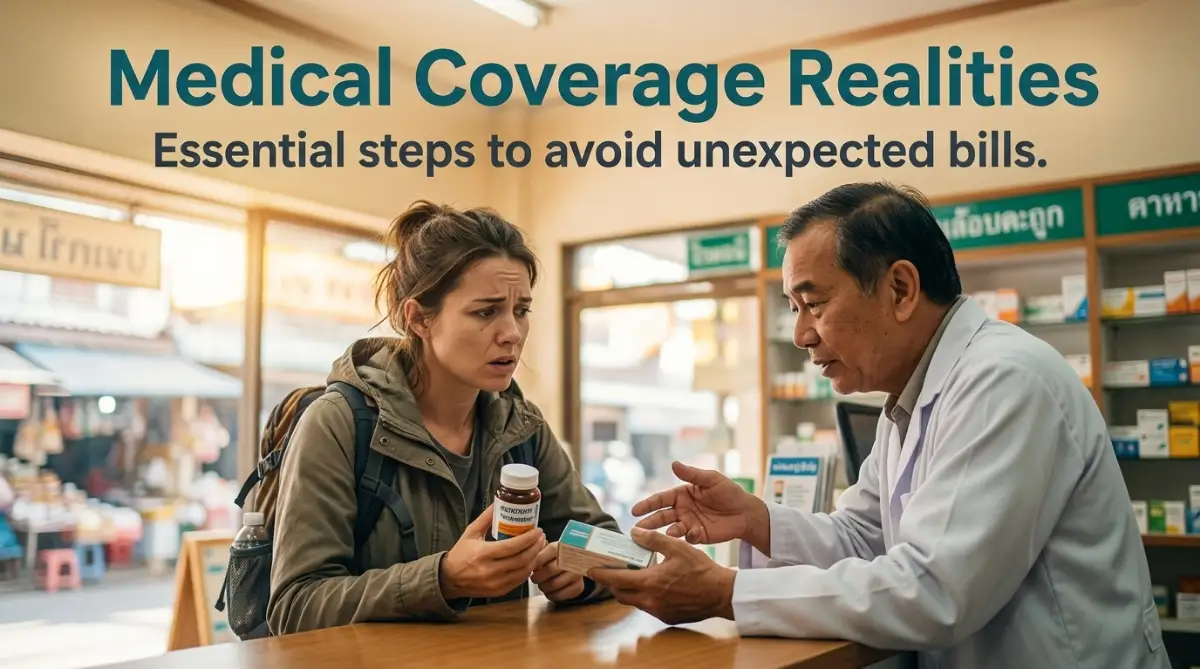
We often assume that paying for insurance is a "set it and forget it" task. This is the first mistake. There are subtle ways travelers sabotage their own coverage without even knowing it.
The "I'll Deal With It Later" Syndrome
The most common mistake is failing to contact the insurer immediately after an incident. Many policies state that you must report an emergency within twenty-four to forty-eight hours. If you wait until you get home to file a claim, they can legally deny it.
They need to be involved in your care from the start. They might want to approve the hospital or the doctor you are seeing. If you go to a facility they don't approve of, you might be footing the entire bill yourself.
Assuming Your Home Insurance is Enough
Another dangerous assumption is that your standard home or health insurance will cover you abroad. For most people, this is simply false. Many domestic health plans provide zero coverage once you cross an international border.
Think of it like why home insurance companies deny claims and how to stay protected in your daily life; the same logic applies to travel. Just as your home policy has exclusions for specific types of damage, your travel policy has distinct boundaries. Do not mix them up or you will be left with no support when you need it most.
The "Cheapest Plan" Trap
It is tempting to look at a comparison site and just pick the lowest price. However, the cheapest plans are almost always the ones with the most restrictive terms. They might have high deductibles, low coverage limits, or extremely narrow definitions of what an emergency is.
If you are a freelancer or someone who is self-employed, you know that saving a little upfront can lead to massive losses later. This is exactly like the passive income fallacy; why your online revenue is stalled because you did not invest enough in the foundation of your business. Treat your insurance like the foundation of your trip.
Forgetting to Check the "Alcohol Clause"
Most people do not realize that almost every travel insurance policy has an exclusion regarding alcohol. If you are injured while intoxicated, the insurer can deny your claim.
This does not mean you have to be stumbling around; even a moderate amount of alcohol in your bloodstream can be used as a reason to reject the payout. Be mindful of your consumption while you are away. It is not just about local laws; it is about your financial protection.
Your Roadmap to a Secure Trip
Taking charge of your travel medical safety is not about living in fear. It is about removing the uncertainty so you can actually enjoy your experiences. When you know you have the right coverage, you can try that new food, go on that hike, and meet new people with confidence.
You have the tools now to read your policy, ask the right questions, and prepare your documentation. This small investment of time before your trip is the best travel insurance you can buy. It changes the way you view the world from a place of risk to a place of adventure.
I want you to look at your next trip not as a potential disaster, but as a well-planned opportunity. Start by checking your current policy, and if it lacks the things we talked about, do not hesitate to upgrade or switch. My goal is to make sure you never have to deal with the stress I once faced. You can do this, and you will be much safer for it.
Common Questions About Travel Medical Coverage
Should I trust the insurance suggested by my airline or booking site?
These plans are often sold for convenience and may not provide the comprehensive coverage you need. It is usually better to buy a policy directly from a reputable insurance provider where you can customize the limits and check the fine print yourself.
Does travel insurance cover me if I get sick from a common cold?
Most policies cover "acute onset" illnesses, meaning sudden sickness that requires medical attention. However, they will not cover routine check-ups or the purchase of basic over-the-counter medicine for minor symptoms that do not require a doctor.
What happens if the hospital refuses my insurance?
Always try to contact your insurer’s 24/7 emergency line first. They can often call the hospital and advocate for you or arrange a guarantee of payment. If you must pay upfront, save every receipt and report, as you will need these for reimbursement.
Is trip cancellation the same as medical coverage?
No, they are two completely different things. Trip cancellation protects your financial investment in flight and hotel costs, while medical coverage protects your physical health. You need both to be fully protected.
Do I need insurance if I am visiting a country with "free" healthcare?
Yes, you do. Many countries only offer free or subsidized care to their citizens and legal residents. As a tourist, you will likely be charged as a private patient, and those costs can be very high.
Disclaimer: This content is provided for informational purposes only and does not constitute professional legal, financial, or medical advice. Insurance policies vary significantly by provider, location, and individual circumstances. Always review the full terms and conditions of your specific policy and consult with a licensed insurance agent or legal professional before making any decisions regarding your coverage.