The Invisible Battle Happening Inside Your Walls
I was sitting on my couch, trying to load a simple video, and it just kept spinning. It was a classic "buffering" moment that everyone knows too well. I started blaming my internet service provider, calling them up to complain about my slow speeds.
It wasn't until a friend visited and casually glanced at my router that I realized I was part of the problem. He asked why I had all my smart home devices, my laptop, and my streaming box all crammed onto the same Wi-Fi band. I looked at him like he was speaking a different language.
That night, I started reading about the invisible frequencies filling my home. I realized I was treating my Wi-Fi like a one-size-fits-all solution, when in reality, it was more like choosing between a dirt road and a highway. I had been driving my high-speed data down the dirt road while the highway sat empty next to me.
The frustration I felt—that feeling of being trapped by a "slow" internet connection—is something I hear about all the time. People buy expensive routers and pay for high-speed plans, but they miss the small configuration steps that actually make the tech work. It feels like your connection is failing you, but often, the hardware is just fine.
You don't need a degree in physics to fix this. You just need to understand the simple trade-off between range and speed. Once you see it, you can’t unsee it, and your internet experience will change instantly. Let’s look at why your devices might be struggling and how to give them exactly what they need to run fast.
The Physics of Airwaves: A Simple Breakdown
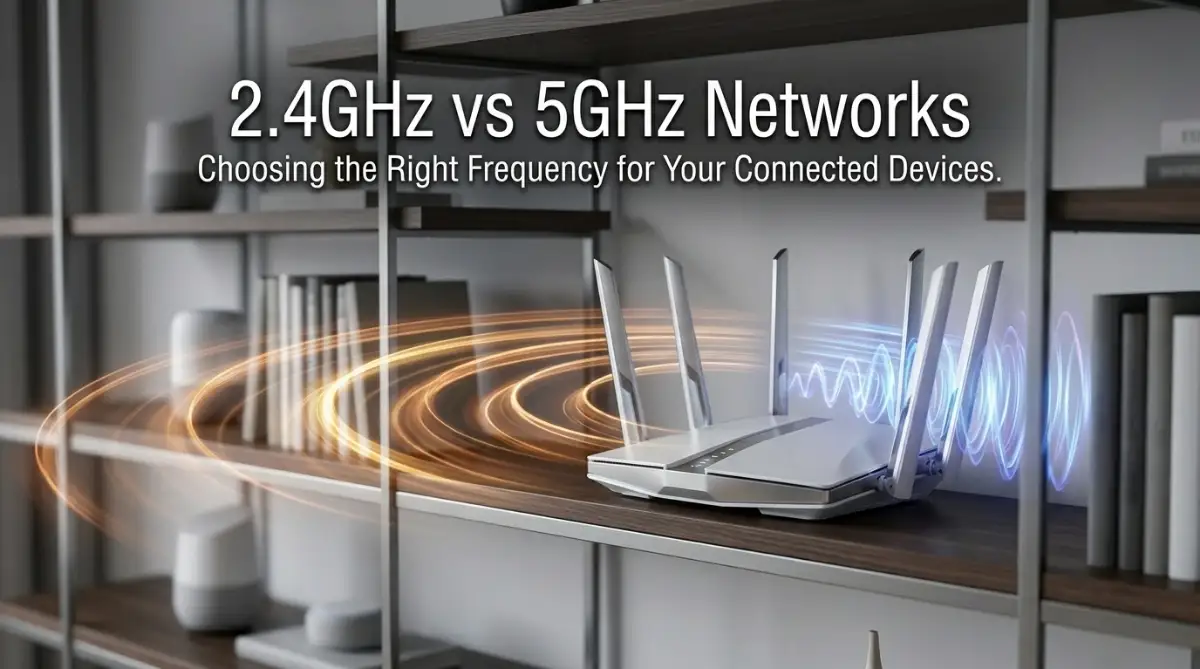
To understand why your Wi-Fi acts the way it does, we have to look at the two different lanes your router provides. Think of these as two distinct highways that your data travels on to reach your laptop or phone.
The Reliable Long-Distance Runner: 2.4GHz
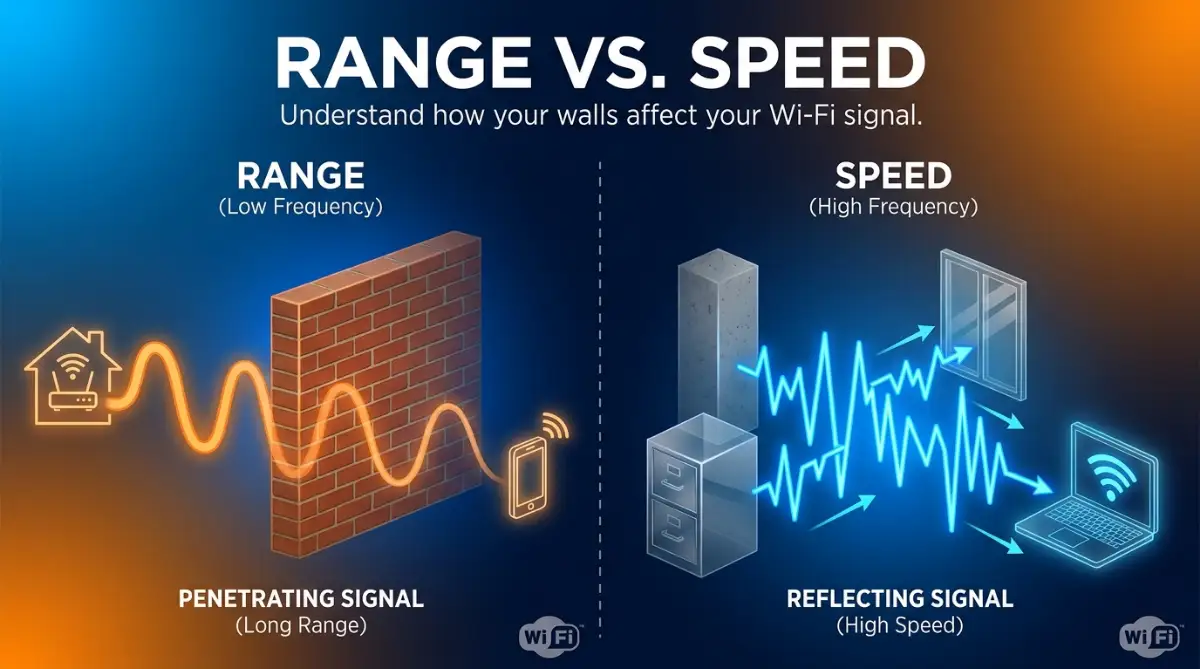
The 2.4GHz frequency is the veteran of the wireless world. It has been around for a long time, and almost every device on the planet is built to use it. Its main strength is its ability to travel through walls, floors, and furniture.
If you are trying to get a signal from your router to a room on the other side of the house, this is the band you want. It is the "freight train" of your network; it carries data over long distances without getting stopped by the average bedroom door. However, it is also very crowded.
Your microwave, your neighbor's router, and even some Bluetooth devices use the same 2.4GHz space. This leads to interference. When too many signals try to occupy the same space, the "train" gets stuck in traffic. This is why your connection might feel slow or "choppy" even if the signal strength bars look full.
The High-Speed Express: 5GHz
The 5GHz frequency is the newer, faster lane. It is designed for speed and carries a massive amount of data in a very short time. If you want to stream high-definition video or play online games without lag, this is where you want to be.
The trade-off is that it is a "sprinter," not a long-distance runner. The 5GHz signal struggles to punch through solid objects like brick walls or thick concrete. If you move too far from the router, or if there is a heavy object in the way, the speed drops off much faster than it does on the 2.4GHz band.
Think of 5GHz as a wide, open highway with very little traffic. Because fewer devices use this frequency, you don't have to worry as much about your neighbor’s router interfering with your signal. It is clean, it is quick, and it is efficient for your high-bandwidth devices.
Finding the Right Fit for Your Devices
Not every device needs the same thing. Your smart light bulb, for instance, sends very small bits of data. It doesn't need the massive speed of 5GHz. It just needs to stay connected, often from a spot far away from the router.
On the other hand, your gaming console or your 4K television is a data-hungry machine. It needs the fastest connection available to keep up with your media. Putting these high-demand devices on 5GHz makes perfect sense.
A Pro Tip on Router Placement
I once kept my router inside a metal cabinet to keep the room looking "clean." It was a huge mistake. Metal blocks signals, and hiding the router meant the signal had to work twice as hard to reach my devices. My realization: Put your router out in the open, high up, and away from other electronic interference. A few inches of height makes a bigger difference than you might imagine.
Mapping Your Home's Needs
Take a walk through your home and list your devices. Which ones stay in one place? Which ones move with you? Which ones are "always on" but don't move data often?
- Fixed, high-speed devices: PC, Gaming Console, Streaming TV (Put these on 5GHz).
- Mobile devices: Phones, Tablets (Use 5GHz when near the router, switch to 2.4GHz if you wander into the garage).
- Low-power smart devices: Light bulbs, Smart plugs, Temperature sensors (These belong on 2.4GHz).
By sorting them this way, you reduce the congestion on your network. Your router will stop having to balance a hundred different requests on the same crowded lane. It will treat your high-speed devices with priority and give the low-speed devices a reliable path to stay connected.
Want to see how to actually log into your router and name these bands differently? This video walks you through the settings step-by-step.
Handling Signal Interference
If you live in an apartment complex, you are sharing airwaves with dozens of other people. Everyone is using 2.4GHz. You might notice that your internet feels fine in the morning but slows to a crawl in the evening when everyone gets home.
This is classic interference. Your router is trying to talk to your phone, but it is being drowned out by the router next door. When this happens, move your primary devices to the 5GHz band immediately. It is your best tool for escaping the digital "noise" of your neighbors.
When to Upgrade Your Router
If you find that you are constantly fighting to get a signal, or if your router is several years old, it might be time for a change. Modern routers often have a feature called "Band Steering." This allows the router to automatically decide which device goes on which band.
It basically takes the guesswork out of the process. Your router will push your TV to 5GHz and your light bulb to 2.4GHz without you having to manage it. It is a fantastic convenience if you don't want to dive into the settings every time you buy a new smart plug.
The Role of Wi-Fi Mesh Systems
For larger homes, even 5GHz might not reach every corner. In these cases, a "Mesh" system is often the solution. These systems use multiple units placed around your house to create one large, seamless network.
They handle the switching between 2.4GHz and 5GHz for you. You don't have to connect to a different network as you walk from the bedroom to the kitchen; the mesh system hands your device off to the closest unit. It is the ultimate way to get 5GHz speeds in every room of the house.
Safety First in Your Network Setup
While we focus on speed, remember that your network security is equally important. When you set up your different bands, ensure both are protected with a strong, unique password. Do not leave the guest network open or use the default password that came with the router.
Security and speed go hand-in-hand. A secure router is often a better-performing router because it keeps malicious traffic from bogging down your resources. Take the time to audit your security once you have finished balancing your frequencies.
Making the Connection Personal
At the end of the day, your home network is the backbone of your digital life. It connects your work, your entertainment, and your family. Spending a little time to organize it pays off every single day.
You don't need to be a tech expert to do this. You just need to be a little bit intentional. Look at your settings, test your speeds, and don't be afraid to experiment. Your home will thank you with smoother streaming, faster downloads, and less frustration.
Final Thoughts on Your Setup
You are now ready to take control of your home network. It is not about buying the most expensive gear; it is about using the features you already have effectively. Start by separating your smart home devices from your high-performance machines.
Make those small changes today, and you will see the difference immediately. Your devices will connect better, your speeds will feel more consistent, and you will finally stop wondering why your internet feels "slow." You have all the tools you need right now to build a better, faster, and more reliable home network.
Common Questions About Wi-Fi Frequencies
Why does my phone sometimes switch to 2.4GHz automatically?
Your phone is smart enough to know when the 5GHz signal is too weak. If you walk behind a thick wall or move far away, the phone will switch to 2.4GHz because it has a better range, ensuring you don't lose the connection entirely.
Can I have the same name for both 2.4GHz and 5GHz?
Yes, most modern routers use the same name (SSID) for both. This allows the router to manage the switching. However, if you have trouble with a smart home device, giving them separate names can help you force the device to connect to the 2.4GHz band it needs.
Is it better to use a wired connection?
If possible, always use a wired (Ethernet) connection for devices that don't move, like a desktop PC or a game console. It is always faster and more stable than any Wi-Fi connection, leaving more "room" on your Wi-Fi bands for your mobile devices.
Does 5GHz use more electricity?
Generally, the power difference is negligible for your devices. The battery drain on your phone comes more from the signal strength; if your phone has to boost its power to maintain a weak 5GHz signal, it might drain faster, which is why your phone switches to 2.4GHz automatically.
Can I change my Wi-Fi channel to get better speed?
Yes, if you have a lot of interference, changing the channel in your router settings can help. Most routers can be set to "Auto" channel, which is usually the best bet, but you can manually test different channels to see which one is the least crowded.
Fine-Tuning Your Home Network for Maximum Performance
If you really want to get the most out of your internet connection, you have to think like an engineer. Most people plug in their router and leave it alone for years. That is a mistake.
Wireless signals are not magic. They are radio waves, and they behave exactly like the radio in your car. They can be blocked by metal, absorbed by water (which includes people!), and interfered with by other devices.
To keep your connection fast, you need to be proactive. Small tweaks can turn a frustrating "buffering" experience into a smooth, high-speed ride. Here is how you take full control of your frequency setup.
The Art of Channel Selection
Your router doesn't just broadcast on one line; it uses channels. Think of these like lanes on a highway. If everyone in your apartment building is driving in the same lane, traffic stops.
Most routers are set to "Auto," which sounds helpful. But often, the router picks a busy lane and stays there forever. You can log into your router’s admin page and manually select a channel that is less congested.
There are free tools, such as the Wi-Fi Alliance’s recommendations, that explain how different channels interact. If you live in a dense area, changing your 2.4GHz channel to 1, 6, or 11 can drastically reduce lag. It is the single most effective way to clean up your connection without buying new gear.
Balancing Bandwidth for Your Smart Devices
We have more connected devices than ever before. If you let all of them fight for bandwidth on the same band, the network will collapse. You need to be the traffic cop for your home.
Move your "mission-critical" devices like your PC, console, or streaming box to the 5GHz band immediately. Keep your low-data devices like smart bulbs and thermostats on the 2.4GHz band. If you want to master the way these devices operate, reading about how to bridge the professional skill gap by mastering basic automation tools can help you understand how to manage your smart home better.
This division of labor keeps your high-speed lane open for the things that actually need it. Your light bulb will never need a gigabit connection, but your 4K television certainly does.
Why Quality of Service (QoS) Is Your Secret Weapon
Some modern routers have a feature called QoS. This allows you to tell the router which devices are the "boss." If you set your gaming console as the top priority, the router will clear traffic for it first.
This is a game-changer if you have multiple people using the internet at once. When someone else starts downloading a massive file, your game won't stutter. It is the best way to maintain a smooth experience regardless of what else is happening in your house.
The Impact of Modern Security Practices
While you optimize for speed, do not forget about who else might be using your airwaves. An open network is a slow network because strangers are eating your bandwidth. If you want to keep your private data safe, refer to this home network security guide to ensure your Wi-Fi is locked down.
You also need to be careful with the apps you install on your mobile devices. If you are granting unnecessary permissions to newly installed android apps, those apps might be sending data in the background, consuming your precious bandwidth. Keep your apps lean and your permissions tight.
Pitfalls That Slow Down Your Wireless Setup
It is easy to blame the router, but often, the problem is something we are doing wrong. We make small, invisible mistakes that ruin our internet speeds without realizing it.
The "Metal Wall" Syndrome
You would be surprised how many people hide their router inside a metal TV stand or a cabinet. Metal acts like a Faraday cage, blocking your signal from getting to your devices. Your signal needs a clear path to travel through the air.
If your router is shoved behind a television or tucked away in a closed closet, move it out into the open immediately. It needs to be central and elevated for the best results. Treating it like an appliance that needs "hiding" is a guaranteed way to lose half your speed.
Ignoring Signal Obstruction
Signals struggle with solid mass. Thick brick walls, large mirrors, and even fish tanks are major signal killers. If you are in the bedroom and the router is in the living room with a kitchen in between, the 5GHz signal will likely die before it reaches you.
You can check FCC interference guidelines to see how household objects affect wireless performance. It isn't just about distance; it is about what is in the way. Avoid putting your router near cordless phone bases or microwave ovens, as they share the same frequency spectrum.
Assuming "More Bars" Means Better Speed
We are trained to look at the signal bars on our phone, but those bars lie. They tell you the signal strength, but not the signal quality. You might have full bars on a 2.4GHz connection that is so crowded with noise that it can barely load a webpage.
High-quality internet is about the "Signal-to-Noise" ratio. If there is too much noise, your device has to ask for the data packets to be sent again and again. This results in high latency, which feels like a slow, unresponsive connection.
The "Default Password" Risk
Many people leave their router’s admin settings with the default factory password. This is a massive mistake. Not only is it a security risk, but unauthorized users can hog your bandwidth without you ever knowing.
If someone else is streaming movies on your network, your devices will struggle. Change your admin password to something only you know. It keeps your network yours, ensuring all that speed is reserved for your own devices.
Neglecting Firmware Updates
Your router is a computer, and it needs regular updates. If you haven't checked for a firmware update in a long time, you might be missing out on performance tweaks that the manufacturer released. These updates often improve how the router handles traffic and can even fix bugs that cause frequent disconnects.
Set a reminder to check your router's update page every few months. It is a quick five-minute task that can keep your hardware running like new. Don't let your gear fall behind the times.
Final Steps to a Faster Home Network
Taking control of your network settings is an empowering experience. You stop being a passive user and start being the manager of your digital environment. The steps we covered are not just one-time fixes; they are habits that will keep your connection smooth for years.
Your Action Plan for Tomorrow
- Audit your device list: Kick off any device you don't recognize.
- Separate your bands: Put the heavy-hitters on 5GHz and the smart-gadgets on 2.4GHz.
- Check for interference: Move your router away from your microwave and cordless phones.
- Update your firmware: Ensure your router is running the latest software from the manufacturer.
I spent a long time being frustrated by slow speeds until I realized that the problem wasn't my ISP; it was my own setup. Once I optimized my router placement and frequency management, the difference was night and day. My internet feels snappy, my games don't lag, and my streaming is perfectly crisp. You can have that same experience by just being intentional about how you set things up.
Frequently Asked Questions About Network Frequencies
Why does my 5GHz Wi-Fi drop when I go to another room?
5GHz waves are shorter and cannot penetrate solid objects like walls or floors as well as 2.4GHz waves. If you are moving behind an obstacle, your device naturally drops the 5GHz signal to maintain a connection, even if it is slower.
Should I turn off 2.4GHz entirely?
No, most smart home devices only work on 2.4GHz. Unless you are absolutely sure that every single device you own supports 5GHz, you need to keep 2.4GHz enabled to keep your smart home functional.
What is "Band Steering"?
Band steering is a smart feature on modern routers that helps your devices choose the best frequency automatically. It basically tells your device, "Hey, go use 5GHz because it’s faster," which saves you from having to do it manually.
How do I know if my neighbor is causing interference?
You can download a "Wi-Fi Analyzer" app on your phone. It will show you a graph of all the wireless networks around you. If you see many networks clustered on the same channel as yours, that is your neighbor causing the interference.
Will buying a new router solve all my problems?
Not always. If the problem is signal obstruction or interference, even the most expensive router might struggle. Try optimizing your current settings and placement first before deciding to buy new hardware.
Disclaimer: The content provided here is for general information and should not be considered professional IT advice. Router interfaces and features can vary significantly by brand and model. I am not responsible for any issues that may occur while modifying your network settings.