The Hidden Frustration of Not "Getting" AI
I remember sitting in a boardroom meeting a few months ago, feeling completely lost. My colleagues were throwing around terms like "neural networks," "data layers," and "predictive modeling" as if they were talking about the weather. I nodded along, pretending to understand, but inside, I felt like a total fraud. My heart rate picked up every time someone asked for my opinion on our company’s new AI strategy. I was terrified that someone would look my way and ask me to explain how our systems were actually making decisions.
Have you ever been in that spot? You go home, open your laptop, and try to search for answers, but every article you find is written for computer scientists. They talk about calculus, complex coding, and massive data sets. You end up closing the tab, feeling even more overwhelmed than before. This gap in knowledge is stressful. It makes you feel like you are falling behind in your own career, even if your job isn't technical at all. You start to doubt your ability to lead or contribute effectively in an age where everything is becoming automated.
The truth is, you don’t need to be a coder to grasp these ideas. You just need someone to drop the jargon and explain it in human terms. My own journey toward understanding this started when I stopped trying to read technical manuals and started asking for analogies instead. Once I understood the logic, the anxiety simply faded away. I want to help you reach that same point of clarity today. You deserve to feel confident when the topic of AI comes up. Let’s break down these barriers together, one simple concept at a time.
How Neural Networks Mimic Our Own Brains
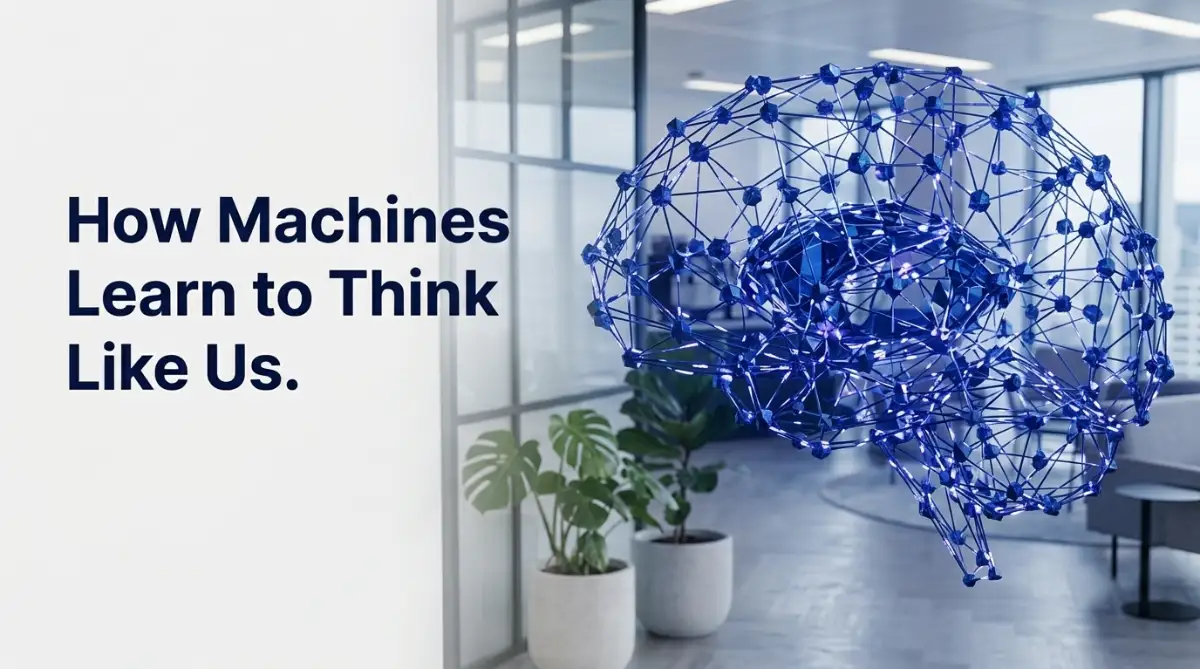
To understand a neural network, you don't need a math degree. You just need to think about how you learned to recognize a dog as a child. When you were young, you didn't have a list of mathematical formulas to identify a golden retriever. You just saw a few of them, and your brain naturally built a pattern. A neural network is basically a digital version of that learning process. It is a system designed to recognize patterns by looking at massive amounts of information.
The Role of Input Layers
Think of the Input Layer as the eyes of the computer. If you show a picture to a computer, it doesn't "see" a cat. Instead, it breaks that picture down into thousands of tiny pixels. Each pixel sends a bit of information into the network. This is the very first step of the journey, where raw data enters the system to be processed.
How Information Flows Through Hidden Layers
This is where the real magic happens. Between the input (what the computer sees) and the output (what the computer decides), there are several Hidden Layers. These layers are like different filters in your brain. One layer might look for lines and edges in an image. The next layer might look for shapes like circles or ears. The final hidden layer might look for specific textures like fur. Each layer takes the output from the one before it and makes it more refined.
Pro Tip: I used to think that the computer "knew" what it was doing from the start. That was my biggest misconception. I realized that the network is actually just guessing at the beginning. It makes mistakes, and then it learns from those mistakes. My advice is to stop looking for perfection in AI and start looking for patterns of improvement.
Learning from Mistakes: The Feedback Loop
How does the network get smarter? It uses something called a Feedback Loop. When the system makes a guess—for example, saying a cat is a dog—it receives a "correction." It then goes back through its internal connections and adjusts the "weight" of the information. Think of this like a thermostat adjusting the temperature until the room feels perfect. Over time, these tiny adjustments make the machine incredibly accurate at its task.
Why This Matters for Your Daily Work
You might wonder why you need to know this. The answer is simple: Decision Making. When your team uses software to predict sales or customer behavior, you are interacting with these networks. Knowing that these systems learn from patterns helps you understand why your data quality is so important. If you feed a system "noisy" or bad data, it will learn the wrong patterns. Your job is to ensure the "input" is as clean and clear as possible.
Understanding AI Myths vs. Reality
There is a lot of fear around AI taking over jobs. In reality, these networks are just pattern-matching tools. They are not conscious, and they do not have intentions. They are excellent at doing repetitive tasks that involve sorting through data. They are terrible at tasks that require genuine human empathy or complex ethical judgment.
A Practical Look at Data Processing
Check out this video to see how these neural networks look in action:
I found this video to be the most helpful explanation of how neural network connections actually form over time. It makes the complex visual concepts look surprisingly easy:
Bridging the Gap Between You and Your Tech Team
When you speak to your technical team, you don't need to ask how the code works. Instead, ask them: "What patterns is this system trained to look for?" or "How does the system handle data that it hasn't seen before?" These questions show that you understand the logic behind the tool. It changes the dynamic of the conversation. You go from being a passive observer to an active, informed participant.
The Power of Being "Tech-Literate"
Being tech-literate doesn't mean you can write scripts. It means you understand the strengths and weaknesses of the technology you use. You know that if a system is trained on biased data, the output will be biased. You know that if the input is limited, the output will be limited. This kind of awareness is what will make you a standout professional in the coming years.
Looking Ahead with Confidence
The world of AI is moving fast, but the core principles remain the same. These systems are just mirrors reflecting the data we give them. By understanding these concepts, you remove the "magic" and replace it with logic. You no longer have to feel intimidated by the tech jargon. You have the foundation to ask the right questions and make better business decisions.
Keep exploring these ideas at your own pace. You don't need to learn it all in a day. Focus on one layer, one concept, and one question at a time. The more you learn, the more you will realize that you are perfectly capable of mastering the basics of this technology. You are moving in the right direction, and that is what matters most. Stay curious, keep asking questions, and remember that even the most advanced systems in the world started with a single, simple concept.
Mastering AI Logic for Your Professional Growth
You have already learned that neural networks are just patterns in motion. To really step up your game, you need to think about how to apply this to your own workflow. My biggest secret for staying ahead is to treat every piece of software as a collaborative partner rather than a magic wand. You don’t need to know the math behind the curtain to understand the logic of the stage.
Leveraging AI Patterns in Your Daily Tasks
When you look at your daily tasks, try to identify which ones are repetitive. If you are doing something that involves sorting emails, organizing spreadsheets, or summarizing long reports, you are looking at a perfect candidate for a neural-network-powered tool. Instead of being afraid of these tools, focus on data hygiene. If the input you give an AI is clear, organized, and honest, the results will naturally be much better.
I often tell my colleagues that if you want better performance from any digital system, you have to fine-tune your input quality just like you would explain a task to a new intern. When you start treating AI prompts with the same care you give to a professional email, you notice an immediate jump in output quality. This isn't about being a tech wizard; it is about being a smart communicator.
The Art of Long-Term AI Adaptation
You might feel pressure to learn every new tool that hits the market. Please, stop doing that to yourself. It is much more effective to master the fundamental logic of one or two tools that serve your specific professional needs. Once you understand the "why" behind the technology, learning the next tool becomes much easier.
I once spent weeks trying to learn a complex automation platform, only to realize I didn't need the whole system. I only needed to bridge my skill gap by using simple, low-code tools that did 90% of what I required. Always look for the simplest path to your goal. Complexity is rarely the friend of productivity.
Why Data Quality Rules the Game
Your influence in the workplace will grow when you realize that machines are only as good as the information they receive. Industry leaders at the MIT Technology Review often highlight that data integrity is the primary hurdle for any AI project. If you are the person in the meeting who asks, "Where is this data coming from?" or "Is this information outdated?", you are providing massive value. You are protecting your team from the common trap of relying on "hallucinated" or incorrect AI outputs.

Pitfalls That Trip Up Most Professionals
Many people jump into using AI tools with the wrong mindset. They expect perfection immediately and get frustrated when the system makes a "silly" mistake. This leads to them abandoning useful tools too early. They miss out on the long-term benefits because they treated a learning system like a static calculator.
Another common danger is ignoring your own privacy while experimenting. It is tempting to dump company files into an AI tool to save time, but this can lead to massive security issues. You should always be mindful of what permissions you grant to apps on your devices. Never share sensitive data, passwords, or private client details with a public AI model.
The Trap of Over-Reliance
You might also fall into the trap of letting the AI do all your thinking. When you stop verifying the work, your own critical thinking skills start to dull. I make it a habit to check every single output an AI gives me. If you blindly trust the machine, you are eventually going to make a mistake that affects your reputation. Always act as the final editor of any AI-generated content.
Furthermore, if you find your computer running slow while managing these tasks, it is often because of hidden background processes that you are not aware of. Do not blame the AI for a slow machine when it is often just poor device management. Keep your digital environment clean to keep your work flowing smoothly.
Moving Forward With Confidence
You have the power to stay relevant in a changing world by simply staying curious. You don't need to be a developer to understand the impact of neural networks on your industry. By focusing on quality input, protecting your data, and maintaining a critical eye, you are already ahead of the curve. You are learning to use tools, not be used by them.
I have found that the most successful professionals are those who remain adaptable. My advice is to keep testing, keep questioning, and never lose your human intuition. You have the ability to combine machine speed with human judgment—and that is a winning combination. Go out and apply these insights to your work today, and you will see your confidence grow by leaps and bounds.
Common Questions About Neural Networks
Is it hard for a beginner to learn how neural networks function?
It is not hard if you stick to the logic of pattern recognition. You don't need math to understand the basic concept of inputs, layers, and outputs.
Will AI eventually replace my professional role?
Most likely, no. AI is great at automating boring tasks, but it lacks the human experience, empathy, and ethical judgment required for high-level professional work.
What is the most important skill for a non-technical person in the AI age?
Critical thinking and data verification are the most important skills. Knowing when to trust an AI and when to verify its work will make you indispensable.
Can I use AI tools safely without risking my company's data?
Yes, as long as you use enterprise-grade versions of tools that have strict privacy policies. Always avoid inputting sensitive company data into free, public AI chatbots.
Disclaimer: This article is for educational purposes only and does not constitute professional technical, financial, or legal advice. Please consult with your organization's IT department or a qualified expert regarding the use of AI tools in your specific professional environment to ensure compliance with privacy and security standards. Always follow the guidelines provided by your workplace when handling sensitive information. If you ever face syncing problems or other technical glitches, refer to the documentation of your specific software provider.