When Your Phone Just Cannot Keep Up
I remember sitting in a coffee shop last week, waiting for a very important call. I looked at my phone, and the battery icon was sitting at a miserable four percent. My heart actually sank. I was not near a charger, and I was not going home for another three hours. I started panicking. I began closing every single app I had open, turning down my screen brightness, and even switching to airplane mode. It was frustrating. I felt like my device, which is supposed to be my best tool, was actually working against me.
Have you ever been in that spot? You step out for the day, fully charged, and by the afternoon, you are hunting for a power bank or a wall outlet like your life depends on it. It is exhausting. You start to wonder if your battery is failing or if the phone itself is just getting old. But here is the secret: it is rarely about the battery physically dying. Most of the time, your phone is working overtime on tasks you do not even know are happening.
Think about it like this. Imagine you are trying to read a book, but five different people are whispering in your ear, asking for directions, and trying to sell you something all at the same time. You would get tired pretty fast, right? Your phone experiences the same thing. Every app on your phone wants a piece of its attention. They want to check for updates, send you notifications, and track your location, even when you are not using them.
This happens constantly throughout the day. Your phone is basically running a marathon while you are just trying to send a text. It is no wonder you feel the mental drain alongside your phone’s battery drain. You are constantly worried about where the nearest charger is instead of focusing on what you are actually doing. It interrupts your flow, kills your productivity, and honestly, it is just a huge annoyance that we do not have to live with.
The good news is that you have more control than you think. You do not need to be a tech genius to fix this. You just need to know which knobs to turn and which buttons to flip. I have spent a lot of time experimenting with my own settings to see what actually works. I have stopped the panic and started managing my device better. In this guide, we are going to look at exactly how to take that control back. We will walk through the steps to stop your phone from wasting energy on things that do not matter.
Taking Charge of Your Device Settings
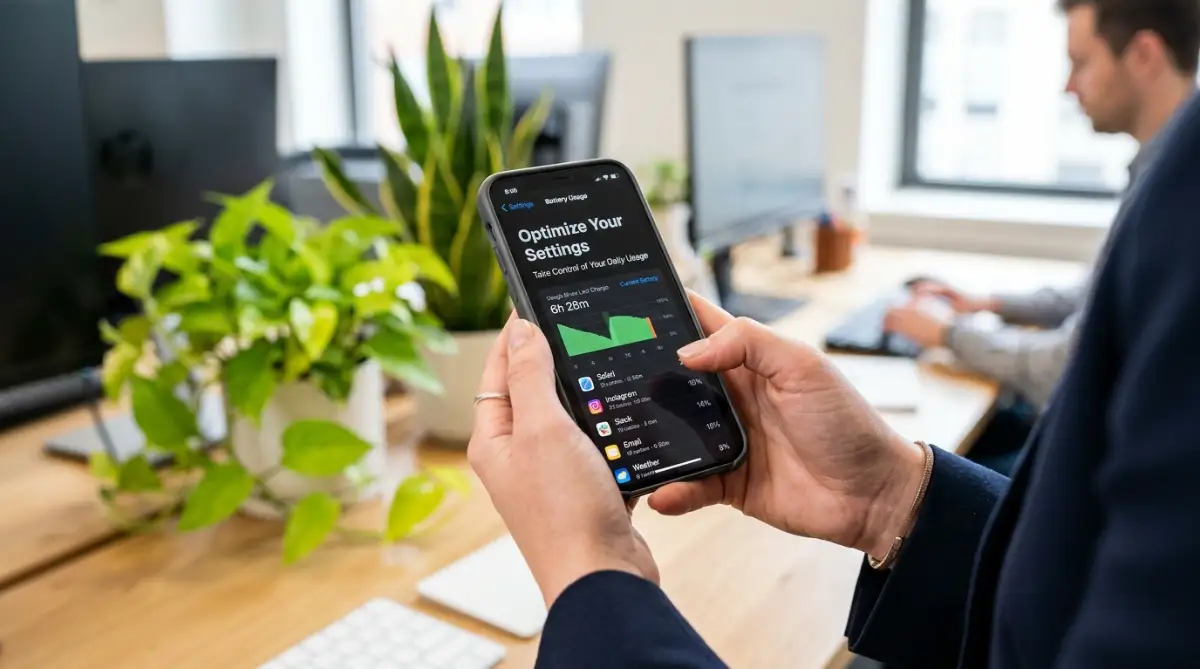
The first thing you need to realize is that "Background App Refresh" is often the main culprit. Think of this as the engine of your car running while you are parked at a red light. It consumes fuel, but you are not actually moving anywhere. Many apps, especially social media and shopping apps, love to stay "awake" in the background so they can update their content the second you open them. This is convenient, but is it worth the battery cost? Probably not.
To start fixing this, go into your settings menu. Look for the "Battery" or "General" section. You will likely see an option specifically for "Background App Refresh." You do not need to turn it off for everything. That would be a headache. Instead, be selective. Go through the list and toggle off the apps you do not need to have instant updates for. Do you really need your fitness tracker or your food delivery app checking for data every five minutes? Probably not.
Managing Location Services for Better Power
Location services are another major energy hog. GPS is a high-power feature. It has to connect to satellites and use your cellular data to pinpoint exactly where you are. Some apps, like weather apps or maps, obviously need this. But why does your flashlight app or your calculator app need to know your location? They do not.
Check your "Privacy" or "Location Services" settings. You will see a list of apps that have permission to track you. Change them from "Always" to "While Using" or "Never." You will be surprised by how many apps are tracking you in the background without any real reason. Restricting this access saves a massive amount of power over the course of a day.
The Truth About Screen Brightness
We all love a bright, crisp screen. It looks beautiful. However, your display is the largest consumer of battery power on your device. Having your screen at 100% brightness is like leaving all the lights on in your house when you are only sitting in the living room. It is a waste.
Most phones have an "Auto-Brightness" feature. You should definitely use this. It adjusts to your surroundings. If you are in a dark room, it dims. If you are outside in the sun, it brightens. Also, consider using "Dark Mode" if your phone has an OLED screen. This mode turns off individual pixels for black areas of the screen. Since those pixels are literally turned off, they consume zero power. It is a simple switch that makes a big difference.
Stopping the Notification Overload
Notifications are designed to grab your attention, but they also wake up your phone every single time they pop up. If your phone is in your pocket and it buzzes fifty times an hour, that is fifty times your screen and processor had to wake up. That constant "waking up" process drains battery fast.
Go into your notifications settings. Disable notifications for apps that are not important. You do not need an alert for every single "like" on a social media post or every minor game update. Keep notifications turned on only for things that really matter, like messages from family or work emails. Your phone will stay in "sleep mode" much longer, and your battery will thank you for it.
Pro Tip: I realized a while back that my email app was set to "Push" notifications. This meant my phone was constantly checking the server for new mail every few seconds. I changed this to "Fetch," which means the phone only checks for new emails every thirty minutes or even once an hour. This one small change stopped my battery from plummeting during the workday. I still get my mail, but on my terms.
Simplifying Your Synchronization Settings
Many of us have our phones syncing with the cloud—photos, notes, contacts, and app data. This is great for backups, but it often happens over cellular data. Syncing heavy files like high-resolution videos or large photo collections takes a lot of power and data.
Check your "Accounts and Sync" settings. Make sure that large file syncing is restricted to when you are connected to Wi-Fi. It is much more efficient for your phone to sync when it is plugged into a charger or on a stable Wi-Fi connection. It stops your phone from struggling to maintain a heavy data connection while you are out and about.
Want to see these settings in action? Check out this video guide below where I walk through my own device to show you exactly how to toggle these features for maximum battery life:
Video Guide: How to Optimize Your Smartphone Settings for All-Day Battery Power
Why Regular Maintenance Matters
Maintaining your battery is not just about disabling things. It is about how you treat your device daily. Many people leave their phones plugged in all night, every single night. While modern phones are smart enough to stop charging when full, keeping them at 100% constantly can be stressful for the battery chemistry over time.
Try to keep your battery between 20% and 80%. This "sweet spot" helps the battery last longer in the long run. If you know you are going to be away from a charger, you can charge it fully before you leave, but try not to make it a daily habit if you do not need the full capacity. It is a small habit that pays off.
Myth vs. Reality: Closing Apps
There is a common myth that you should constantly "force close" your apps from the task switcher to save battery. I used to do this all the time. I would swipe them away obsessively. The reality is that this often does the opposite.
When you force close an app, and then you open it again later, your phone has to reload everything from scratch. This uses more processor power and more battery than simply letting the app sit in the background in a "suspended" state. Modern operating systems are actually quite good at managing memory. Unless an app is frozen or acting up, let it be. Your phone is smarter than you think.
Connectivity Matters
Think about your connection settings. If you are in an area with very poor cellular service, your phone will work double-time, constantly scanning for a stronger signal. It will increase its transmission power, which burns through your battery life incredibly fast.
If you know you are going to be in a "dead zone" for a while, like on a long flight or in a basement, just switch your phone to "Airplane Mode." You are not going to get a signal anyway, so why let your phone struggle to find one? It saves a surprising amount of power and keeps your phone ready to go when you are back in a service area.
Keeping Your Software Updated
This might sound counter-intuitive, but keeping your phone’s operating system updated is helpful. Sometimes, manufacturers release updates specifically to fix battery drain bugs. If you have been ignoring those "System Update" notifications, consider installing them when you have the chance.
However, do be careful with major OS upgrades if you have a very old phone. Sometimes, newer software is optimized for newer hardware. If you have an older device, a quick search online to see if others are experiencing battery issues with the update is a smart move before you click install.
Small Habits for Big Results
I know it seems like a lot to manage, but you do not have to do this all at once. Pick one or two of these tips and try them for a few days. You will start to notice that your phone is not getting as hot, and the battery percentage is not dropping as aggressively.
It is about finding a balance. You want your phone to be useful, but you also want it to be reliable. When you stop your phone from doing things you do not need, you regain that reliability. You stop checking the battery percentage every ten minutes, and you get back to actually using your phone for the things that you enjoy.
Final Thoughts on Battery Management
Taking care of your smartphone battery is not about being paranoid. It is about being efficient. Most of the battery-draining issues we face are caused by settings we never even touched—defaults that are meant to prioritize convenience over power efficiency. By taking just a few minutes to adjust these settings, you make your phone a much more dependable companion.
We rely on our phones for everything today. From navigation to communication to entertainment. When the battery works, everything is smooth. When it fails, everything comes to a halt. By disabling the unnecessary background noise and optimizing how your phone interacts with its environment, you are not just saving battery. You are saving your own peace of mind.
Start with the location services and background refresh settings today. Those two alone usually account for the biggest improvements. Then, move on to notification management. Once you get these under control, you will find that you are no longer living in constant fear of the dreaded one-percent mark. You will have a phone that works for you, not against you.
Remember, these devices are here to serve us. A little bit of setup now will save you a lot of trouble later. Go ahead and take a look at your settings. You might be surprised at what you find running in the shadows. Your battery is waiting for that relief, and your day is about to get a whole lot less stressful.
Beyond the Basics: Pro-Level Battery Optimization
We have already covered the standard settings that help save battery power. Now, let’s look at the hidden areas of your operating system. These are the deeper tweaks that experienced users utilize to squeeze every last drop of performance from their devices. I have spent years refining my own setup, and these adjustments made a genuine difference in how long my phone lasts during a busy day.
Unlocking Developer Options for Better Control
Many people do not realize that their phones come with a hidden menu specifically for power users. By accessing the developer mode on your Android device, you gain access to settings that normal menus hide. Once you activate this, you can adjust the "Background Process Limit." This setting tells your phone exactly how many apps can stay active in the background at one time.
If you set this limit to a lower number, your phone will automatically kill off excess processes that are clogging your memory. This is a powerful way to stop apps from silently running when you are not using them. It keeps your processor idle more often, which is exactly what you want for battery health. However, be careful not to set it to "zero processes," or your phone will start closing apps that you actually need.
The Hidden Cost of Permission Abuse
We often install apps and blindly click "Allow" on every permission request without thinking twice. This is a massive mistake. Every time an app asks for permission to track your location, access your microphone, or sync data, it creates a potential background task. Why you should stop granting unnecessary permissions to newly installed apps is a lesson I learned the hard way after seeing my battery drain overnight by twenty percent.
Go into your app management settings and audit every single application. If you have a weather app, does it really need to access your contacts? Does a photo editor need constant access to your cellular data? Revoking these unnecessary permissions prevents the app from "waking up" your phone’s internal components. It is a simple administrative task that significantly reduces the load on your hardware.
Automating for Efficiency
Sometimes the best way to save battery is to let your phone do the work for you. Many people struggle with manual settings because they forget to toggle things back on. You can bridge the professional skill gap by mastering basic automation tools on your phone. For example, you can set up "modes" or "routines" that trigger automatically.
My phone is set to turn off Wi-Fi and Bluetooth automatically when I leave my home Wi-Fi range. It then switches to mobile data only when needed. When I arrive at work, it automatically lowers the brightness and puts the phone into a "do not disturb" mode. These tiny automated triggers save a lot of battery over a full day. You do not have to think about it; the phone just handles it for you. This kind of setup creates a streamlined experience where your device works as efficiently as possible.
Understanding Lithium-Ion Chemistry
To keep your battery healthy long-term, you need to understand how it works. Lithium-ion batteries, which are found in almost all modern smartphones, do not like to be at 100% or 0% for long periods. According to research on lithium-ion longevity, keeping your charge between 20% and 80% is the best way to keep the battery chemicals happy.
Think of it like a rubber band. If you stretch it to its limit and hold it there, it loses its elasticity. It is the same with your battery. If you rarely let it go to 100% or below 20%, you will find that the battery holds its capacity for years longer than if you drain and charge it to the max every day. I try to unplug my phone when it hits 80% whenever I am at my desk. It has kept my phone's battery health significantly higher compared to friends who charge it overnight to 100%.
Mistakes That Cost You More Power
We have all been there. You are low on battery, and you start panic-tapping buttons, hoping to find a quick fix. Unfortunately, many of the "solutions" people rely on actually make the situation worse. Avoiding these common traps is just as important as the steps we already discussed.
The "App Killer" Myth
One of the most persistent lies about smartphone usage is that you need to swipe away and "force close" your apps constantly. I used to do this every hour. I thought I was clearing out the junk. In reality, modern mobile operating systems are designed to keep apps in a suspended state.
When you force an app to close, you are essentially telling the phone to dump the app's data from the memory. When you open that app again—which you will, because it is something like WhatsApp or your email—the phone has to restart the entire process from the ground up. This uses more battery than if you had just left the app in the background. Stop obsessing over your task manager. It is wasting your time and your phone's power.
Beware of "Battery Saver" Apps
If you go to your app store and search for "Battery Saver," you will find thousands of results. Most of these apps are not what they claim to be. In fact, many of them are just glorified adware that runs in the background, showing you ads and tracking your data.
To save battery, these apps run their own constant monitoring tasks. You are installing a battery-draining app to save battery. It is a complete paradox. Stick to the built-in "Power Saving" or "Battery Saver" modes provided by the manufacturer of your phone. They are integrated deep into the system and are far more efficient than any third-party app could ever be.
Ignoring OS Updates
Some users avoid updating their phone’s operating system because they fear it will slow down their device. While this used to be a common issue, modern updates usually include bug fixes for power consumption. Manufacturers like Apple and Google monitor battery drain reports closely.
When they see that a specific process is using too much power, they release an update to optimize it. By refusing to update, you are stuck with the unoptimized, inefficient code that was causing the drain in the first place. Always check the release notes. If you see "battery improvements" or "bug fixes," that is your cue to update as soon as you have a stable Wi-Fi connection.
The Trap of Poor Signal Management
When your phone has a weak signal, it does not just sit there. It constantly broadcasts a signal, trying to reach a cell tower. This uses an enormous amount of power, often much more than a strong, stable connection. Experts at Wired highlight how signal strength directly impacts your daily battery percentage.
If you are in a basement or a remote area with one bar of service, your phone is likely red-hot because it is working so hard to connect. In these situations, the most effective move is to toggle Airplane Mode on. You might miss a call, but you will save hours of battery life. It is better to have a phone that lasts until you get to a better signal area than to have a dead phone because it spent all its energy hunting for a connection.
Taking Control of Your Digital Environment
You have now learned that battery management is less about finding a "magic button" and more about good habits. It is about understanding that your device is a tool. If you do not manage your tools, they start to wear down. By auditing your background processes, fixing your notification settings, and being smart about how you use your phone, you are in charge.
You do not need to be a technology expert to make these changes. You just need to be mindful. When you see your battery drop, ask yourself: "What am I actually doing right now?" If you are not doing anything, then look at your settings. Something is running in the shadows, and now you have the skills to find it and stop it.
Managing your battery is a lot like learning to stay calm and invest wisely during market volatility. It requires patience and a steady approach. You do not panic; you just make logical adjustments. When you apply this steady, thoughtful mindset to your tech, you eliminate the stress of dying batteries.
I truly believe that once you set these things up, you will forget the anxiety of looking for a power outlet. I have gone from carrying a heavy portable charger everywhere to just going through my day worry-free. My phone lasts until I get home every night. You can do the same. Start today. Change one setting, observe the difference, and enjoy the freedom of a phone that actually lasts.
Common Questions About Battery Life
Does 5G always drain my battery faster?
Yes, generally. 5G signals often require more power for the phone’s antenna to maintain a connection compared to 4G. If you do not need 5G speeds for your current task, switching your preferred network to 4G in your settings can help save power.
Is fast charging bad for my battery?
It can be, if done constantly. Fast charging generates heat, and heat is the enemy of lithium-ion batteries. Use it when you are in a rush, but for overnight charging, a standard charger is actually much better for your battery's long-term health.
When should I replace my battery?
Most modern phones show a "Battery Health" percentage in the settings menu. If this number drops below 80%, you will likely notice a significant decline in performance and battery life. That is when it is usually worth considering a professional battery replacement.
Do dark wallpapers actually save battery?
They do, but only if you have an OLED or AMOLED screen. These screens turn off individual pixels to create black colors. A pure black wallpaper means those pixels are completely off, which saves power compared to a bright, colorful image.
Is it safe to leave my phone plugged in overnight?
Yes, modern smartphones are designed to stop charging once the battery hits 100%. They have sophisticated management chips to prevent overcharging. However, as we discussed, keeping it at 100% all night is not ideal for chemical longevity, so it is better to unplug it if you can.
Disclaimer: This guide provides general information based on common smartphone settings and practices. Battery performance can vary significantly depending on the age of your device, hardware condition, and specific software versions. I am not responsible for any changes you make to your device settings. If you have concerns about your specific hardware or warranty, please contact your device manufacturer's support team.