
Travel Itinerary Success:
- Energy First: Schedule high-intensity activities for the morning when you are fresh.
- Buffer Time: Leave at least one hour of gap between tasks to handle transit delays.
- Flexibility: Allow yourself to skip optional activities if you feel tired or overwhelmed.
- Slow Travel: Stay in fewer locations for longer to avoid the fatigue of constant travel.
MaThe Morning I Realized My Vacation Was a Mistake
Stop treating your vacation like a race to the finish line. Most travelers burn out by day three because they pack their schedules until there is zero room to breathe. You deserve a trip that actually leaves you feeling refreshed, not ready for another holiday. Here is how to build an itinerary that balances your need to see the world with your need for actual rest.
But instead of feeling refreshed, I felt like I was working a shift at a job I didn't like. My feet were throbbing, my head was spinning from the constant movement, and I couldn't even remember the name of the cathedral I had visited just yesterday. I had treated my vacation like a military operation, not a break from reality. I was checking boxes, not making memories.
That was the moment I realized that my obsession with "seeing it all" was actually destroying my ability to see anything at all. I was moving too fast to appreciate the rhythm of the places I was visiting. The joy of travel had been replaced by the stress of the schedule. I was losing the point of taking a vacation in the first place.
This struggle is far more common than you might think. We get so wrapped up in the idea of maximizing every second that we turn our downtime into a high-pressure performance. We fear missing out on the "top ten" sights, so we cram them all into a timeframe that doesn't allow for digestion or reflection. The emotional toll is real, and it often leads to what many call "vacation burnout."
When you return home, you should feel recharged. Instead, you feel like you need another vacation to recover from your vacation. It feels like a wasted opportunity, and that realization stings. You wanted to escape the grind, but you just brought a different version of the grind with you.
The good news is that it doesn't have to be this way. You don't have to choose between seeing the world and getting some rest. You just need to learn how to structure your time differently. It is entirely possible to have a trip that is both rich in experiences and generous with your energy levels. Let’s talk about how to rethink your approach to planning.
The Concept of the Energy-Balanced Schedule
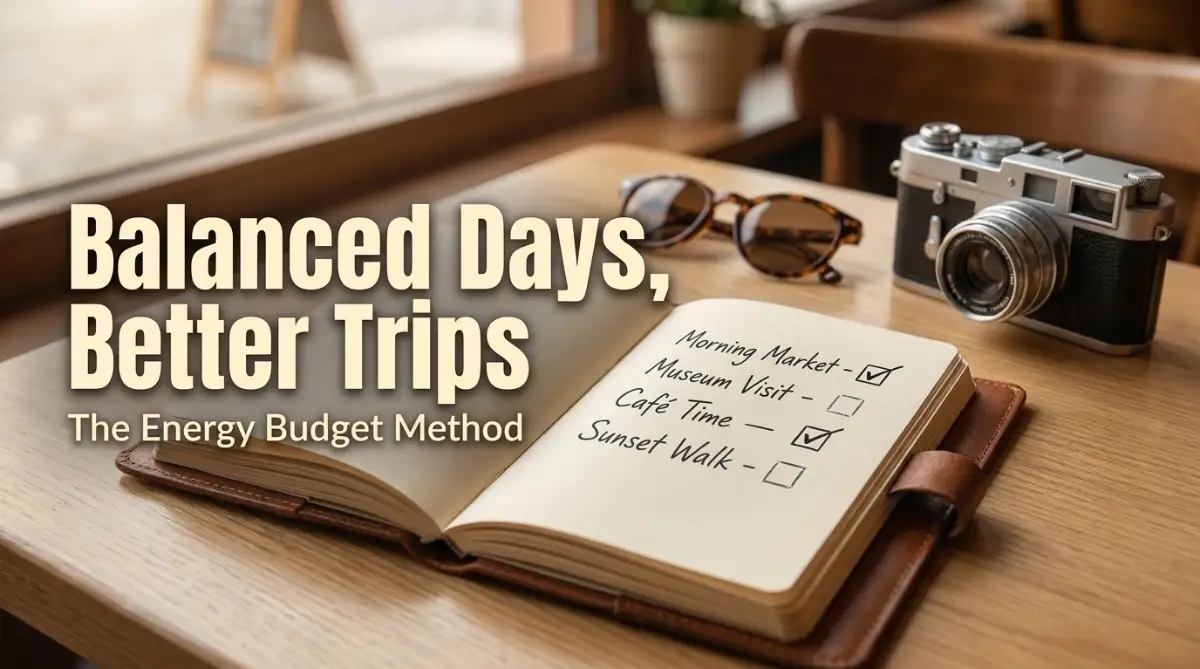
Most people plan their trips based on time. They have seven days, so they fill those seven days with as much as they can hold. I want you to start planning based on energy. Think of your energy as a battery that needs to be managed, not just emptied.
Understanding Your Personal Energy Rhythm
Everyone has a different pace. Some of you can spend eight hours walking around a city and feel great. Others find that three hours of sightseeing leaves them needing a nap. You need to be honest about your own capacity.
Don't copy the itinerary of a friend who has more energy than you. If you know you are an introvert who needs quiet time, build that quiet time into your plan. If you know you get cranky when you are hungry, schedule your meals before you schedule your tours. Your itinerary should fit you like a glove, not like a borrowed suit.
The Power of the "Low-Input" Day
This is my favorite secret weapon for long-term trips. For every two days of heavy sightseeing, schedule one "low-input" day. This is a day where the only goal is to exist in your destination.

Maybe you go to a local park and read a book. Maybe you find a cafe and watch people walk by for an hour. Maybe you spend the afternoon just wandering through a market with no specific target. These days act as a reset button. They give your brain the chance to process all the new input you have been receiving.
Managing Expectations vs. Reality
Social media is the enemy of a balanced itinerary. We see influencers hitting ten landmarks in one day, and we feel like failures if we don't do the same. But remember, those influencers are working. You are there to enjoy your life.
It is okay to miss a landmark. It is okay to skip a museum if you are tired. The goal of a vacation is to experience a new environment, not to complete a checklist. When you stop chasing the "Instagram shot," you start finding the moments that actually matter.
Identifying Your "Must-Do" vs. "Nice-to-Do"
When you are planning your trip, write down everything you want to see. Now, take a red pen and circle only the three things that would make you truly sad to miss. Those are your "Must-Dos." Everything else is a "Nice-to-Do."
If the trip gets busy or you feel tired, you have full permission to cut the "Nice-to-Dos." This removes the pressure to do everything. You have already accomplished your main goals by hitting your "Must-Dos." The rest is just bonus time.
Pro Tip: My Realization
I once spent an entire morning trying to find a specific restaurant because I had read it was "the best." By the time I found it, the line was two hours long, and I was miserable. My pro tip for you is this: Don't plan your meals around prestige. If you are hungry, eat where you are. Some of my best memories and meals have been at random spots I found when I wasn't looking. Be open to the unplanned.
A Visual Guide to Better Planning
Sometimes, seeing how a day looks on paper can help you organize your thoughts. Here is a simple way to visualize your day to ensure you don't overschedule.
[This video breaks down exactly how to structure a vacation day so you get the most out of it without needing a nap every four hours. It shows you how to pick your spots and balance your morning and evening.]
Embracing the "Slow Travel" Philosophy
Slow travel is not about doing less; it is about doing things more thoroughly. Instead of staying in four cities in ten days, stay in two cities for five days each. You save time on travel, you save money on transport, and you get to know the rhythm of the place.
You will find that you start to recognize the local baristas, you learn the shortcuts, and you stop feeling like a tourist. You become a temporary resident. That shift in perspective is where the real magic of travel happens. It is a much deeper experience than rushing from site to site.
The Importance of Buffer Time
Always, and I mean always, schedule buffer time. Trains get delayed. Taxis get lost. It rains when you wanted to walk. If your schedule is back-to-back, one small hiccup ruins your entire day.
If you schedule a tour from 10:00 to 12:00, don't schedule your next one until 14:00. This gives you two hours for lunch, travel, and the inevitable "oops" moment. It makes your day feel open and flexible instead of trapped and scheduled. You will find that you actually see more because you aren't constantly stressed about the clock.
Listening to Your Body’s Cues
If you feel your mood dropping, stop. It’s that simple. If you are starting to argue with your travel partner or feeling overwhelmed, you have passed your limit. A 30-minute break to sit down can fix a situation that would otherwise ruin the whole afternoon.
Travel brings out the best and worst in us. Being aware of your own emotional state is a skill. When you take a break before you reach your breaking point, you save the relationship and the trip. It’s an investment in the quality of your time together.
The Three-Point Planning Rule:
- Must-Do: Only 3 things per day that you absolutely want to see.
- Padding: Add 60 minutes between every activity for travel delays.
- The Exit Clause: If you feel tired, allow yourself to skip any "nice-to-do" task without feeling guilty.
The Value of Unplanned Evenings
I love leaving my evenings mostly open. Maybe I find a cool music venue, or maybe I hear about a local festival, or maybe I am just so tired that I want to order room service and watch a movie.
If you have a set reservation for every night, you lose the ability to go with the flow. Keep your nights fluid. Let the day guide you. Some of the best nights I have had abroad were the ones I didn't plan at all.
Reflecting on Your Experiences
At the end of each day, take ten minutes to write down what you did. Not as a record of achievement, but as a record of memory. What did you smell? What did you laugh about?
This reflection keeps you connected to the why of your trip. It turns a blur of sights into a collection of stories. It helps you decide what you want to do the next day, based on what you actually liked, not just what the guidebook said you should like.
Final Thoughts on Itinerary Balance
You have the ability to plan a trip that leaves you refreshed instead of depleted. It just takes a little bit of honesty about what you can handle and a lot of grace for the things that go wrong.
Don't strive for a perfect itinerary. Strive for a sustainable one. Strive for one that allows you to see the world without losing yourself in the process. You are the architect of your own time. Build a structure that serves you, not one that binds you.
I hope you go into your next trip with a fresh perspective. Take the pressure off, build in the rest, and focus on the moments. The world is waiting for you to see it, but it’s not going anywhere. Take your time.
Common Questions About Vacation Planning
How do I know if I'm overpacking my schedule?
If you find yourself looking at the clock every hour to see if you are "on schedule" for your next tour, you are overpacking. Your vacation shouldn't feel like a calendar invite.
How much buffer time is too much?
There is no such thing as too much buffer time. At minimum, try to leave an hour of "blank space" between major activities. It saves you from stress and gives you room to breathe.
Is it okay to change my plans once I'm already there?
It is more than okay; it is recommended. Once you are on the ground, you might find that you hate a certain area but love another. Don't feel obligated to follow a plan that you made weeks ago when you didn't know what the place was like.
What should I do if my travel partner wants to do more than me?
Communicate before you leave. Agree on a "split" strategy where you do your own things for part of the day and meet up for dinner. You don't have to be attached at the hip for the entire trip.
How do I balance sightseeing with rest?
Use the "two-to-one" rule. For every two hours of active sightseeing, give yourself one hour of quiet or low-energy activity. It keeps your energy levels consistent throughout the entire vacation.
stering Your Long-Term Travel Rhythm
You have already learned the basics of tracking your daily output. Now, let’s talk about the strategies that professionals use to ensure their vacation time delivers the highest level of relaxation for decades. Most travelers think that if the itinerary is full, the trip is a success. That is like saying your car is ready for a cross-country race just because it starts, even if the engine is overheating.
One of the most effective tools for a pro-level travel audit is the "Energy Budgeting" framework. When you are on a long-term trip, you cannot treat every day like a sprint. If you visit a crowded museum for six hours, your battery is drained. You need to schedule an "energy recharge" day immediately following. According to recent studies by The Journal of Travel Medicine, travelers who space out their high-intensity activities experience significantly less burnout and higher satisfaction levels.
Another secret is managing the pace of your logistics. I realized early on that just booking the cheapest train or flight isn't always the right move. If your travel day involves three layovers and a middle-of-the-night arrival, you are not saving money; you are spending your future energy. It’s a small detail, but it changes how your trip feels from the start. You might want to consider why your visa application takes time - a clear guide to the process because managing the "boring" administrative parts of your trip is just as important as the fun parts.
You also need to understand how how to bridge the professional skill gap by mastering basic automation tools plays into your long-term success. Even on vacation, if you have to handle quick work tasks, using automation can keep you from wasting hours. You aren't just saving time; you are positioning yourself to actually enjoy your destination. When you look out for your own schedule as if it were a client project, you become a much more efficient traveler.
Keep your documents and digital itinerary updated, just like you would with your computer’s operating system. Sometimes, a simple shift in local festival dates or a change in train schedules can ruin your flow. If you are also dealing with how to stay calm and invest wisely during market volatility, keep in mind that managing your trip's financial and logistical stress is the same game. It is not just about the destination; it is about the systems that keep your trip profitable in terms of joy and rest. It is not just about the hardware; it is about the software of your planning.
Finally, think about your social rhythm. If you are traveling with a partner or group, realize that they are also an engine that likes to be kept within a certain mood range. If one person is an early riser and the other is a night owl, you are killing the capacity of your relationship to enjoy the trip. Understanding the need for independent time is part of being a complete travel planner. Take care of your travel partner's preferences, and they will take care of your peace of mind when the logistics get tough.
- Expert Tip: I keep a "Day Zero" buffer. No matter where I land, I never schedule an activity for the first day. I use that time to walk the neighborhood, find a local grocery store, and simply sit in a park. This simple habit prevents the "travel shock" that hits most people on day one. It lets me get my bearings before the real sightseeing begins.

Watch Out for These Travel Traps
The biggest mistake I see people make is letting their ego drive their planning. You book a fancy tour because it looks good in a brochure, even though you hate group activities. In reality, you are just signing up for a stressful day where you feel trapped.
People often neglect their energy levels because they find "slow travel" boring. They pack their days with every possible site, and they never look at their own capacity. This is dangerous. If you don't check your energy levels every few days, you aren't actually on a vacation; you are just moving your stress from your office to a foreign country. If you don't check your habits, you aren't prepared.
Another trap is failing to tell anyone your backup plan. We live in a world where we can track each other, but don't assume your hotel or tour guide knows what you need. If you go silent or miss a tour, you are just a statistic. Failing to share your plans is a massive risk when you are exploring areas with limited cell service.
Some travelers get into trouble by trying to do things they don't understand. If you don't know how to navigate the local public transport, buy the pass but also watch a video on how to use the machines before you leave. Fumbling with a transit card at a busy station is not the time to learn the system. It leads to frustration, broken plans, and bruised egos.
Also, be wary of "vacation debt." I have known people who didn't even realize they had spent their entire budget on the first three days because they didn't track their expenses. Always keep your receipts and official documentation, because the bank treats this as a financial asset. If you want to understand how budgeting impacts your life, you can look into how people approach other financial hurdles, such as understanding the gap - how deductibles and out-of-pocket limits work. While it is a different field, the logic of "being prepared with clear data" is exactly the same for your vacation. If you have the data, you can prove your own needs.
Finally, don't assume that your travel destination is exempt from local regulations. Some owners add more activities or change their routes without updating their documentation or checking if their transit pass covers it. This can cause you to get fined or delayed. Always keep your paperwork updated, and ensure that any changes are legal. You don't want to get flagged by the local authorities for something that could have been handled with a simple permit or phone call.
A Better Way to Vacation
You have the power to change how you experience the world. It starts with slowing down and treating your vacation as a personal restoration project rather than just a checklist. You are building a trip that will be part of your memory for decades, so take the time to get the foundation right.
Stay curious. Ask the hard questions about your schedule before you book, not after. Keep your records organized, and don't be afraid to walk away from a plan that feels wrong. Your gut feeling is usually a good indicator that something in the itinerary needs more attention.
I have walked through these steps myself, and I can tell you that the feeling of having everything settled and secure is worth it. When you know you are organized and that your planning is in order, you can finally relax and just enjoy the sights. When you know you are aligned with what you need, you can finally enjoy the moments.
You are doing the right thing for your mind and your happiness. Just keep your eyes open, verify every detail, and move forward with the confidence of an informed traveler. I am cheering you on as you make this transition toward smarter, more balanced vacations.
Common Questions About Trip Planning
How do I know if I'm overpacking my schedule?
If you find yourself looking at the clock every hour to see if you are "on schedule" for your next tour, you are overpacking. Your vacation shouldn't feel like a calendar invite.
How much buffer time is too much?
There is no such thing as too much buffer time. At minimum, try to leave an hour of "blank space" between major activities. It saves you from stress and gives you room to breathe.
Is it okay to change my plans once I'm already there?
It is more than okay; it is recommended. Once you are on the ground, you might find that you hate a certain area but love another. Don't feel obligated to follow a plan that you made weeks ago when you didn't know what the place was like.
What should I do if my travel partner wants to do more than me?
Communicate before you leave. Agree on a "split" strategy where you do your own things for part of the day and meet up for dinner. You don't have to be attached at the hip for the entire trip.
How do I balance sightseeing with rest?
Use the "two-to-one" rule. For every two hours of active sightseeing, give yourself one hour of quiet or low-energy activity. It keeps your energy levels consistent throughout the entire vacation.
Disclaimer: This content is for educational purposes only and does not constitute professional travel or vacation planning advice. Travel schedules and personal energy needs vary widely among individuals. Always consider your specific physical and mental health requirements when planning long-term trips. By following these suggestions, you acknowledge that you are responsible for your own vacation planning and safety decisions.