
Traveler’s Recovery Roadmap:
- Pre-Flight Prep: Shift your bedtime by one hour each night for three days before you fly.
- Hydration is Key: Drink at least 8 ounces of water for every hour you are in the air.
- Light Control: Use direct sunlight to stay awake or dark rooms/sunglasses to prepare for sleep.
- Meal Timing: Synchronize your hunger to your destination's local time immediately after arrival.
Fog That Follows a Long Flight
Landing in a new time zone with a pounding headache and a brain that feels like static is the fastest way to ruin a trip. You don't need expensive supplements or complicated travel hacks to fix it. You just need to understand how light exposure and meal timing force your internal clock to reset. Let’s break down the science of jet lag so you can start your vacation at full speed.
That first day of a trip is supposed to be the best—the anticipation, the new sights, the excitement. But instead, I was a zombie, dragging myself through a haze of confusion. I kept checking my watch, but the time on the dial meant nothing to my body. I felt frustrated because I had spent so much money to get there, and yet, I was effectively paralyzed by my own internal clock.
You have likely been in this spot, too. You try to push through, drinking cup after cup of coffee, only to feel wired and exhausted at the same time. You end up falling asleep at the wrong hour, waking up at three in the morning, and repeating the cycle for days. It ruins the first few days of your vacation or your business trip, leaving you irritable and out of sync.
This isn't just about feeling tired. It is a fundamental disruption of your biology. Your cells, your hormones, and your brain are all screaming that something is wrong. When you ignore that signal and try to force your body to conform to a new time zone instantly, you are fighting a battle you cannot win.
The frustration is even worse when you realize you are helpless against it. You think you can just "power through" by sheer force of will. But the body doesn't care about your itinerary or your desire to see the sights. It follows the light, and it follows its own rhythm.
I learned that fighting the feeling only makes it last longer. You have to work with your body, not against it. Once I stopped trying to force my way into the new time zone and started using a few biological "hacks," everything changed. My recovery time dropped from days to hours. You can have that same experience, and it starts with understanding what is actually happening under the hood.
The Master Clock Inside Your Brain
To solve the problem, you have to look at the machinery. Deep inside your brain, there is a tiny cluster of cells called the suprachiasmatic nucleus (SCN). Think of this as the "master clock." Its only job is to tell the rest of your body when to be awake and when to be asleep.
The Role of Natural Light
The master clock is incredibly sensitive to light. This is why you feel groggy on a rainy day and alert when the sun hits your face. When sunlight enters your eyes, it sends a direct signal to the SCN. This signal tells your brain to stop producing melatonin—the hormone that makes you sleepy—and start pumping out cortisol to keep you alert.
When you fly across multiple time zones, you essentially rip this master clock off the wall. Your brain still thinks it is in your home time zone, but the light outside is telling it a different story. This conflict is the root cause of the fog, the headache, and the total lack of energy. You are living in two times at once.
Why Your Gut Is Also Confused
It’s not just your brain. You have peripheral clocks all over your body, including in your liver and your gut. These organs have their own rhythms for digestion. When you land in a new place and eat a heavy meal at a time when your gut thinks it should be resting, you cause "metabolic jet lag."
This is why you feel bloated and nauseous when you travel. Your digestion system is effectively jet-lagged, too. Giving your body a rest from heavy food during the first few hours of arrival is a secret most travelers ignore. You are giving your gut clock a chance to catch up with your brain clock.

The Science of "Phase Shifting"
We call the process of resetting your clock "phase shifting." You are shifting your biological phase to match your new environment. It is not an instant flip of a switch. It is a slow, gradual slide.
The Travel Recovery Matrix
| Travel Direction | Natural Adjustment Speed | Strategy for Success |
| :--- | :--- | :--- |
| Flying East | 1 hour per day | Go to bed 1 hour earlier for 3 days before. |
| Flying West | 1.5 hours per day | Stay up 1 hour later for 3 days before. |
| Short Trips | Minimal shift | Stick to your home time zone schedule. |
Most people can adjust their clock by about one hour per day. If you cross six time zones, don't expect to feel normal in twenty-four hours. You are looking at a week-long process. Knowing this prevents the panic of thinking, "Something is wrong with me." Nothing is wrong; you are just a biological entity, not a digital clock.
Step 1: Pre-Trip Preparation
You can actually start shifting your clock before you ever board the plane. If you are flying east, try going to bed one hour earlier each night for three nights before you leave. If you are flying west, go to bed one hour later.
This small shift reduces the "distance" your body has to jump once you land. It is like warming up before a race. You are easing your brain into the new routine so the shock isn't so severe. It takes a little discipline, but it saves your body a massive amount of stress.
"Boost your understanding with this short visual guide to mastering your biological rhythm during travel, and then continue reading for our final checklist."
Step 2: In-Flight Adjustments
Once you are on the plane, the clock starts ticking. Change your watch to the destination time immediately. This is not just a reminder; it is a mental trick. Start acting as if you are already in that time zone.
If it is nighttime at your destination, try to sleep. If it is daytime, force yourself to stay awake, even if you are tired. Use an eye mask and earplugs to create a dark environment. Avoid the movies that keep you alert and the heavy meals that keep your gut busy.
Step 3: Managing Light Upon Arrival
The moment you land, sunlight is your best friend. If you arrive in the morning, get outside. The light will signal your brain that the day has begun. It is the most powerful tool you have to reset your master clock.
If you arrive at night, do the opposite. Wear sunglasses if you have to, keep the lights low, and get to bed. By controlling your light exposure, you are manually forcing your SCN to adjust to the new "correct" time. It is the most effective biological override you have.
Pro Tip: The Hydration Realization
I once spent an entire trip feeling terrible because I treated my flight like a vacation, drinking soda and skipping water. My pro tip is simple: Drink more water than you think you need. Flying is incredibly dehydrating, and dehydration mimics the symptoms of jet lag. If you are thirsty, you are already behind. Aim for a glass of water for every hour you are in the air. It sounds like a lot, but it keeps your system moving and prevents that sluggish feeling.
Managing Your Temperature
Your body temperature actually dips when you sleep. You can "trick" your body into thinking it is time to sleep by keeping your environment cool. If you are trying to stay awake, keep the room bright and warm. If you are trying to sleep, make the room cool and dark. Your internal temperature is a subtle cue that tells your body it is time to wind down.
Eating on Destination Time
Try to eat your meals according to your destination's schedule, not your hunger. If you land at noon local time, have a light lunch, even if your body thinks it’s midnight. By feeding your "gut clock" at the right time, you help synchronize your peripheral clocks with your brain’s master clock. This alignment is vital for a faster recovery.
Avoiding Alcohol and Caffeine
This is the hardest one for many travelers. Alcohol makes you sleepy, but it ruins your sleep quality, meaning you will wake up feeling worse. Caffeine is a crutch that masks the symptoms but delays your recovery by pushing your brain into a false state of alertness. During the first twenty-four hours, stick to water and herbal tea. It is a sacrifice, but your recovery will be much smoother.
Movement is Medicine
Once you arrive, don't sit in the hotel room. Go for a walk. Move your body. The physical activity increases your heart rate and signals to your body that it is time to be alert. It also helps your circulation, which is often poor after a long flight.
Keep the walk light. You don't need a heavy workout. Just moving through the new environment, smelling the air, and seeing the sights helps your brain map the new reality. It creates a "spatial" cue that says, "We are somewhere else now."
Using Melatonin Wisely
Some people find success with melatonin, but you must be careful. It is not a sleeping pill; it is a signal. It tells your brain that darkness is coming. If you take it at the wrong time, you will do the opposite of what you want and confuse your clock further.
Consult with your doctor before trying this. If you do use it, use a very low dose—often less than a milligram is enough—to help shift your internal rhythm. Don't use it as a hammer to knock yourself out; use it as a subtle nudge to the SCN.
Building Your Own Recovery Ritual
You will eventually develop your own rhythm that works for you. Maybe you like a specific tea, or a certain kind of meditation, or a short bath. Once you find what works, stick to it. Travel becomes much less stressful when you have a proven plan for your biological recovery.
Don't be hard on yourself if you still feel tired. You have just crossed oceans. It is perfectly natural for your body to take its time. Keep practicing these steps, and you will eventually find that your body adapts much faster than it used to.
Watching the Data
If you wear a fitness tracker, look at your sleep data. You will see how your body slowly settles into the new routine. It is a fascinating way to see your own biology in action. But don't become obsessed with the numbers. If you feel rested, you are winning, regardless of what the watch says.
Final Thoughts on Your Biological Clock
You are a traveler, not a robot. You were built to walk, not to fly across oceans in a few hours. Jet lag is just the price we pay for the modern marvel of air travel. It is a temporary state, and it always passes.
Take it easy on yourself. Give your body the time it needs to catch up. You have a lifetime of travel ahead of you, and mastering your own recovery is just part of the adventure. You will get there, and you will feel great, as long as you respect the rhythm of your own heart and mind.
Common Questions About Jet Lag
Why is jet lag worse when flying East?
Flying east "shortens" your day, which is harder for the human body to handle. We are naturally better at extending our day than shortening it, which is why flying west is usually easier for most people.
How long does it usually take to fully recover from jet lag?
A general rule is one day of recovery for every time zone crossed. If you cross five time zones, give yourself five days to feel completely back to normal.
Does being physically fit help with jet lag?
Yes. Healthier individuals often recover faster because their body is more efficient at regulating stress and managing hormonal shifts. Good health gives your body more reserves to handle the strain of travel.
Should I sleep on the plane?
Only if it is nighttime at your destination. If it is daytime there, avoid sleeping as much as possible, or keep it to a short nap of under twenty minutes to avoid deep sleep grogginess.
Does air cabin pressure affect jet lag?
Yes, the low cabin pressure and low humidity contribute to fatigue. It is not just the time zone shift; your body is also working hard to handle the lack of oxygen and the dry air. Stay hydrated to counteract this stress.vanced Hacks for Faster Synchronization
You have already learned the basics of tracking your light exposure and managing your sleep cycles. Now, let’s talk about the strategies that professionals use to ensure their biological clock adjusts to a new time zone as quickly as possible. Most travelers think that if they just power through the exhaustion, they will be fine. That is like trying to force a car to run on empty; you will eventually stall.
One of the most effective tricks for a pro-level recovery is utilizing intermittent fasting to trick your body. Your gut has its own clock, and it is sensitive to food. If you skip a meal during your flight and have your first meal at the breakfast time of your destination, you are sending a strong signal to your internal system that the day has officially started. Research from the Harvard Medical School suggests that food can be a powerful "zeitgeber," or time-giver, that resets your metabolic clocks. By aligning your meals with local time, you bypass much of the fatigue that usually plagues travelers.
Another secret involves temperature regulation. We often forget that our body temperature naturally drops when we are supposed to be asleep. If you are arriving in a new time zone and you need to sleep, keep your environment cool. If you are trying to stay awake, keep the room warm or move around. This temperature manipulation is a subtle but powerful way to communicate with your internal clock. It is just as important as why mental health check-ups are just as essential as physical screenings because keeping your internal systems in balance affects your overall mood and stress levels.
You also need to understand how social synchronization plays into your long-term success. If you are traveling for business, try to schedule your most important meetings for the middle of your day. Avoid doing deep analytical work or high-stakes decision-making until you have had at least two nights of sleep in the new time zone. If you are also dealing with how to stay calm and invest wisely during market volatility, keep in mind that making major choices while you are exhausted is a recipe for regret. Give your brain the recovery window it needs before you sign any major papers.
Keep your hydration strategy focused on electrolytes, not just plain water. After a long flight, your body is often depleted of essential minerals, which makes you feel even more sluggish. Sip on electrolyte drinks that are low in sugar to keep your energy levels steady. And remember, keep an eye on your expenses during your trip; decoding medical bills - a plain english guide for patients can help you manage your resources wisely so you aren't stressed about unexpected costs while you are trying to recover in a foreign city.
Finally, never stop being curious about the specific cues that trigger your alertness. For some, a cold shower in the morning is the perfect trigger. For others, it’s a specific type of herbal tea. Experiment with these triggers in a controlled way. This high-level awareness helps you anticipate how your body will react to travel before you even book your ticket. You won't just be reacting to your fatigue; you will be ready for it.
- Pro Tip: I keep a small "reset kit" in my carry-on bag. It includes a high-quality eye mask, noise-canceling earplugs, and a pair of blue-light-blocking glasses. If I am flying during the day and I need to stay awake, I don't wear the glasses. But if I need to signal to my brain that it is time for rest, I put the glasses on two hours before I want to sleep. It cuts the blue light from screens and cabin lights, letting my body start producing melatonin naturally.

The Traps That Keep You in the Fog
I see so many smart travelers stall because they get caught in the wrong loops. The biggest mistake is the "Coffee Trap." You see a new city, feel the grogginess, and immediately slam three cups of espresso. You feel better for an hour, but then you crash hard, and you have just pushed your natural sleep time back even further.
This wastes your day and leaves you feeling drained. It is much better to stick to small amounts of caffeine only in the early morning and then switch to water. If you are struggling with this, you might be falling into traps similar to those in why traditional study habits often fail to retain complex information. Consistency with your intake beats the urge for a quick hit of energy every single time.
Another mistake is assuming that you can "power through" the exhaustion by ignoring your body. I once worked with a colleague who refused to take a nap after a ten-hour flight because he wanted to "see everything." He spent his whole day miserable, snapping at people and making silly errors. Eventually, he fell asleep at a restaurant table.
Don't let your desire to see the world stop you from taking a twenty-minute rest. If you are absolutely crashing, a short, timed power nap is better than a miserable, full day of forced activity. Experience is valuable, but only when you are actually awake and alert enough to appreciate it. If you refuse to rest, you become the person who is "hard to be around." This ruins your travel reputation faster than any scheduling mistake ever could. Keep your mind open to the idea that rest is part of the itinerary.
Also, be careful not to hide in your hotel room. It is tempting to stay in the dark to avoid the glare, but you need to get out into the natural light to sync your clock. Some people get so afraid of being tired that they stay in bed all day. This is a massive error. Real travel growth happens outside, in the streets, and in the local markets. Use the light to help you, not to avoid the world.
Finally, watch out for the trap of "passive consumption." You might read articles and watch tutorials about travel all day, but that isn't the same as doing the work. You need to plan, pack, and prepare with purpose. If you find yourself researching how to be comfortable but not actually preparing your routine, stop reading and start planning. The best way to travel is to put your feet on the ground and get to exploring.
Your Path to a Restorative Travel Experience
You have the tools to change how you travel. You don't need to be a flight expert to beat the fog. You just need to be mindful of how your biology responds to the movement.
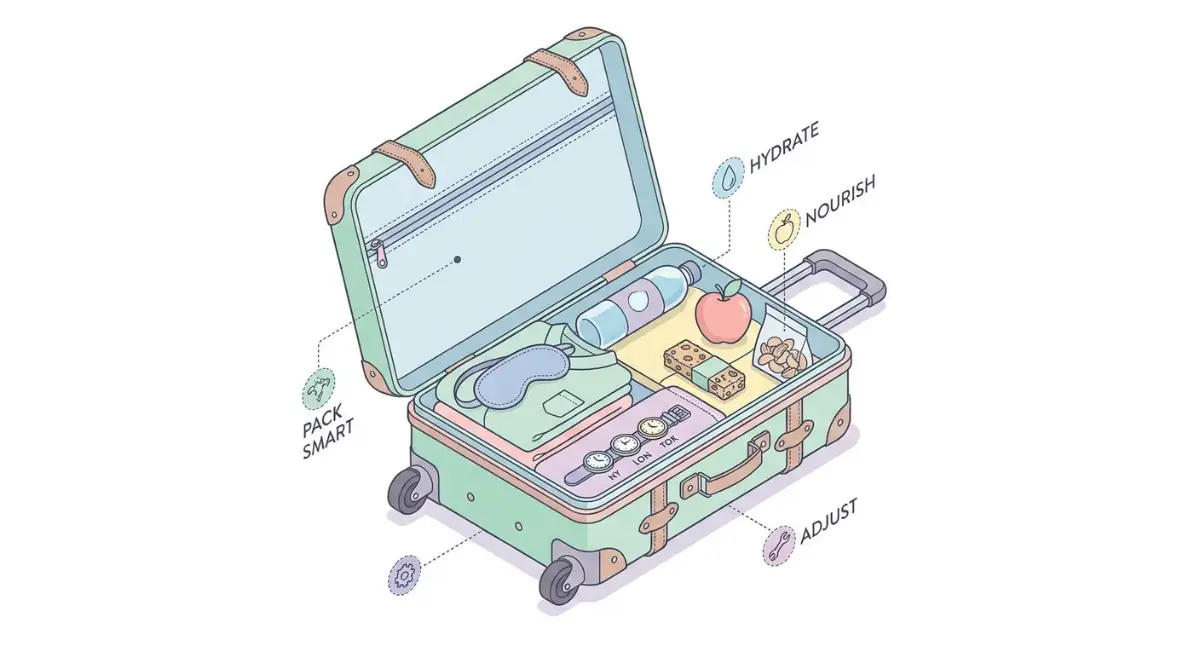
Start by treating your sleep like a mission. Make it a habit. Check your light exposure. Toggle off the caffeine when you need to be winding down. When you feel the pull of exhaustion, pause for two minutes and assess your needs. Those two minutes are the difference between a wasted day and an incredible one.
I have spent years cleaning up my own travel habits, and I can tell you that the feeling of control is worth the effort. It is peaceful knowing that my clock is in sync with the destination and I can actually enjoy the sights instead of just surviving them. My travel finally feels like a hobby again, not a struggle against my own cells. You deserve that same peace of mind.
Start with one tip today. Just one. Look at your schedule for your next trip and plan your light exposure accordingly. Change the way you eat and see what happens. You will likely find that you feel much sharper, much faster. Take that win, celebrate it, and move on to the next. You have got this, and I am right here with you on this journey.
Common Questions About Jet Lag and Travel
Why do I feel like I'm hungover after a long flight?
Dehydration and the body's struggle to adjust to time shifts create symptoms that feel very similar to a hangover. Your brain is essentially confused, and your fluid levels are likely low, which explains the headache and the sluggishness.
Is it really impossible to avoid jet lag completely?
It is difficult to avoid entirely if you are crossing many time zones, but you can definitely minimize it. The key is in the transition—preparing your body before you leave and using light and meal timing to reset your clock upon arrival.
Why is flying West usually easier for people?
Most of us have a natural rhythm that is slightly longer than twenty-four hours. This makes it easier for our bodies to "delay" our sleep (which happens when flying west) than to "advance" our sleep (which happens when flying east).
What if I have to travel for work immediately?
If you have a high-stakes meeting, try to arrive at least two days early if possible. If that isn't an option, use your light exposure aggressively on the first day and prioritize getting eight hours of solid sleep at the local time.
How do I know when I've "reset" to the new time?
You will know when you wake up at a normal time without an alarm and feel relatively alert within the first hour of being awake. It usually happens gradually, but it feels like a sudden lifting of the fog.
Disclaimer: This content is for educational purposes only and does not constitute professional health or travel advice. Travel schedules and individual biological responses vary significantly, so you should always prioritize your health and consult with a medical professional if you have concerns about sleep or travel-related fatigue. By choosing to implement these strategies, you acknowledge that you are responsible for your own health and travel decisions.