
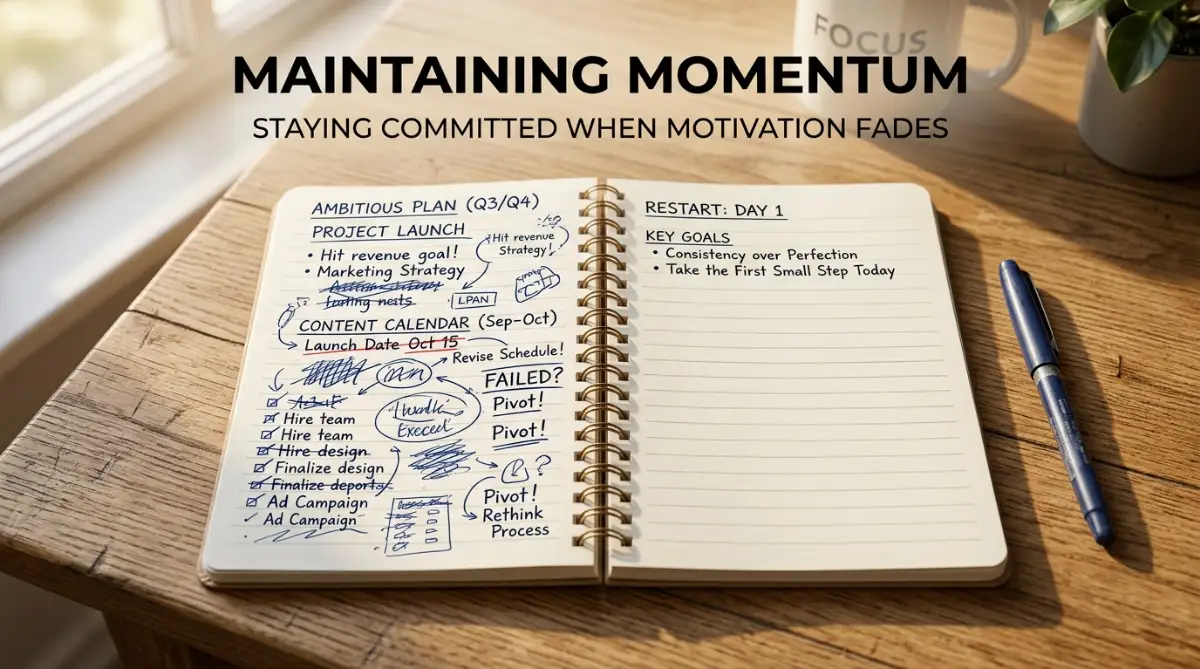
The Morning the Spark Died
You wake up, coffee in hand, ready to crush your to-do list—but the moment you sit at your desk, you freeze. That heavy, hollow feeling isn't laziness; it’s your system breaking down because it was built on "motivation" instead of reality. Let's fix that cycle today by building a routine that works even when you don't feel like working.
Then came the third Monday. I woke up, looked at my desk, and felt absolutely nothing. The excitement that usually pushed me out of bed was gone, replaced by a heavy, hollow sense of resistance. I sat there for an hour, scrolling through my phone, trying to force myself to care, but the spark had simply vanished into thin air.
I thought I was just lazy. I told myself that if I really wanted this, I should be able to push through the boredom without even thinking about it. But the harder I tried to force that initial energy, the more I wanted to quit. It was a crushing realization that my willpower had a limit, and I had hit it hard.
Have you ever felt that wall? You start with a burst of inspiration, but as soon as the novelty wears off, the reality of the work sets in. It’s not just you. We are all prone to the "start-up high," and we are all prone to the inevitable crash that follows.
The struggle is not about your character or your dedication. It is about how we define progress. When you rely on a fleeting feeling to get things done, you set yourself up to fail the moment that feeling leaves. Your peace of mind shouldn't depend on whether you feel "inspired" today. It should depend on a system you can trust.
Quick Summary: Your Action Plan
- Motivation is a trap: Stop waiting to "feel" like working; rely on automatic systems instead.
- Micro-Actions: Break huge goals into tasks so small they are impossible to skip.
- Track the Chain: Use a visual calendar to mark your progress; don't break the chain.
- Focus on Input: You can't control the outcome, but you can control whether you show up today.
Why Your Willpower is Failing You
We often confuse motivation with discipline. Motivation is the "push" you get when you see a shiny new outcome. It is emotional, fast, and completely temporary.
Discipline, however, is the bridge between where you are and where you want to go. You cannot build a bridge out of emotions because emotions change with the weather. You need to build it out of systems, habits, and clear expectations.
The Problem with High Intensity
Most of us try to change our lives by going from zero to one hundred in a single day. We try to read three books a week, work out for two hours, or learn a new language overnight. This high-intensity start feels great, but it is a trap.
Your brain is not designed for sudden, massive shifts in energy. When you exhaust your reserves in the first few days, your body and mind will naturally force you to stop. That crash isn't laziness; it is a biological safety mechanism.
 Motivation vs. Systems
Motivation is great when you're just getting started. You feel excited, you have a goal in mind, and you want to get moving. But that feeling doesn't last forever. Some days you'll be tired, busy, bored, or simply not in the mood. If you depend on motivation every time, it's easy to stop.
That's why having a simple system helps. A system is basically doing something at a certain time or in a certain way without having to think about it too much. You don't wake up every morning wondering whether you should brush your teeth. You just do it because it's already part of your routine. Your important goals can work the same way. Make the habit simple enough to become a normal part of your day, even when you don't feel particularly motivated.
The Comparison of Approaches
Building Your Personal Consistency Bridge
You need a new way to look at your daily work. Stop trying to "win" every single day. Start trying to "show up" every single day.
The Energy Audit: Motivation vs. Discipline
Break Tasks into Micro-Actions

If your goal is to write a book, don't set a goal to write ten pages a day. Set a goal to write one paragraph. One paragraph is so small that you can do it even on your worst days.
When you make the task small, you remove the resistance. You won't feel like quitting because the work is manageable. Once you start with that one paragraph, you will often find that you write three or four without even trying.
Use the "Don't Break the Chain" Method
Get a calendar and put an X on every day you complete your task. Your goal is simply to keep the string of X's going for as long as possible. Seeing that physical evidence of your progress creates a sense of accountability.
It becomes a game. You don't want to break the chain because that means starting over from zero. This visual cue is a massive boost for your focus.
The Two-Minute Rule
My "Daily Shutdown" Ritual (3 Minutes to Success):
- Clear the Desk: Move everything off the desk except tomorrow's #1 task.
- Review the Win: Write down one thing I actually finished today (don't focus on what you missed).
- Draft the List: Put the sticky note with tomorrow’s first task on the laptop lid.
If a task takes less than two minutes, do it immediately. Don't add it to your to-do list, don't think about it, just do it. This keeps your mind clear of small, nagging responsibilities that drain your energy.
Pro Tip: My Realization About Getting Things Done
I used to believe that being productive meant doing everything perfectly from the start. Instead of making progress, I often found myself worrying about whether my work was good enough. The more I focused on getting every detail right, the easier it became to put things off.
Eventually, I started using what I call the “B-minus” approach. Rather than aiming for perfection on the first try, I focus on creating a decent first draft and improving it later. Once I have something to work with, making changes feels much easier than starting from scratch.
This simple shift helped me stop overthinking and make progress on tasks I had been putting off for too long. I've learned that the first version doesn't need to be perfect. It just needs to exist. You can refine your work as you go, but you can't improve something you never start.
Why You Should Watch This
Sometimes, seeing the philosophy of small steps explained by experts makes it click in a way that reading doesn't.
This video breaks down how to use the "Seinfeld Strategy" to maintain daily habits and keep your momentum going:
Addressing the Mid-Project Slump
Every project has a "middle." This is the part where the excitement is gone, but the result is not yet in sight. It is where most people quit.
Schedule Your Rest Days
If you push yourself seven days a week, you will eventually snap. You need to plan your time off. Knowing that you have a break coming up makes it much easier to stay focused on the days you are working.
Rest is not a sign of weakness. It is a necessary part of your productivity cycle. Treat your rest days with as much respect as your work days.
Audit Your Environment
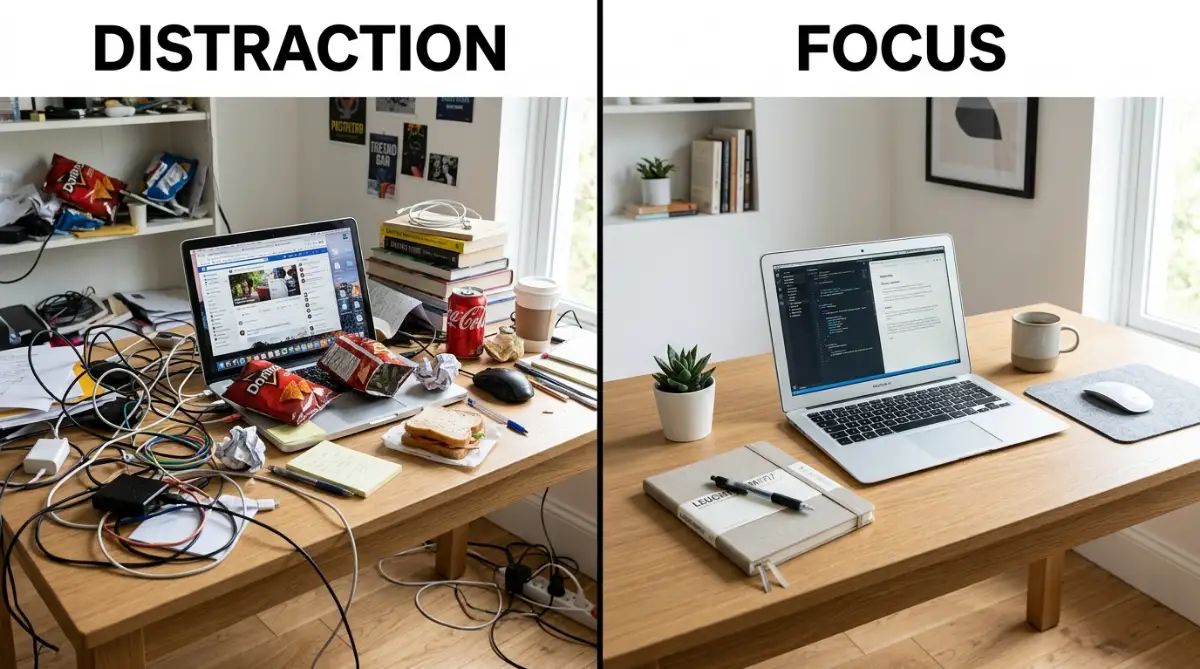
If you are constantly losing your momentum, look at your surroundings. Is your workspace cluttered? Are you getting constant notifications?
Your environment often dictates your behavior. If you make it difficult to get distracted, you make it much easier to stay committed. Simple changes, like moving your phone to another room, can increase your output.
Dealing with Perfectionism
Perfectionism is just procrastination in a fancy coat. It tells you that if you can't do it perfectly, you shouldn't do it at all. This is the fastest way to kill your momentum.
Focus on Input, Not Output
You cannot control the result of your work, but you can control your input. You can control whether you show up today. You can control whether you put in the time.
When you focus on the input, you strip away the anxiety about the outcome. You stop being a judge of your success and become a practitioner of your craft. That shift in perspective is incredibly liberating.
How to Reset After a Bad Day
You will miss a day. It is inevitable. The danger isn't that you missed one day; the danger is that you decide you've "ruined" your streak and stop altogether.
If you miss a day, don't get angry. Just get back on track the next morning. Treat the next day as a completely fresh start. One miss is an accident; two misses is the beginning of a new habit.
The Long-Term Perspective
Staying committed for a week is easy. Staying committed for a year is where the true value is found. This is about playing the long game.
Compound Interest in Effort
Productivity works just like compound interest in a bank account. A small gain today doesn't look like much, but over a year, it creates massive results. You are building a mountain, one grain of sand at a time.
Don't judge your life by what you did today. Judge your life by the trajectory you are on. Are you better than you were last month? If yes, keep going.
Celebrate the Boring Days
Most successful people are not those who had the most exciting days. They are the ones who put in the most "boring" days. When you learn to show up on the days you don't feel like it, you have reached a higher level of success.
Give yourself credit for the times you did the work even when you were tired. That is when the real progress is made. Those are the days that separate the dreamers from the achievers.
Stay Humble and Stay Hungry
No matter how much momentum you build, you can lose it in an instant if you get arrogant. Stay curious. Keep learning new ways to improve your systems.
Never think you have "arrived." You are always in the process of becoming. That mindset keeps you focused and ready for the challenges that come next.
Frequently Asked Questions
Is it normal to feel like quitting?
Yes, it is perfectly normal. Almost every major goal involves a point where you will want to quit. The key is to recognize that feeling as a symptom of the process, not a sign that you should actually stop.
How do I know if I should quit or keep going?
If you want to quit because you are bored or tired, keep going. If you want to quit because the goal itself no longer aligns with your life or values, it might be time to pivot. Be honest about why you feel like stopping.
Can I be productive without being stressed?
Yes, but you have to prioritize consistency over intensity. When you stop chasing "perfect" results and start focusing on "consistent" actions, the stress levels usually drop significantly.
What if I have a really busy week and can't keep my schedule?
Focus on maintenance. On a busy day, do just five minutes of work. It’s not about the quantity of work; it’s about the fact that you honored your commitment. That prevents your brain from thinking it's okay to skip the habit entirely.
How can I find more motivation?
Stop looking for motivation and start looking for clarity. If you aren't doing the work, it is often because you don't clearly understand the next step. Break your goal down until the next step is so obvious you can't ignore it.
Should I change my goals if I lose interest?
Not immediately. Sometimes losing interest is just part of the "slump" mentioned earlier. Stick with it for a bit longer, but if the lack of interest persists, take some time to reflect on whether this goal was ever really yours or if you were chasing someone else's definition of success.
Strategies to Sustain Your Drive Beyond the Initial Rush
You have mastered the art of starting. Now, you need to master the art of staying. Most people fail because they think motivation is a permanent state, but it is actually a passing feeling.
True progress relies on how you behave when you are tired, bored, or stressed. This is when you need to lean on systems, not feelings. If you want to build a bridge that lasts, you have to reinforce it with these advanced habits.
Shift Your Identity to Match Your Goal
The most powerful way to stay committed is to stop thinking about your goal as a "thing you do" and start thinking about it as "who you are." If you are writing a book, don't say you are trying to write. Say, "I am a writer."
When you view yourself as a writer, you show up at your desk because that is what writers do. It isn't a struggle anymore; it is just your identity. This mental shift makes it much harder to skip a day because skipping a day would mean acting against your own self-image.
Design Your Environment to Work for You
Your brain is naturally wired to take the path of least resistance. If you want to practice guitar, put the guitar on a stand in the middle of your living room. If you hide it in a case in the closet, you are adding friction.
You can also use this to avoid bad habits. If you find yourself checking social media too much, delete the app from your phone or move the icon to a hidden folder. By removing the friction, you make the good habits easier and the bad habits harder.
If you are working from home, setting up a dedicated space helps significantly with this process. You can check out this guide on how to design a home office that actually boosts your focus to create an environment where you are naturally more productive. When your physical space supports your goals, your mental resistance drops.
The Power of Energy Management
We focus too much on time management and not enough on energy management. You can have ten hours of free time, but if you are exhausted, you will get zero work done. Learn when your energy peaks and protect those hours for your most important tasks.
For most people, the morning is the best time for deep work. You can experiment with different approaches by reading about how to design a morning routine for lasting daily energy to see what fits your biological clock. When you work with your body instead of against it, you sustain your momentum for months, not just days.
Track Your Progress With Data
We are often bad at noticing our own progress. We feel like we aren't moving because the change from day to day is too small to see. This is why you need to record your work.
Keep a simple log of what you did. Did you hit your word count? Did you exercise? Did you make that call? Seeing those checkmarks accumulate over time provides the proof you need to keep going, even when you feel like quitting.
According to research published in the European Journal of Social Psychology, habit formation takes time, but consistent tracking helps keep your brain focused on the long-term win. It turns the boring work into a series of completed tasks that you can be proud of.
Embrace Digital Minimalism
Modern life is full of tiny distractions that pull you away from your goals. You might think one quick scroll on social media won't hurt, but it breaks your mental flow. If you find your focus shattered, you might need a simple guide to digital minimalism to regain control over your attention.
When you simplify your digital input, you find you have much more energy for your real-world goals. Don't let your phone decide what you think about today. You decide.
Learn How to Retain What You Know
One reason we lose momentum is that we forget how far we have come. We lose track of the lessons we have already learned. If you are struggling with this, looking into why traditional study habits often fail to retain complex information can help you change your approach.
The more you understand about how your brain stores information, the more efficiently you can work. You stop wasting time on methods that don't stick and start using tools that actually help you keep the knowledge you need.
The Hidden Traps That Will Sabotage Your Progress
It is not just about doing the right things; it is about avoiding the wrong ones. Many people lose their momentum because they fall into predictable traps that destroy their discipline.
The All-or-Nothing Trap
This is the most common mistake of all. People believe that if they can't do their routine perfectly, they might as well skip the day. They see one missed workout as a total failure, so they quit for the rest of the week.
Reality check: one missed day does not ruin a month of work. Perfection is an illusion that keeps you stuck. Aim for progress, not excellence.
The Comparison Thief
You go on social media, see someone who seems to be "crushing it," and suddenly your own progress feels small. Comparing your "behind-the-scenes" to someone else’s "highlight reel" is a recipe for disaster.
Stay in your own lane. The only person you need to be better than is the person you were yesterday. When you focus on others, you lose focus on the work you are responsible for.
Ignoring Your Mental Fatigue
Sometimes your body and mind scream for rest, and you call it "weakness." You try to push through, but you end up doing low-quality work and resenting the process. That leads to burnout.
You need to listen to your signals. If you are truly running on empty, taking a planned, deliberate break is actually a productivity strategy. It allows you to return with fresh energy and a clearer head.
Waiting for Inspiration
Inspiration is a guest that shows up when it wants to. It is not a reliable employee. If you only work when you feel "inspired," you are leaving your success up to chance.
Professional athletes, artists, and business leaders do not wait for inspiration. They show up, do the work, and eventually, the inspiration finds them. You must treat your goals as a commitment, not a hobby.
Over-Planning Without Acting
This is the "analysis paralysis" trap. You spend weeks planning your routine, buying the perfect planner, and reading books on productivity, but you never actually start the work.
Planning is useful, but it can be a way to hide from the fear of starting. Give yourself a time limit for planning and then move directly to action. You will learn more in one hour of doing than in ten hours of planning.
Lack of Accountability
If no one knows you are working on a goal, it is very easy to quit when things get tough. Humans are social creatures, and we are wired to do better when we have some level of social pressure.
Find a partner or a mentor who will hold you to your word. You don't need a cheerleader; you need someone who will ask you, "Did you do the work today?" That simple question can save you from a week of inactivity.