
Quick Guide: Legal Setup for Beginners
- Start Lean: Don't pay for complex structures until your revenue justifies the paperwork.
- Insurance First: Often, a good liability policy offers better protection than an LLC.
- Keep it Separate: Always maintain a separate business bank account to avoid financial messes.
- Focus on Sales: Your primary job is getting the first client, not filing papers for a ghost business.
The Paralyzing Fear of Legal Paperwork
You have a laptop, a WiFi connection, and a solid business idea. But instead of landing your first client, you're three weeks deep into government websites, losing sleep over "liability protection" and tax codes you don't understand. If you're obsessing over business structure before you've made a single dollar, you aren't doing it wrong—you're just doing it backward. Let’s strip away the fear and look at the real legal steps that actually matter for your project.
My desk was covered in printed guides, comparison charts, and endless tabs open on my browser, all screaming about "liability protection" and "tax implications." I felt like a failure before I had even earned my first dollar. I was stuck in a loop of overthinking, assuming that "professional" meant I needed to pay hundreds of dollars for a structure I barely understood. It felt like I was trying to build a skyscraper when all I really needed was a sturdy shed.
This fear is something I see so many people struggle with today. You start with a great idea, but the weight of "doing it right" from a legal standpoint can crush your motivation. It turns the excitement of entrepreneurship into a chore of paperwork and anxiety. You want to work, but you feel like you need a law degree just to get started. I am here to tell you that this feeling is common, but it is often based on myths rather than reality.
Cutting Through the Complexity: What Actually Matters
Many people jump straight into forming a company because they hear horror stories about liability. They think that as soon as they sell a service or a product, they are one bad interaction away from losing their house. While it is smart to be careful, we often blow the risks out of proportion. In many cases, the risks of a small, low-stakes project do not require the same legal armor as a large corporation.
Assessing Your Real-World Risk
Not every business project is a high-risk operation. If you are teaching a guitar lesson, writing a blog post, or doing graphic design, your risk profile is very different from someone running a chemical plant or a construction crew. Most small projects have limited exposure. You need to look at your work with a clear, honest eye.
Ask yourself, "If something goes wrong here, what is the worst that can happen?" For many, the answer is a refund or a minor dispute. You can often manage these risks with good contracts and clear communication. You do not always need a corporate veil to protect yourself. Sometimes, being a professional and having a solid agreement is worth more than a piece of paper from the state.

The Sole Proprietorship: The Default Reality
When Should You Consider Forming a Business Entity?
For most people starting out, the default path is a sole proprietorship. This is not a failure; it is a starting point. It is the easiest way to work because it doesn't require a separate legal identity. You and your business are seen as one. This means your taxes are simpler, your paperwork is minimal, and you can focus on the work rather than the filing.
Many people are terrified of this because of "unlimited liability." While this is a real legal concept, it often scares people more than it should for low-risk work. If you have few assets to lose and your project involves very little physical danger to others, the sole proprietorship is a perfectly valid and common way to operate. You are simply trading some legal separation for a massive amount of operational simplicity.
When the Complexity Becomes a Burden
There is a point where a formal structure makes sense, but it is usually when you start earning real money, hiring people, or taking on high-risk contracts. When you are just testing an idea, jumping into a complex structure is like wearing a suit of armor to go to the grocery store. It is heavy, it is expensive, and it makes moving around very difficult.
When you create a formal entity, you add layers of maintenance. You have annual filings, separate banking requirements, and potential tax complexities. If you are not ready for that, you might find yourself managing paperwork more than you are managing your project. You want to keep your overhead low while you are proving your concept.
Professional Liability Insurance vs. Corporate Structure
One of the biggest secrets that legal professionals might not tell you is that insurance is often more effective than a business entity. If you are worried about a client suing you, a good professional liability policy can often provide better protection than an LLC. It covers the costs of defense and potential settlements.
For many small projects, spending money on a good insurance policy is a much better use of funds than paying incorporation fees. You get real, active protection for your specific line of work. It is proactive instead of just being a static shield on paper. Look into policies tailored for your industry before you rush to register an entity.
[Pro Tip: My Realization]
I once spent hours worrying about setting up an LLC, only to realize I had no revenue yet. I learned that my time was better spent getting my first paying client rather than filing papers for a business that didn't exist. My biggest mistake was treating the "legal setup" as a way to procrastinate on the actual work.
Analyzing the "Piercing the Veil" Concept
People often form an LLC because they believe it is an impenetrable fortress. In reality, courts can "pierce the corporate veil" if you mix your personal and business finances. If you set up an LLC but treat the business bank account like your personal wallet, you might not have the protection you think you do.
This means that even with a formal structure, you still have to be disciplined. You must keep your records clean, your accounts separate, and your operations distinct. If you are not willing to do that, you are doing the work of a corporation without getting the benefits. A sole proprietorship is at least honest about the lack of separation.
Evaluating Your Specific Industry Needs
Some industries require formal structures. If you are applying for government contracts or trying to get venture capital, you will likely need an entity. That is a different situation entirely. But if you are doing freelance consulting, selling digital downloads, or offering creative services, you are playing a different game.
Don't let the advice meant for a tech startup apply to your one-person gig. They are different creatures with different needs. Look at what successful people in your specific niche are doing. You will often find that many of them started very simply and only added complexity as their revenue grew to justify it.
Watch the video below to understand how to evaluate your business risk and why keeping things simple might be the best legal strategy for your early-stage projects.
The Cost of Over-Complication
Every hour you spend researching entity types is an hour you are not spending on product development or sales. There is an "opportunity cost" to legal setup. When you are small, speed and agility are your biggest advantages. Don't throw them away by getting bogged down in administrative tasks that don't generate income.
If your project fails, it should be because the market didn't want it, not because you spent all your startup money on legal fees. Keep your costs lean. Lean business models are more resilient to failure. If you start small, you can always scale up your structure later when the money is coming in.
The Myth of “Professionalism”
Having a formal business structure doesn’t automatically make you look more professional. Most clients are more interested in the quality of your work, how well you communicate, and whether you do what you say you’ll do. They usually aren’t asking to see your business formation documents before deciding whether to work with you.
Instead, put your energy into building a strong portfolio, earning a good reputation, and giving clients a reliable experience. Those are the things that tend to build trust over time. A client is ultimately looking for someone who can solve a problem or deliver a result—not simply someone with “LLC” after their name.
Build the quality and reputation of your business first. When the time comes, you can choose a formal structure that fits your situation and local requirements.
When to Seek Legal Guidance
The "Professional Help" Checklist
Stop managing it yourself and talk to a pro if:
- You are signing contracts worth more than 6 months of your income.
- You are hiring employees (not just freelancers).
- Your project involves physical safety or regulated data (medical/financial).
- You have a business partner with equal ownership.
I am sharing my perspective, but I am not your lawyer. There are times when you should consult a professional. If you have partners, you absolutely need a legal structure to define the relationship. If you are dealing with hazardous materials or sensitive health data, you need a lawyer to help you navigate the risks.
Use a professional when you are crossing a threshold where the potential consequences are huge. For everything else, take a breath. Read the information, understand your risks, and make an informed decision based on your own situation. You don't have to follow the crowd just because they are all filing the same forms.
Developing Your Growth Roadmap
Start by defining your project's scope. Is it a one-time gig? Is it a recurring service? Is it a product launch? Each of these has different legal needs. For a one-time gig, you probably don't need an entity. For a recurring service, you might eventually want one, but you can start without it while you validate the idea.
Keep a checklist of "triggers." For example, when my revenue hits a certain level, I will consult an accountant. When I hire my first contractor, I will set up an entity. By creating these triggers, you remove the guesswork. You stop acting on fear and start acting on clear, business-driven milestones.
Summary of Differences
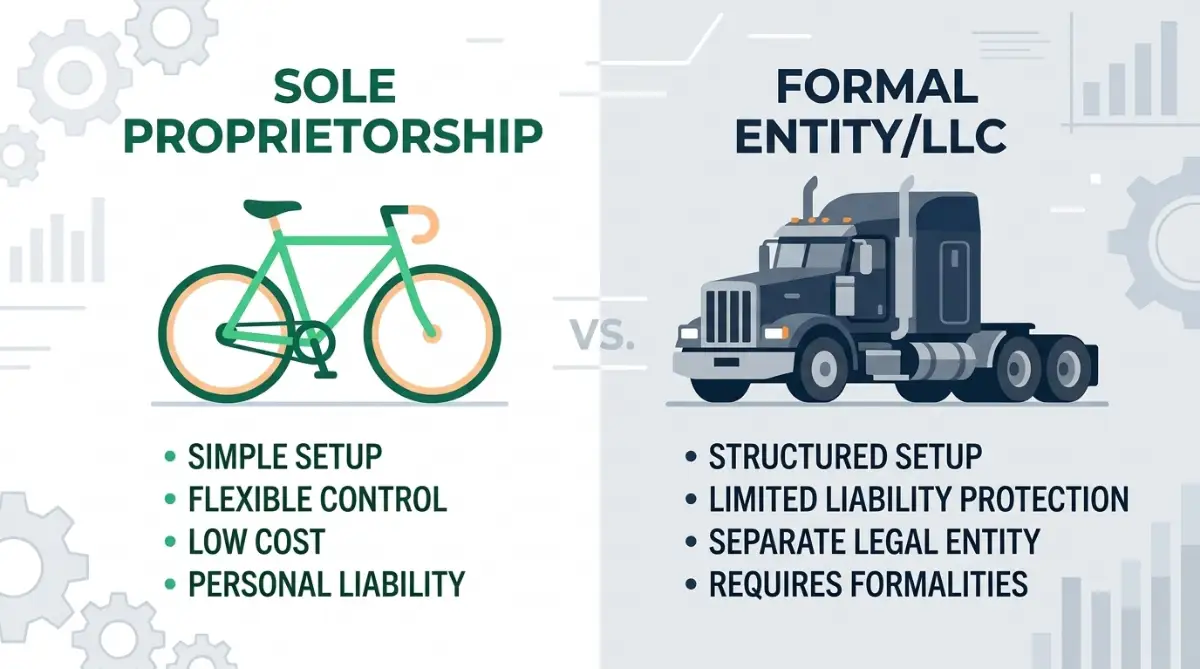
To help you visualize the choice, think about the trade-off. A sole proprietorship is like a lightweight bike—fast, easy to maintain, but not great for hauling massive cargo. A formal entity is like a heavy-duty truck—it can handle a lot, it is safer in crashes, but it is expensive to run and requires a lot of maintenance.
You wouldn't use a semi-truck to go pick up a single loaf of bread. Don't use a complex legal structure to run a project that isn't ready for it. Choose the tool that fits the task at hand. If the task grows, upgrade the tool. It is simple, logical, and smart.
Final Perspective on Your Journey
Your goal is to build something valuable. The legal structure is just the container for your project, not the project itself. Don't spend all your time decorating the container while the contents are empty. Put your energy into the thing you are creating.
Everything else can be adjusted. You can register an entity in an afternoon once you have the money and the need. For now, focus on your customers, your skills, and your output. That is the surest way to build a sustainable and successful career, regardless of how your business is registered.
Taking Action Without the Noise
You are smarter than you think. You can navigate the legal world without being a lawyer by simply being attentive and asking the right questions. Stay away from the "you must do this" advice from people who don't know your specific project.
Trust your judgment. If you are doing honest work, providing value, and keeping your professional life organized, you are ahead of most people. Keep moving forward, keep learning, and keep focused on the work that actually brings in the results. Your success is in your hands, not in a stack of registration forms.
Master Your Workflow with Smarter Systems
Now that you have decided to keep your project structure lean, how do you actually handle the professional side of things without losing your mind? Operating a business project without a complex entity does not mean you operate without discipline. In fact, when you run a simpler operation, you have to be even sharper with your organization.
The Paper Trail Advantage

You need to become best friends with your documentation. Even if you are a sole proprietor, you should treat your business finances as if they were a separate entity. Create a dedicated bank account for your project revenue and expenses immediately.
This habit saves you from the "commingling" disaster where personal and business expenses get tangled. If you are curious about why this matters for your long-term success, check out this guide on managing personal budgets to see how clear tracking helps in the long run. When tax time rolls around, you will be glad you didn't have to dig through your grocery receipts to find your project expenses.
Contract Clarity as Your Shield
A formal business structure is just a piece of paper, but a well-written contract is a real-world tool. You can avoid most legal disputes by simply being extremely clear about what you are providing and what you expect in return. Never start work on a project without a written agreement, even if it is just a simple email confirmation of the scope.
If you are worried about your professional capabilities, bridging the professional skill gap by using modern tools can actually make your contract work easier. Automate your invoices, automate your project delivery tracking, and keep a digital paper trail of every agreement. This is far more effective for preventing problems than relying on the "corporate veil" of an LLC.
Insurance: The Quiet Protector
Many entrepreneurs forget about the power of simple liability insurance. You can get a general liability policy that covers your business activities for a fraction of the cost of forming and maintaining an entity. Organizations like the U.S. Small Business Administration (SBA) provide excellent resources on why insurance is often the smartest first investment for a new project.
It provides a level of protection that acts like a safety net while you are still finding your footing. When you have insurance, you are saying that you take your work seriously. It also gives your clients peace of mind. They don't care if you have an LLC; they care that if something goes wrong, there is a process in place to handle it.
Keeping Your Reputation Clean
Your name is your brand, and in the early stages, your reputation is the only business structure that matters. If you deliver high-quality work, respond quickly, and act with integrity, you will grow. If you do sloppy work, no amount of legal protection will save your business.
Stay updated on how your work impacts your life. Sometimes, we get so wrapped up in the "business" side that we neglect our own stability. For example, if your business stress is affecting your ability to plan for the future, you might want to look into smart dividend investing to keep your personal financial health on track. A stable personal life makes you a better, more focused business owner.
The Power of Networking
You don't need a corporate board of directors, but you do need a support system. Find a mentor or join a local group where you can discuss your project challenges. SCORE is a fantastic resource for entrepreneurs looking for free, expert mentoring. Getting advice from someone who has "been there, done that" is worth more than any legal manual you could read.
They can help you decide when the right time is to shift from a sole proprietorship to something more formal. They will look at your revenue, your risk, and your goals. They will give you the perspective that a generic online article never can. Always seek human advice over robotic, one-size-fits-all legal templates.
Navigating the Traps That Trip Up New Owners
We all want to succeed, but sometimes our enthusiasm leads us into mistakes that actually hurt our projects. The biggest error is getting distracted by the "fun" part of starting a business—like picking a logo or filing for an entity—instead of doing the hard work of finding clients.
The Premature Expansion Trap
Many people register an entity because it makes them "feel" like a business owner. They waste weeks picking a name, designing a website, and filling out government forms before they have sold a single item. This is a classic example of the silent killers that cause startups to fail. You end up building a fancy storefront for a shop that has no customers.
Don't let the legal stuff give you a false sense of security. If you don't have customers, you don't have a business—you have a hobby. Focus all your energy on getting that first "yes" from a client. Everything else is secondary to that one goal.
Ignoring Tax Realities
A common mistake is thinking that forming an entity automatically saves you money on taxes. In reality, it often makes your taxes more expensive to file and more complex to manage. You might pay more in accountant fees than you save in taxes for several years.
Before you jump into a formal structure for tax reasons, sit down with a tax professional. They can show you the math. Often, the savings don't kick in until your business reaches a specific, high-profit threshold. Until then, the sole proprietorship is often the most cost-effective way to operate.
Mixing Finances Unnecessarily
Even if you don't have an LLC, do not pay for your personal groceries from the same account where your project clients pay you. It is a messy habit that is hard to break later. It also makes it impossible to see if your project is actually profitable.
You need to know your numbers. If you aren't tracking your income and expenses, you are flying blind. Use a simple spreadsheet if you have to, but keep it separate. It’s about building the mindset of a business owner, not just the legal structure.
Neglecting Contractual Protection
Some people think, "I don't need an LLC, so I don't need a contract either." This is the exact opposite of what you should do. If you are operating without a formal entity, you must use strong contracts. Your contract is your only barrier between you and a dispute.
Don't rely on "gentleman's agreements" or handshake deals. Always get the terms of the project in writing. Nolo provides great, plain-English guidance on how to write simple agreements that protect your interests. It doesn't have to be a 50-page legal document; just be clear, be specific, and be fair.
Moving Forward: Your Action Plan for Success
You have the tools and the perspective to move forward with confidence. You don't need to over-complicate your life to be successful. The best business model is the one that allows you to focus on the work you love while keeping your risks manageable.
Your Path to Growth
- Validate Your Idea: Spend your time getting clients, not filling out forms.
- Keep Records: Use a separate account and track every penny from day one.
- Protect Yourself: Get professional liability insurance instead of rushing into an entity.
- Use Contracts: Always define the scope of your work in writing.
- Re-evaluate: Once your business is consistently profitable, consult a pro about forming an entity.
This approach keeps you agile and focused. You are building a foundation based on real results, not just paperwork. If you ever find yourself getting overwhelmed by legal concerns, remember to check in on your personal well-being. If you find your stress levels rising due to project uncertainty, why mental health check-ups are just as essential as physical screenings is a topic you should prioritize to keep your head in the game.
A Note from My Experience
I have been in your shoes, staring at the forms and feeling the pressure to "be official." I learned that the hard way—I spent money I didn't have on a legal structure I didn't need. My advice is to trust your own ability to generate value first. If you keep your focus on the work, the rest will fall into place when the time is truly right. You have got this, and the world is waiting to see what you create.
Common Questions About Project Legalities
Do I need a lawyer for every single project I do?
No, you don't. For most small, low-risk projects, you can use standard contract templates or clear, written emails to define your agreements. You only need a lawyer when you are dealing with large sums of money, complex regulations, or high-risk industries.
Is it hard to change my business structure later?
It is actually quite common to start as a sole proprietorship and transition to an LLC or corporation later. Many successful businesses do this once they reach a certain level of revenue or risk. It is a sign of growth, not a failure of your initial strategy.
What is the biggest sign that I should form an LLC?
The biggest sign is when your liability risk starts to exceed what your insurance can cover, or when you start hiring employees. Until then, focus on making your project a reliable source of income.
If I don't register, will the government penalize me?
You don't necessarily have to "register" as a business entity to operate, but you must report your income for tax purposes. You still need to pay your self-employment taxes, regardless of your business structure. Always keep your tax records in order to stay in the clear.
Can I have a business name without an LLC?
Yes, in many places you can register a "Doing Business As" (DBA) name. This allows you to operate under a specific brand name while still being a sole proprietorship. It is a great way to look professional without the overhead of a formal entity.
Disclaimer: This article is for informational and educational purposes only and does not constitute legal or financial advice. Business laws, tax regulations, and liability rules vary significantly by jurisdiction. Before making any decisions regarding your business structure, tax filings, or legal strategy, please consult with a qualified attorney or certified public accountant in your area.