The Morning I Thought My Insurance Failed Me
You think you’re protected until the insurance adjuster says those three words: "Claim is denied." It’s the ultimate financial sucker punch. We pay for peace of mind, but if you don't know the specific rules of your policy, you’re just paying for an empty promise. Here is the reality of why claims get rejected and how you can lock down your protection today.
I called my insurance agent immediately, ready to get the paperwork moving. The agent was polite, but as they started explaining the details, my heart sank. They mentioned "perils," "deductibles," and specific exclusions. It turned out that while I was covered for the tree limb, my understanding of what that coverage truly entailed was completely off. I had assumed it was a magic shield against any bad luck that befell my car.
The realization hit me hard: I had been paying premiums for years without actually knowing the boundaries of my protection. That day wasn't just about a damaged hood; it was about the uncomfortable truth of being underinsured in the areas I thought were safe. My peace of mind shattered along with the windshield. I had to pay out of pocket for things I swore were included in my plan.
The 60-Second Policy Audit
Before you panic about your insurance, check these 3 things:
- Deductibles Matter: Don't pick a $1,000 deductible if you don't have $1,000 in your savings.
- Comprehensive vs. Collision: Know the difference—it determines if you get paid for pothole damage vs. theft.
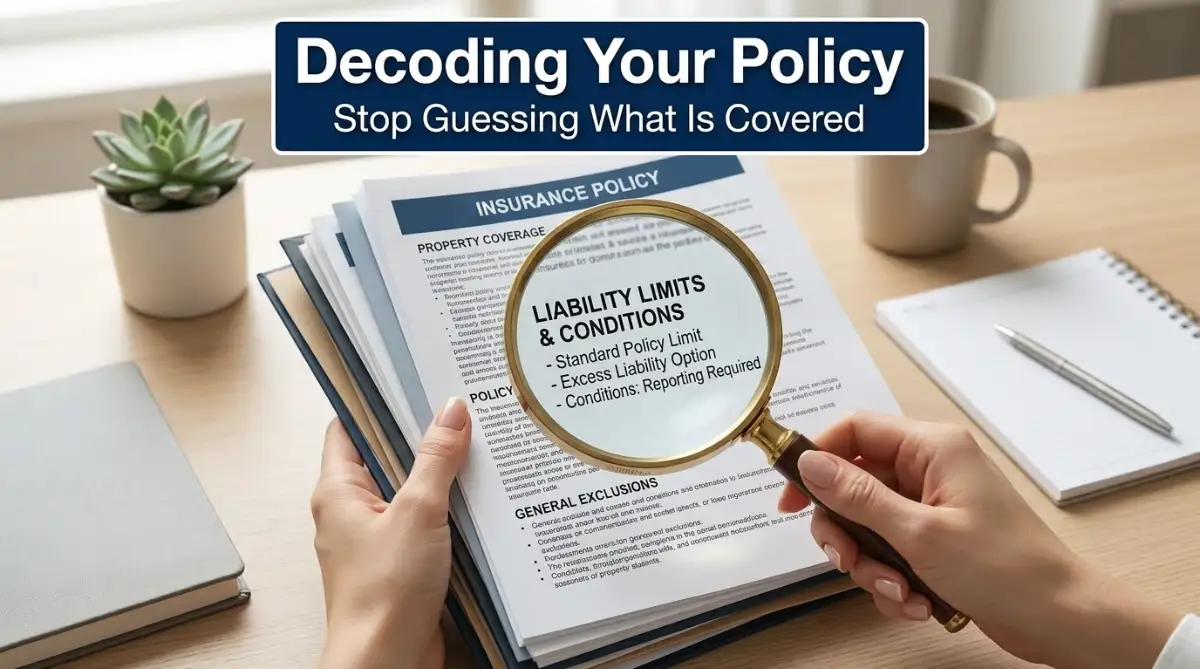
- The Declarations Page: This is the only page in your policy that lists your real coverage and limits. Read it today.
What Does Comprehensive Coverage Actually Mean?

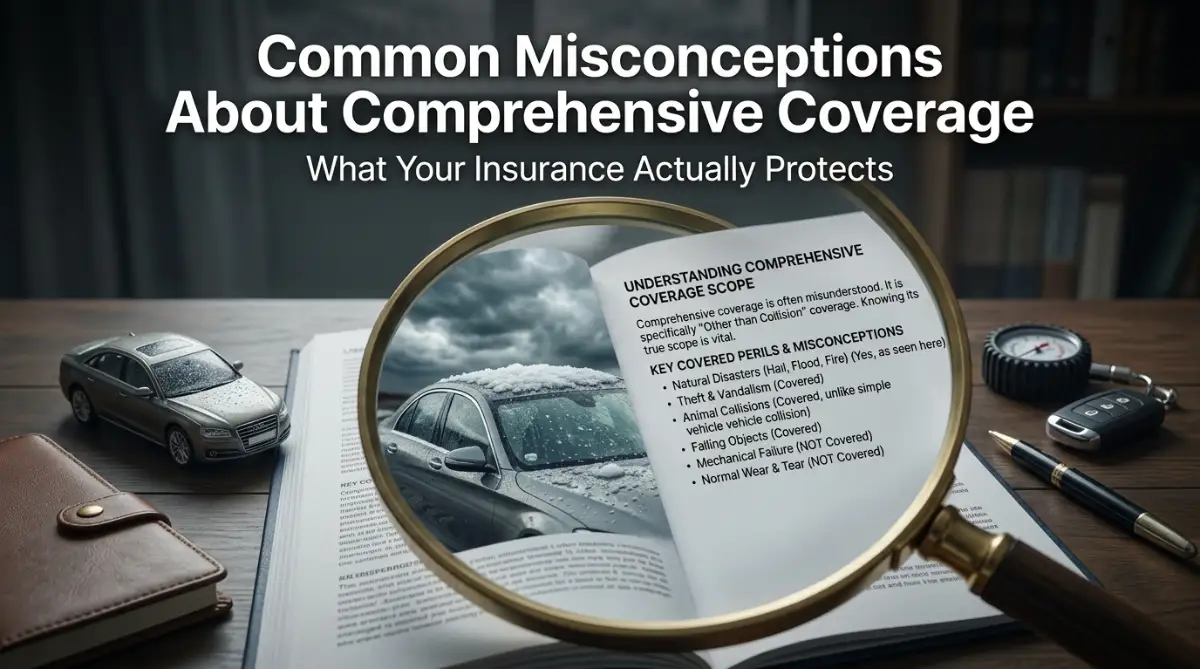
There is a massive amount of confusion surrounding the term "comprehensive." People often treat it as the "everything" button on a control panel. In reality, it is much more specific. In the insurance world, comprehensive coverage is technically defined as "Other than Collision."
The “Other Than Collision” Rule
Think of your car insurance policy as having two different lanes. Collision coverage generally helps pay for damage to your vehicle when you collide with another vehicle or an object, such as a fence, pole, or building. Comprehensive coverage, on the other hand, generally applies to certain types of damage that happen outside of a collision.
This is why comprehensive coverage is often described as “other than collision” coverage. It can help with situations such as theft, vandalism, fire, falling objects, and certain types of glass damage, depending on your policy.
For example, if a tree branch or entire tree falls onto your parked car, that may be a comprehensive claim. If someone deliberately scratches or keys your vehicle, the resulting damage may also fall under comprehensive coverage because it is considered vandalism rather than a collision.
One important point: coverage details and exclusions vary by policy and insurer, so always check the specific terms of your policy before assuming a particular type of damage is covered.
The Myth of "Full Protection"
The biggest mistake people make is believing that "comprehensive" equals "full coverage." There is no single insurance product that covers every possible scenario. Even with comprehensive, there are lists of exclusions. For example, it does not cover normal wear and tear.
If your engine blows up because you forgot to change the oil, that is not a comprehensive claim. It is a maintenance issue. Insurance companies protect against accidents and sudden, unexpected events. They do not act as a warranty for your car's mechanical health.
Addressing the Pothole Confusion
Pothole damage is one of the most common areas of confusion when people compare comprehensive and collision coverage. If you drive over a deep pothole and damage your tire, wheel, suspension, or alignment, you might assume comprehensive insurance will pay because you did not crash into another vehicle.
In most cases, however, pothole damage is treated as a collision claim. The reason is that your vehicle made an impact with an object—the road surface itself. Collision coverage is generally designed to handle damage caused when your vehicle strikes another vehicle or object, including certain road hazards.
This distinction matters when choosing your coverage. If you have comprehensive coverage but no collision coverage, you may find that pothole-related vehicle damage is not covered under your policy.
Always check your specific policy, because coverage rules, exclusions, deductibles, and claim handling can vary by insurer and location.
The Financial Reality of Deductibles
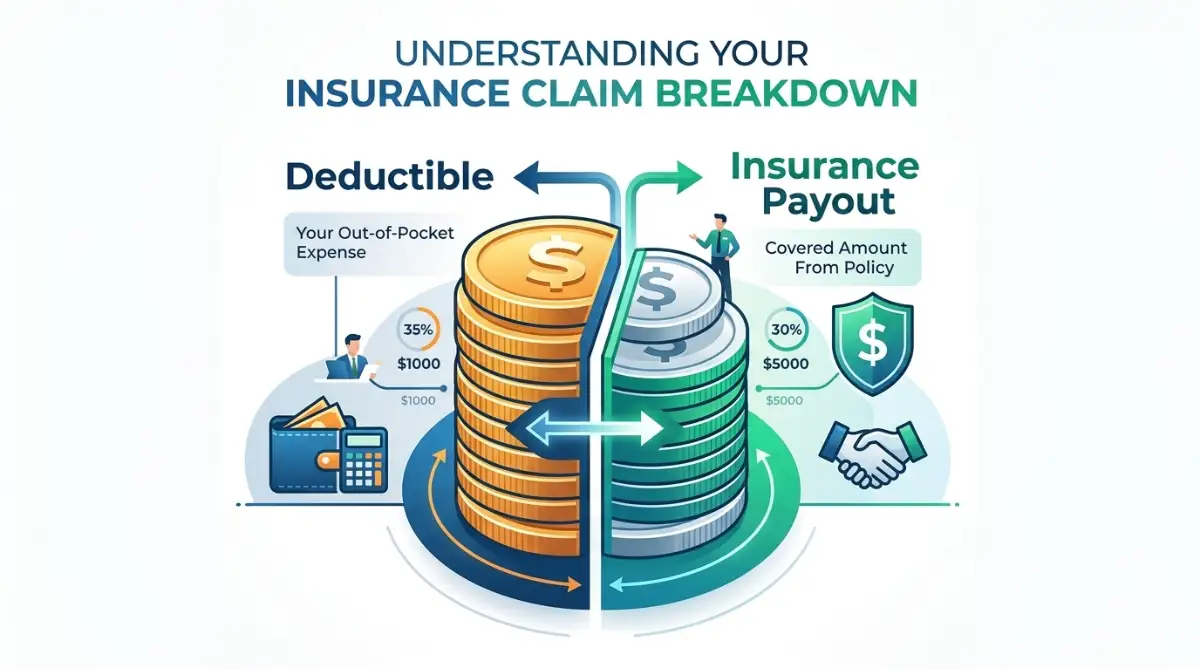
Many people choose a high deductible to keep their monthly premiums low. It sounds like a smart financial move until the damage actually happens. When you file a claim, the insurance company subtracts your deductible from the settlement amount.
If your car suffers $2,000 in damage and your deductible is $1,000, the insurance company only pays $1,000. You are responsible for the rest. This gap can be a shock if you haven't planned for it. It is important to know how these numbers interact with your personal budget. For a deeper look at how to manage these financial gaps, you can read more about understanding the gap between deductibles and out-of-pocket limits.
Why Claims Get Denied
It is frustrating to think you are protected, only to have a claim denied. Often, the reason for denial is simply a lack of documentation or a misunderstanding of what the policy covers. Sometimes, the damage is considered "pre-existing," meaning it happened before you bought the policy or before the specific incident you are claiming.
The Denial Prevention Checklist
Before you hit "Submit" on that claim, ensure you have:
- Time-stamped Photos: Take pictures of the damage and the surrounding area.
- Police Report: Essential for theft, vandalism, or major accidents.
- Maintenance Proof: Keep records of oil changes and repairs to prove the car was in good shape.
- Policy Copy: Have your "Declarations Page" handy to reference your exact deductible.
Insurance companies are rigorous about verifying the cause of loss. If you say a tree fell on your car, they will look for evidence. If the damage looks like it came from a collision that you didn't report correctly, they will deny the claim. To protect yourself and understand why these denials happen, check out this guide on why home insurance companies deny claims and how to stay protected. While that link focuses on home insurance, the principles of documentation and policy honesty apply directly to auto insurance as well.
Pro Tip: The "Declarations Page" is Your Best Friend
I used to ignore the "Declarations Page" that comes with every renewal packet. I assumed it was just legal filler. I learned the hard way that this single page is the most important document in your policy. It lists exactly what coverages you have, your limits, and your deductibles. Take ten minutes today to find it. If you see "Comprehensive: $500 Deductible," that is the number you need to keep in your savings account for a rainy day.
Watch This to Understand Your Coverage
Visualizing how these policies work can make a huge difference. Sometimes hearing it explained clearly helps the concepts stick better than just reading about them.
This video breaks down the difference between common insurance terms so you can check your policy with confidence:
Common Myths That Cost You Money
Beliefs can be expensive. When you operate based on misconceptions, you expose yourself to financial risk. Let’s break down a few more common myths that catch people off guard.
Myth 1: It Covers Rental Cars
Some people think their comprehensive coverage automatically extends to a rental car they pick up at the airport. This is often not true. Rental car protection is usually a separate add-on or requires a specific policy endorsement. Do not assume you are safe just because you have full coverage on your personal vehicle.
Myth 2: It Covers Your Personal Belongings
If your car is broken into and your laptop, phone, or camera is stolen, you might assume your comprehensive auto insurance covers those items. This is rarely the case. Auto insurance covers the car itself, not the personal items inside it. Your homeowners or renters insurance policy is usually where that claim belongs.
Myth 3: It Covers "Acts of God" Without Question
While comprehensive coverage does cover events like hail, storms, and floods, it isn't a blank check. If you intentionally drive your car into a flooded street because you think, "Hey, it’s comprehensive," the insurance company might label that as "reckless behavior" or "gross negligence." They have the right to deny claims if your actions directly contributed to the damage in an avoidable way.
How to Audit Your Coverage Today
You don't need to be an insurance expert to take control. You just need to be diligent. Here is a simple plan you can follow this weekend to ensure you aren't caught off guard.
1. Request Your Full Policy Document
If you don't have a copy, ask your agent or download it from your insurance provider’s portal. Don't look at the summary; look for the "Exclusions" section. This section tells you exactly what they won't pay for. It is boring reading, but it is the most honest part of the contract.
2. Verify Your Deductible
Ask yourself: "If something happened today, do I have this amount in my savings account?" If the answer is no, you might be better off raising your premiums slightly to lower your deductible. Or, you need to start an emergency fund specifically for this gap.
3. Check for Add-Ons
Some insurers offer "Glass Coverage" as a specific add-on. If you live in an area with a lot of gravel trucks or severe storms, this might be worth it. It often has a lower deductible—or no deductible at all—compared to your standard comprehensive deductible.
4. Ask "What If" Questions
Call your agent. Don't be afraid to sound uninformed. Ask them, "What happens if a deer hits my car?" or "What happens if I encounter a flood?" Their answers should match your policy documents. If they say something that isn't in writing, ask them to show you where it says that in your policy.
The Relationship Between Your Credit and Coverage
Many people don't realize that their insurance rates can be influenced by factors outside of their driving record. In many places, insurers use credit-based insurance scores. This doesn't mean your credit card limit, but it means they use your financial history to predict risk.
If you have been working hard to improve your financial habits, it might be time to ask your insurance company for a rate review. They may not do it automatically. You have to be the one to pick up the phone and ask, "Are there any discounts I am missing?" or "Can we review my rate based on my current profile?"
Understanding Depreciation and "Total Loss"
A common shock comes when an older car is damaged. You might think, "The repair costs $3,000, and my car is worth $5,000, so they will pay for it." However, insurance companies evaluate the "Actual Cash Value" (ACV) of your vehicle.
If the cost to repair the car is close to the ACV, the insurance company will declare it a "total loss." They won't fix it; they will write you a check for what they deem the car is worth. This is often much less than what you think the car is worth. Comprehensive coverage doesn't protect you against depreciation. It protects you against the event, not the declining value of your vehicle.
Taking Charge of Your Insurance Journey
Insurance is a tool. Like any tool, you need to know how it works to use it properly. When you stop treating your policy as a mysterious black box and start treating it as a financial contract, you gain power.
You are not just a customer paying a bill. You are a partner in a risk-management agreement. When you know what is covered and, more importantly, what is not, you can make better decisions. You might choose to set aside more savings. You might choose to park in a garage instead of the street. You might choose to upgrade your policy to include roadside assistance or rental reimbursement.
The goal isn't to be paranoid about every potential event. The goal is to be prepared. When you understand your coverage, you sleep better. You stop wondering "what if" and start feeling confident that you have a plan.
Take the time to review your documents. Ask the hard questions. If you find gaps, address them now, before you are standing in your driveway with a damaged car and a sinking feeling. You have the ability to make your insurance work for you, not against you. Stay informed, stay prepared, and keep your financial future secure.
Mastering Your Policy: Advanced Strategies for Smart Protection
Taking the time to understand your policy is a step most people never take. While most drivers just look at the premium price and hope for the best, you can go deeper. By learning how insurance companies actually classify damage, you gain leverage. This isn't just about reading a contract; it is about knowing how to advocate for yourself when things go wrong.
The Secret of OEM Endorsements
A common issue I see is the disagreement over repair quality. Many standard comprehensive policies allow insurance companies to use "aftermarket" or generic parts to fix your car after a covered loss. These parts might not fit perfectly or match the safety standards of the original equipment.
If you own a newer vehicle, you should ask your agent about an OEM endorsement. This stands for "Original Equipment Manufacturer." When you have this added to your policy, the insurance company is contractually obligated to use parts made by your car’s manufacturer rather than cheaper alternatives. It adds a small amount to your premium, but it protects the value and safety of your vehicle significantly.
Periodic Policy Audits
Your life changes, and your policy should change with it. Most people renew their insurance year after year without making a single change. This is a mistake. You should review your policy every time you have a major life update. Have you moved? Did you install a high-end security system? Did you pay off your car loan?
These life changes can directly impact your rates or the type of coverage you actually need. If you are curious about why your premiums might be shifting over time, reading about why your insurance rate goes up can help you understand the underwriting process. An informed policyholder is always in a better position than a passive one.
Understanding the "Gap" Between Reality and Coverage
Many drivers do not realize that they are often sitting in the underinsurance trap. This happens when your policy limits are lower than the actual cost of replacing or repairing your vehicle in today’s market. Inflation affects car parts and labor just as much as groceries.
If your policy was set up years ago, you might be carrying limits that no longer make sense. Review your "Declarations Page" and compare your total coverage limits against what it would cost to buy a similar car today. If there is a massive difference, talk to your agent about adjusting your limits. It is a simple step that provides massive peace of mind.
The Importance of Proper Documentation
I cannot stress this enough: documentation is the backbone of every successful claim. When an incident occurs, you should treat it like a legal case. Take photos from every angle, not just of the damage, but of the environment. If a tree fell on your car, take pictures of the tree, the branch, and the surrounding area.
If you are confused about what to keep, mastering your insurance claims through essential documentation is a skill that saves money. Keep a digital folder on your phone for all your receipts, police reports, and repair estimates. The more organized you are, the faster your claim moves. The National Association of Insurance Commissioners provides great resources on what information you should have on hand before filing.
Dealing with Deductibles Strategically
We often look at deductibles as a gamble. We choose a high deductible to save on monthly costs, assuming we will never have a claim. If you choose this path, you must ensure you have that deductible amount sitting in a savings account.
If you don't have the cash, that high deductible becomes a liability rather than a strategy. Understanding the gap between deductibles and out-of-pocket limits is the best way to determine which deductible level is actually right for your financial situation. Never set a deductible that would force you to go into debt just to fix your car.
Blind Spots: Dangerous Assumptions That Can Cost You Thousands
It is easy to fall into the habit of thinking, "I’ve been paying for this for years, so I am safe." This mindset is exactly what leads to heartache when a claim is denied. We often assume that our insurance company is our partner, but their business model is based on risk management. They only pay for what is strictly written in your contract.
The "Auto-Renewal" Trap
One of the biggest mistakes is letting your policy auto-renew without ever checking the coverage details. Insurance companies update their forms and exclusions frequently. What was covered two years ago might not be covered today.
If you don't read your renewal documents, you might find that your coverage for specific "perils" has been narrowed. You might even find that you are paying for optional coverage you no longer need. Set a reminder to review your renewal packet every single cycle. Do not just look at the total amount due; look at the coverage breakdown.
Forgetting to Update Your Insurer
Did you move to a new area with a higher crime rate? Did you start parking your car on the street instead of a garage? You might think this is private information, but it affects your risk profile.
If you don't inform your insurer of these changes, and you eventually file a claim, they may use the "misrepresentation" card to deny you. It sounds harsh, but it happens. If your situation changes, send a quick email to your agent. Document that you made the disclosure. This simple step keeps your policy "clean" and protects you from future claim denials.
The Myth of "Full Coverage" Versatility
I have met people who thought "full coverage" meant they were protected even if they drove into a hazardous area that was off-limits. They assumed the insurance would cover the car regardless of their decision-making. This is a dangerous way to look at the world.
Insurance companies have a clause often referred to as "gross negligence." If you willfully drive into a flooded street after being warned, or if you leave your car unlocked with the keys inside in a high-crime area, the insurer might claim you contributed to the loss. This isn't just about having the right insurance; it is about making safe, sound decisions. Always operate your vehicle with the same caution you would if you had zero insurance coverage.
Relying on Verbal Promises
Have you ever spoken to an agent on the phone who said, "Oh, don't worry, that’s covered," and you believed them without seeing it in writing? This is a recipe for disaster. If it isn't in your policy document, it doesn't exist.
Always ask the agent to email you the specific page or clause that supports their statement. If they can't find it, they are likely mistaken. You need the protection of the written contract, not the memory of a phone conversation.
Ignoring Local Laws and Regulations
Insurance requirements vary wildly depending on where you live. The Insurance Information Institute offers great summaries of state-specific laws. If you move across state lines, your old policy might not meet the minimums or the standards of your new home.
Don't assume your current coverage travels perfectly with you. Take the time to check the local requirements of your new area. Failure to do so can result in fines, or worse, finding out you are driving illegally without the proper coverage levels.
Your Path Forward to Total Peace of Mind
You are now equipped with knowledge that most drivers will never take the time to learn. You understand that "comprehensive" doesn't mean "everything." You know that your declarations page is the most important document in your glovebox. And you know how to audit your policy to find the gaps before they become real-world problems.
This isn't about being cynical or expecting the worst. It is about being a savvy consumer who respects their own hard-earned money. When you have a solid plan, you spend less time worrying about "what if" scenarios. You can drive with confidence knowing that you have done the homework.
My own journey with insurance started with a frustration just like yours—a denied claim that felt unfair but was ultimately my own fault for not knowing the details. I turned that experience into a habit of reading every single page of my renewals. Now, I never feel that sinking feeling of being surprised by a claim denial. I know exactly what I am paying for, and I know exactly what I am protected against.
I encourage you to take one action today. Pull out your policy, look at the comprehensive deductible, and verify the coverage limits. You might find you are overpaying, or you might find you are underinsured. Either way, you will be in the driver’s seat. Taking control of these details is the most powerful thing you can do for your financial safety.
Common Questions About Your Insurance Policy
Is comprehensive coverage legally required?
In most places, no. Lenders usually require it if you are financing or leasing your car because they want to protect their asset. If you own your car outright, you are generally not required to carry it by law, though it is usually a smart idea.
Does comprehensive coverage increase my premiums if I use it?
Generally, comprehensive claims have less impact on your premiums than collision or liability claims because they are often considered "no-fault." However, filing multiple claims in a short period can lead to higher rates or even policy non-renewal. Use it when you need it, but try to pay for very small repairs out of pocket if you can.
What should I do if my insurance company denies a valid claim?
Start by asking for a written explanation of the denial, citing the specific policy language they are using. If you disagree, you can appeal the decision through their internal process. You can also reach out to your state's Department of Insurance if you feel you are being treated unfairly.
Does the age of my car affect whether I should keep comprehensive coverage?
Absolutely. As your car ages, its value drops. If the cost of the premiums plus the deductible is high compared to the value of the car, you might decide to drop it. A good rule of thumb is to weigh the cost of the coverage against what you would receive if the car were totaled.
Can I have comprehensive coverage without collision coverage?
Yes, you can choose to have comprehensive without collision. This is often done by people driving older, paid-off vehicles who want protection against theft and weather but are willing to risk the cost of a standard collision accident. Just be aware that you would have zero coverage if you hit another vehicle.
How often should I re-evaluate my insurance needs?
You should review your insurance policy at least once a year, or whenever you experience a "life event." Moving, marriage, buying a new home, or changing jobs are all signals that you should take a fresh look at your coverage limits.
Disclaimer: This content is for educational purposes only and does not constitute financial, legal, or insurance advice. Every insurance policy is unique, and coverage terms vary by state, country, and specific provider. Always consult your insurance contract or speak with a licensed insurance professional before making decisions about your coverage. All financial or insurance decisions should be made based on your specific circumstances and the official documents provided by your insurer.