The Moment I Realized My Policy Was Just Paper
You assume your homeowners insurance covers everything in a disaster, but that assumption is often where the biggest financial traps hide. Most policies are written to pay the bare minimum, not the actual cost of rebuilding your life. If you aren't reading the fine print today, you are essentially gambling with your family's biggest asset. Let’s break down how to audit your policy so you are actually protected when the worst happens.
I had always assumed that if the worst happened, the "homeowners insurance" I paid for every month would simply handle it. But as I read the fine print, my stomach turned. I realized I had no idea what my coverage limits were. Did my policy cover flood damage? What about wind? I had just been paying the bill and trusting that the word "insurance" meant "everything is taken care of."
That night, I realized that a policy is just a piece of paper until it is tested. And if that paper doesn't match the reality of your biggest risks, it is virtually useless. That feeling of uncertainty—the "what if"—is something no homeowner should live with. It is a weight that sits on your shoulders, and it only gets heavier when the sky turns gray.
We live in a world where the weather is becoming less predictable. The risks to our property are real and they are growing. Yet, most of us operate on the hope that "it won't happen to me." That isn't a plan; that is a gamble. You deserve to know that when you pay for protection, you are actually getting it. It is about moving from a place of hoping for the best to being prepared for whatever comes your way.
The Property Protection Blueprint
- Replacement Matters: Always opt for 'Replacement Cost' over 'Actual Cash Value'.
- The Fine Print: Check for standard exclusions like floods, earthquakes, and sewer backups.
- Audit Your Limits: Ensure your coverage limit covers the rebuild cost, not the market value.
- Proactive Records: Digital inventory and video evidence are your best friends during a claim.
Decoding Your Declarations Page
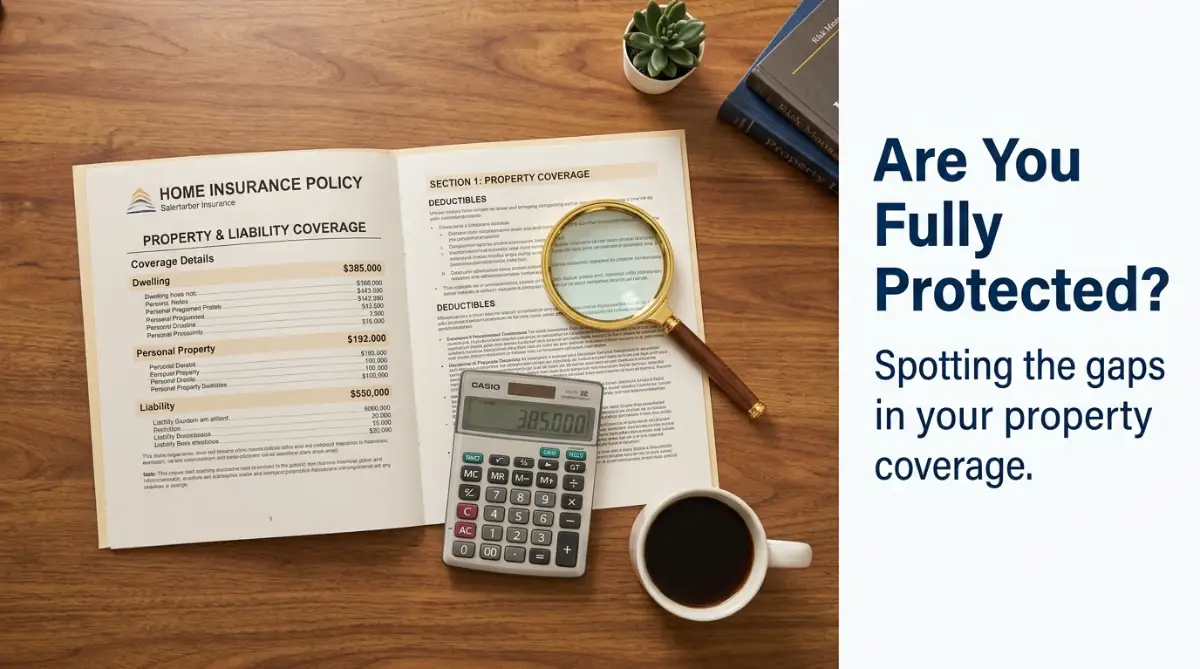
You do not need to be a lawyer to understand your home insurance. You just need to know where to look. The most important page in your entire policy binder is called the "Declarations Page." This is the snapshot of your coverage. It lists the dollar amounts and the specific types of damage you are protected against.
The Limits of Your Coverage
Your policy has a "limit." This is the maximum amount the insurance company will pay if your home is destroyed. Many people don't realize that the value of their home on the real estate market is different from the cost to rebuild it. If your coverage limit is based on your purchase price from a decade ago, you might be severely underinsured today because building costs have gone up significantly.

Replacement Cost vs. Actual Cash Value
This is a term that catches people off guard. "Actual Cash Value" means the insurer pays you what the item was worth at the time of the loss, taking into account how old it was. If your roof was ten years old, you get the value of a ten-year-old roof. "Replacement Cost" is much better. It covers the cost to buy a brand-new roof today, even if your old one was worn out.
| Feature | Actual Cash Value (ACV) | Replacement Cost |
| :--- | :--- | :--- |
| Payout | Based on current depreciated value | Based on new cost to replace |
| Cost | Cheaper monthly premium | Slightly higher premium |
| Risk | High (You pay the difference) | Low (Insurer pays to rebuild) |
The Exclusion List
Insurance policies are written to tell you what is not covered just as much as what is. Read the exclusions carefully. Many standard policies do not cover floods, earthquakes, or sewer backups. If you live in an area prone to these, you likely need a separate policy or a specific "rider" (an add-on) to get protected. Do not assume your basic plan has your back for these major disasters.
Practical Steps to Assess Your Risk
You need to take an inventory of your home. This sounds tedious, but it is the only way to be sure. Walk through every room of your house with your smartphone camera. Open every drawer, film the inside of your closets, and record the brand names of your electronics and appliances.
Quick Disaster Readiness Checklist:
- Digital Copies: Save policy and receipts in a secure cloud drive.
- Local Maps: Check your specific street on FEMA or local hazard maps.
- Liability Check: Confirm if your current limit covers your total net worth.
- Agent Contact: Keep your agent’s direct cell or office number in your phone contacts."

Consulting with Your Agent
Pick up the phone and call your insurance agent. Don't wait for renewal time. Ask them: "If I lost everything in a windstorm tomorrow, what is the maximum amount I would receive?" Listen to the answer. If the number feels low, ask them for a quote to increase your coverage. You might be surprised at how cheap it is to buy peace of mind.
Checking Your Neighborhood Risks
Go to a government website that tracks hazard maps. See if your property is in a high-risk flood zone or an area known for seismic activity. Insurance companies use these maps to set your rates, and you should use them to set your expectations. If the maps say you are at high risk, your standard policy is likely missing critical pieces of protection.
Pro Tip: My Realization on Personal Liability
I learned that my policy had a liability limit that was far too low. If someone was injured on my property during a disaster—like a neighbor slipping on a downed branch—I could have been personally sued for the difference. I increased my liability limit for just a few extra dollars a month. It was one of the smartest changes I made. You are not just insuring your house; you are insuring your entire financial future.
Want to see how the experts handle property disaster coverage? Watch this guide to prepare for your home's safety.
Many homeowners think their job is done once they pay the premium. Your job is to be an active participant in your own protection. You are the one who knows what is inside your walls. You are the one who knows the upgrades you have made to your property. If you don't tell your insurer, they won't know. Update your policy whenever you do major renovations.
Staying prepared is about doing the work while the sun is still shining. It is not about living in fear of the next big storm. It is about having the confidence to look at the forecast and know that if the worst happens, you have a solid plan in place. You are protecting your family, your memories, and your financial foundation. That is a duty worth taking seriously.
Smart Moves for Total Property Protection
Once you have your basic inventory done, it is time to move from being reactive to proactive. Many homeowners stop at just checking their policy limits, but true security requires you to anticipate how the claims process actually works. You want to make sure your coverage is not just a theoretical number on a page, but a real lifeline that works when the pressure is on.
The Power of Gap Analysis
Most standard policies are full of tiny holes that add up to a big problem. You should look for coverage called "law and ordinance" protection. This covers the extra costs you face when you have to rebuild a damaged home to meet modern building codes. Many people forget that building standards change over time, and if you have to upgrade your wiring or structural materials, your standard policy might not pay for it.
You can dig into the specific definitions of these coverages at the National Association of Insurance Commissioners (NAIC), which provides a transparent look at how these standards differ by state. It is a smart move to understand these nuances before a storm hits. This is the difference between getting a full rebuild and being left with a massive bill to satisfy new building codes.
Documenting Your Upgrades
Every time you improve your home, you change the math of your replacement cost. Did you install new energy-efficient windows? Did you add a smart security system? Did you finish your basement? If you do not report these changes, your coverage limit remains stuck in the past.
You need to send your receipts to your insurer and ask them to update your replacement cost estimation. Think of your home as a business asset that needs constant updating. It is just like how to build a fail-safe emergency fund for your general finances; your home insurance needs a check-up whenever your assets change. If you don't update them, you are leaving protection on the table.
Understanding the "Duty to Mitigate"
Most policies have a clause that requires you to prevent further damage after a loss. If a tree falls through your roof, you cannot just walk away and let the rain soak your floors for a week. You are expected to cover the roof with a tarp. If you fail to do this, the insurance company can deny the claim for the interior water damage.
Keep a basic disaster kit on hand that includes heavy-duty tarps, duct tape, and basic tools. Being able to secure your home immediately is a pro-level habit. It shows the insurance adjuster that you took your responsibility seriously. If you have questions about claim denials and how to avoid them, you can look at my guide on why home insurance companies deny claims and how to stay protected.
Digital Documentation is Your Best Friend
Physical papers can be destroyed in the same disaster that damages your home. I always recommend keeping a digital folder in the cloud. Store your policy, your home inventory photos, and a list of contact numbers for your agent. You want to be able to access this from a smartphone even if your house is gone.
Also, think about the home network security guide to protect your privacy at home when setting up this digital vault. You don't want your home inventory and personal policy info to be hacked while you are trying to deal with a physical disaster. Keep your digital assets locked behind strong, unique passwords in an encrypted environment.
Leveraging Independent Assessments
Sometimes, your insurer's estimate of what it costs to rebuild your home is lower than the actual market cost. You can hire an independent contractor to give you a rebuild estimate. If their number is significantly higher than your insurer’s, you have the proof you need to request a coverage increase. You don't have to accept the company's first assessment as the final word.

Traps That Lead to Financial Ruin
We all want to believe that insurance is simple. But the reality is that the industry relies on the fact that most people don't read their policies until they absolutely have to. I have seen friends devastated because they assumed they were safe when they were anything but. Avoid these common traps if you want to keep your family wealth intact.
The "I'll Update It Later" Syndrome
This is the most common mistake. People think they will review their coverage next month, or after their next vacation, or when they have more free time. Disasters do not check your calendar. They happen on a random Tuesday, and if you haven't updated your policy to reflect your current renovations, you are effectively self-insuring the difference.
Treating Deductibles as an Afterthought
Some people pick the highest deductible possible just to lower their monthly premium. But if a disaster strikes and you have to pay a five-thousand-dollar deductible before the insurance kicks in, you might not have that cash sitting in your bank. If you can't cover your deductible, your policy is effectively useless in the moment you need it most. You need to balance your premium savings with your actual liquid savings.
Ignoring the Flood Gap
The biggest shock for many homeowners is finding out that their standard policy does not cover floods. They see water damage on their policy and assume that includes a flood from a rising river or a storm surge. It usually does not. If you are in a flood-prone area, you need a separate policy from a program like the National Flood Insurance Program. Don't wait until the water is at your door to learn this distinction.
The Inventory Blind Spot
People often think their inventory is "good enough" if they have a few photos of their living room. But can you prove what was inside your cabinets? Can you prove the value of your clothing or your tools? A generic photo of a room is often not enough to get a full payout. You need detailed lists, serial numbers, and receipts for anything of value.
Assuming Your Landlord Protects You
If you are renting a home or apartment, do not assume the owner's policy covers your stuff. It almost never does. You need your own renters insurance to cover your belongings and your liability. If you don't have it, you are one fire or theft away from losing everything you own.
Moving Toward a Secure Future
Protecting your property is a journey of active awareness. It isn't about constant worry; it is about taking the small steps that build a massive wall of defense around your family and your assets. When you know you are covered, you can sleep soundly, even when the wind picks up outside.
Action Plan for Tomorrow
- Pull your policy: Take out your declarations page and read it from top to bottom today.
- Run a rebuild cost check: Use an online calculator or talk to a contractor to see if your coverage matches current building costs.
- Audit your gaps: Check for missing flood or earthquake coverage if your area has these risks.
- Update your inventory: Add any new major purchases to your digital file immediately.
I have found that the more I look at my insurance and my coverage, the less I worry about the "what ifs." My insurance stops being a line item on my budget and starts being a partner in my security. I want you to feel that same sense of control. You are doing the work that most people are too afraid to do. You are taking responsibility for your future.
Start today. Make that call to your agent or take those photos of your home. It might take an hour of your time, but that one hour could be the most valuable investment you ever make. You are building a safe haven for your family, and that is a goal worth every bit of effort. Keep tracking, keep asking questions, and keep your home protected.
Common Questions About Property Protection
Can I increase my coverage limits mid-term?
Yes, you can usually increase your limits at any time during your policy period. You don't have to wait for the renewal date to request more protection. Just call your provider and ask to adjust your limits based on your updated property assessment.
What is the difference between flood insurance and water backup?
Flood insurance covers water coming from the outside, such as rising rivers or heavy rain pooling on the ground. Water backup usually covers internal issues, like a sewer line backing up into your basement. Both are important, and neither is usually included in standard home policies.
Will my rates go up if I file a small claim?
It is possible that your rates could rise after a claim, but that is the purpose of insurance. If you have a small issue that costs just a few hundred dollars, you might choose to pay it yourself to keep your claims history clean. But for major disasters, you should never hesitate to file a claim.
How often should I re-evaluate my home insurance?
Aim to review your coverage at least once a year, or whenever you make major changes to your home. Also, if there is a major shift in the local real estate market or building material costs, it is a smart time to update your policy.
Does my policy cover items I store in a garage or shed?
Most policies have specific language about structures that are detached from your home. You should check your policy to see if your shed or garage is covered and what the specific limits are for items stored inside them. You might need to add specific coverage if you keep expensive tools or equipment in those spaces.
Disclaimer: This content is for educational purposes only and does not constitute financial, legal, or tax advice. I am not a financial advisor. All insurance decisions involve risk, and you should perform your own research or consult with a qualified professional before making any choices based on your specific situation.