
When Your Hard Work Stops Paying Offf
Quick Pivot Checklist: Is It Time to Change?
- The Profit Gap: Are you spending more to get a customer than they are worth? If yes, change your acquisition strategy.
- The Silence Test: Are your customers ignoring your updates? Lack of feedback is often a sign of irrelevance.
- The Resource Drain: Are you pouring money into a 'sunk cost' just to prove you were right? It’s time to stop.
- The Team Barometer: Is your top talent looking for the exit? They usually see the business failure before the owner does.
"Most businesses don’t die from a single bad decision; they die from a slow, quiet refusal to change. You might be working harder than ever, yet your profit margins are shrinking. It’s a frustrating cycle of 'busy work' that feels like progress but isn't. If your gut feeling tells you the current strategy is hitting a wall, you don’t need to work longer hours—you need a better direction."
Most of us face this moment of truth at some point in our journey. It is a lonely, frustrating place where you question your competence and your choices.The stress starts to affect your sleep, your health, and even your relationships with family. You stop feeling like an entrepreneur and start feeling like a firefighter, constantly putting out small flames while the main building is burning down.
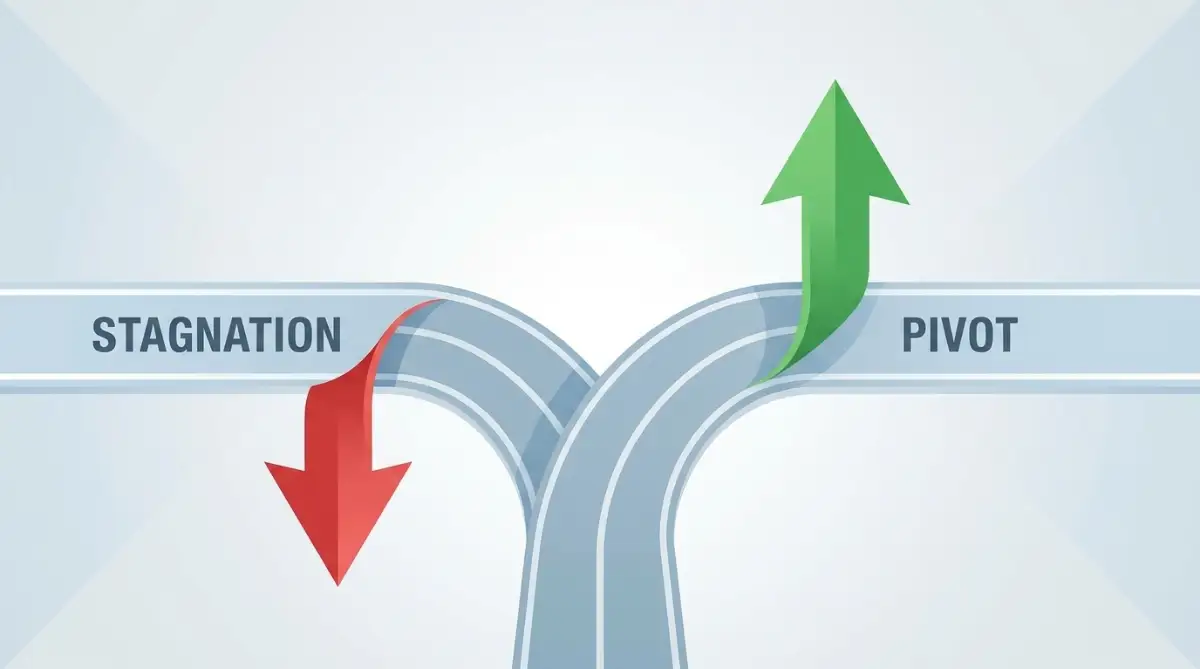
The problem is that we often view a pivot as a failure. We treat the act of changing direction as an admission that we made a mistake in the beginning. This mindset is dangerous. It keeps us locked in a cycle of suffering, clinging to a business model that no longer serves us. You are not a failure because your initial assumption was wrong. You are an entrepreneur who has gained new data. The real failure happens when you ignore that data and continue down a path that leads nowhere.
Analyzing the Silent Signals of a Business Shift
To understand if you really need a change, you have to stop looking at what you want to happen and start looking at what is happening. The market rarely lies, even if it is quiet about it. You need to become an observer of your own business performance. Start by looking at your customer acquisition costs versus the actual value they bring. If you are spending more money to bring a customer in than they are paying you over their lifetime, your foundation is shaky.
Many founders get caught up in the vanity metrics. You might have thousands of followers or high traffic on your website, but if that does not convert into sustainable profit, it is just noise. Ask yourself honestly: are these people actually using my product to solve a problem? Or are they just browsing because it is free or interesting? If the transaction is not happening, you do not have a business; you have a hobby.

Is Your Value Proposition Still Relevant?
Sometimes, the world changes around you, and you do not realize it because you are too busy grinding. Think about the way people shopped ten years ago versus today. Consumer behavior moves fast. If your business model relies on a habit that people are naturally growing out of, no amount of marketing spend will save you. You have to look at your core offering. Is it solving a modern problem, or are you offering a solution to a problem that does not exist anymore?
Pay attention to the feedback you get, or worse, the lack of it. If your customers are silent, that is a huge red flag. A complaining customer is actually an asset because they are telling you what is wrong. A customer who simply leaves without a word has already decided that you are not worth their time. If you find that your customer support inbox is empty, it does not mean you are doing a great job. It often means you are irrelevant.
The Team Burnout Indicator
Your team is a barometer for your business health. If your top performers are leaving, or if the culture in your office has shifted from excitement to dread, you have a problem. People are smart; they can sense when a ship is taking on water. If your internal team sees that the business model is not working, they will start looking for the exits. Ignoring this signal is a recipe for disaster.
Pro Tip: I learned this the hard way during my second venture. I noticed my best salesperson was checking out mentally. I ignored it, thinking it was just a bad month. It wasn't until they quit that I realized they knew the business was stalling before I did. Now, I make it a point to hold "skip-level" meetings where I ask my team, "If you were the CEO, what would you change?" The answers often reveal exactly where the pivot needs to happen.
The Comparison Myth
We often look at competitors to see what we should do, but that can lead you astray. Just because a competitor is doing something does not mean you should copy it. In fact, if you find yourself constantly reacting to what everyone else is doing, you have already lost your edge. A pivot is not about following the crowd; it is about finding a gap in the market that only you can fill.
If you are always playing catch-up, you are never going to lead the pack. Look for the spaces where your competitors are weak. Are they ignoring a specific demographic? Is their customer service slow? Is their pricing model too rigid? Your pivot might just be a shift in how you serve your existing audience, rather than changing the product itself.
[Watch this video to understand the nuances of adapting your strategy without losing your core identity.]
After watching the video, take a moment to write down your top three "leaks" in your business. These are the places where you are losing energy, time, or money. Once you have them written down, look for the common pattern. Is it a product issue? A marketing issue? Or is it a fundamental disconnect between what you offer and what the market actually needs?
Recognizing the Sunk Cost Trap
One of the biggest reasons we avoid pivoting is the "Sunk Cost Fallacy." We feel like since we have spent money, time, and emotional energy on the current path, we cannot change it now. We tell ourselves, "I have come this far, I can't turn back." This is a trap. The time you spent is gone regardless of what you do next.
Think of it like being on a train. If you realize you are on the wrong train heading toward the wrong city, staying on the train doesn't get you to your destination just because you bought a ticket. The only smart move is to get off at the next station and find the right one. Your business is the same. The effort you invested in the past is an expense, not an asset. Do not let your past define your future actions.
Data Over Emotions
When you are deciding whether to pivot, strip away the emotions. Look at the hard numbers. If you were an outside consultant looking at your business for the first time, what would you say? Would you tell a stranger to keep going, or would you tell them to change? Being able to separate your ego from your business is the most important skill you can learn.
Your business model should be flexible. It should be a living, breathing thing that adapts to new information. If you find that your margins are getting thinner every month despite you raising prices, that is a math problem, not a motivation problem. You need to change the structure of how you do business. This might mean moving from a product-based model to a subscription, or from high-touch service to a digital, scalable product.
The Timing of the Pivot
People often ask me, "When is the right time to change?" The answer is simple but hard to execute: as soon as you have evidence that your current path is unsustainable. You don't have to wait for bankruptcy to pivot. In fact, the best pivots happen when you still have resources left. If you wait until you are completely broke, you will be making decisions out of fear and desperation, which rarely work out.
Think of your pivot as an evolution rather than a revolution. You don't necessarily have to throw everything away. Often, the assets you have built—your brand, your customer list, your team—can be repurposed for a new model. Ask yourself, "What parts of this business are working well?" Then, build the new strategy around those strong points while shedding the parts that are failing.
Embracing the Fear of the Unknown
Finally, understand that you will feel afraid. That is normal. Any time you step into the unknown, your brain triggers a warning signal. That fear is not a sign that you are doing the wrong thing; it is a sign that you are growing. The most successful entrepreneurs are not the ones who never get scared; they are the ones who learn to act despite the fear.
Talk to your mentors or peers. Be honest about your struggles. You will be surprised to find that many successful people have been exactly where you are right now. They pivoted, they struggled, and they came out stronger. You have the ability to rewrite your story, but you have to be the one to pick up the pen. Start small, test your new assumptions, and listen to the market. Your next big success might be just one pivot away.
Taking this step requires courage, but it also requires wisdom. Do not hold onto a sinking ship just because you built it. Look at the signs, trust your gut, and be ready to move when the time is right. Your future self will thank you for having the guts to change course when it mattered most. It is time to stop surviving and start building something that actually works.
Master Your Next Move: High-Level Strategies for Sustainable Growth
Success in the business world is rarely a straight line. If you think that once you launch, everything will just go up, you are in for a rude awakening. Staying on the right track requires constant adjustments, often called micro-pivots. You do not always need to tear your entire operation down to rebuild it from scratch. Sometimes, it is about tweaking your approach to match what your customers actually want today.
Think of it like sailing. You cannot control the wind, but you can always adjust your sails. If you find your profit margins shrinking or customer interest fading, you must stop operating on autopilot. One of the best ways to keep your business healthy is to practice radical transparency with your own data. Don't hide from the numbers that make you uncomfortable. Instead, use managing cash flow effectively to get a clear picture of where your money is actually going.
| Situation | Strategy | Recommended Action |
| :--- | :--- | :--- |
| High Traffic, Low Profit | Wrong Monetization | Adjust pricing or upsell |
| Low Traffic, High Retention | Niche Product | Double down on marketing |
| Low Traffic, Low Retention | Wrong Product-Market Fit | Full Pivot Required |
| High Traffic, High Retention | Scaling Phase | Optimize operations |
Building an Agile Feedback Loop
The most successful companies treat every piece of customer feedback like gold. If you only listen to praise, you are ignoring the clues that will help you grow. Create a system where customers can tell you honestly why they might be looking elsewhere. This is how you find your unique business idea in a crowded space.
You should also look for trends in your industry before they become common knowledge. If you are in the software space, check out the latest research from the MIT Sloan Management Review on how companies adapt their business models. They often talk about the importance of "discovery-driven planning." This means you test your assumptions with small experiments rather than betting everything on one big launch.
"Think of Slack. Before it was the world’s biggest team chat app, it was a failing video game company called Tiny Speck. They didn't pivot because they were 'bored'; they pivoted because they realized the internal tool they built to communicate with their team was actually the product people wanted. Don’t be afraid to look at the 'side project' or the 'internal tool' you built—it might just be your next big revenue stream."
The Power of Small Adjustments
You do not need to change your product to change your results. Sometimes, a simple shift in how you talk about your service makes all the difference. Ask yourself: am I solving a "nice to have" problem, or a "must have" problem? If you are a "nice to have," you will be the first thing your customers cut when times get tough.
You must be willing to shift your marketing or your sales process to align with what readers and customers actually need. If your current sales pitch feels like you are pulling teeth, stop. Try a different angle. Talk to five of your best customers and ask them, "Why did you choose us over the competition?" Their answers will often surprise you and give you the exact blueprint for your next marketing campaign.
Keeping Your Team Aligned During Change
Your team needs to know the "why" behind any change. If you wake up one morning and decide to pivot without telling your staff, you will create panic. People hate uncertainty. Be open about the challenges you are seeing. Tell them, "I see that we are struggling in this area, so we are going to try this new approach."
When you include them in the process, they become partners in the solution rather than victims of your decision. This builds a stronger, more resilient culture. It ensures that when you do make a shift, you have everyone rowing in the same direction. A unified team can make even the most difficult pivot look like a natural evolution.

The Invisible Traps That Trip Up Entrepreneurs
We have all been there. You feel the heat, you know things aren't working, but you freeze. You keep doing the same things, hoping for different results. This is the definition of insanity in business, yet we do it because it feels safe. Doing what you have always done is comfortable, even when it leads to a dead end.
One of the biggest mistakes is falling in love with your own solution instead of the problem. You might have built a beautiful app or a fancy service, but if it doesn't solve a pain point, it is useless. When you ignore this reality, you end up failing in cycle one simply because you were too proud to admit your first draft wasn't the final version.
The Danger of the Echo Chamber
We often surround ourselves with people who support our ideas because it feels good to be validated. You might have friends or even employees who tell you, "You're doing great, just keep going!" This is dangerous. You need people around you who will tell you the hard truths. If you cannot find anyone to challenge your logic, you are in an echo chamber, and you are likely missing massive blind spots.
According to studies on small business survival rates from the Bureau of Labor Statistics, a huge portion of new ventures fail because they don't market research properly. They assume the market wants what they have, rather than proving it first. Do not make this mistake. Go where your potential customers are and listen to them. Stop talking and start observing.
Scaling Too Fast on a Broken Foundation
Another trap is trying to scale before you have a proven product-market fit. We see people spending thousands on ads, hiring more staff, and expanding to new cities when their core business model is leaking money. This is like trying to fill a bucket with a hole in the bottom. You are just wasting resources that could have been used to fix the leak.

Fix the foundation first. Make sure your unit economics work. Can you acquire a customer for less than they are worth to you over time? If the answer is no, you have a broken model. Stop spending. Stop hiring. Go back to the drawing board and fix the math before you try to grow.
Ignoring the Human Element
Finally, do not forget that business is done by people, for people. If you treat your customers like numbers in a spreadsheet, they will treat you like a vendor they can easily replace. Build relationships. Show that you care about their success. When you pivot, bring them along for the ride. Explain how this new direction helps them achieve their goals better than the old one.
The moment you lose the human connection, you become a commodity. Commodities are easily replaced by the cheapest option. You don't want to compete on price; you want to compete on value. The only way to do that is to stay connected to the real people on the other side of your transaction.
Moving Forward With Clarity and Purpose
You are now equipped with the knowledge to spot the signs that it is time for a change. It is not about admitting defeat; it is about choosing to survive and thrive. A pivot is a sign of intelligence, not weakness. It means you are paying attention to the market and you are willing to evolve.
Take a look at your current business today. What is one thing you can test this week to see if a different approach works better? Maybe it is a new price point, a different target audience, or a change in how you deliver your service. You do not need to rewrite your whole business plan in one night. Just pick one small thing and start there.
My journey taught me that waiting for the "perfect" moment to pivot is a mistake because that moment never comes. I wasted months worrying about what others would think instead of doing what was right for my bottom line. Once I finally accepted that my old way was not working, the relief was incredible. My business finally started to breathe again. You have the power to change your trajectory today, so please, do not wait for the storm to force your hand. Start small, stay brave, and keep moving.
Common Questions About Business Pivoting
Is a pivot the same thing as giving up?
No, a pivot is a strategic adjustment to save your business. Giving up is walking away completely; a pivot is finding a new way to win.
How do I know if I'm pivoting too early?
If you have given your current model a fair chance and the data shows no growth, you aren't pivoting too early. It is better to pivot while you still have cash in the bank than when you are desperate.
Will my customers leave if I change my business model?
Some might, but most will stay if the change provides them with more value. If you communicate clearly and show them why the change makes your service better for them, they will likely support you.
Do I need a huge budget to pivot my strategy?
Not at all. Many of the best pivots involve changing your messaging or your audience, which costs time rather than money. Focus on low-cost experiments first to see what works.
How do I tell my investors about a pivot?
Be honest and show them the data. Investors would much rather back a founder who is smart enough to change course than one who sticks to a failing plan until the money runs out.
Disclaimer: This content is for informational purposes only and does not constitute professional business, legal, or financial advice. Every business situation is unique, and you should perform your own research or consult with a qualified advisor before making significant changes to your business operations. I am not responsible for any outcomes resulting from the implementation of these suggestions.