The Moment I Realized Taxes and Solar Don't Mix (Unless You Plan)
I remember sitting at my kitchen table, surrounded by piles of tax forms that seemed to multiply overnight. I had finally installed solar panels on my roof, feeling like I’d done something great for my home and the planet. But then, tax season arrived. I stared at the lines on the forms, my coffee going cold, feeling that familiar dread. I had assumed that "going solar" was a one-time thing where the money just sort of... appeared.
I was wrong. I was holding a pen, hovering over a box on a form, and realized I didn't actually know if I qualified for the full credit. I had missed a small detail about my tax liability, and the panic set in. What if I couldn't claim it all? Would I lose the money forever? My heart sank as I thought about the thousands of dollars I might have left on the table simply because I didn't understand the financial rules.
That night, I didn't just search for "how to file." I started a journey to understand the real financial engine behind my solar investment. I realized that millions of us do the same thing: we make the big purchase, get the panels on the roof, and then trip over the finish line when it comes to the actual tax paperwork. It shouldn't be that way, and honestly, you don't need to be an accountant to get it right.
The feeling of not knowing if your biggest home investment is actually paying off is heavy. It’s that constant, nagging thought that you might be missing out on a massive discount just because of a filing error. You don't deserve that stress. You bought solar to save money and gain peace of mind, not to create a new source of anxiety. Let’s clear the air and look at how this really works.
Understanding the Financial Engine of Solar Incentives
Many people think a solar tax credit is like a store coupon you hand over at the register. It’s not. It is a credit against your tax liability. This distinction is the most common reason people get confused.
Think of your tax liability as the total "bill" you owe the government at the end of the year. If that bill is, say, five thousand dollars, and your solar tax credit is three thousand dollars, the credit directly lowers what you have to pay. It’s a dollar-for-dollar reduction.
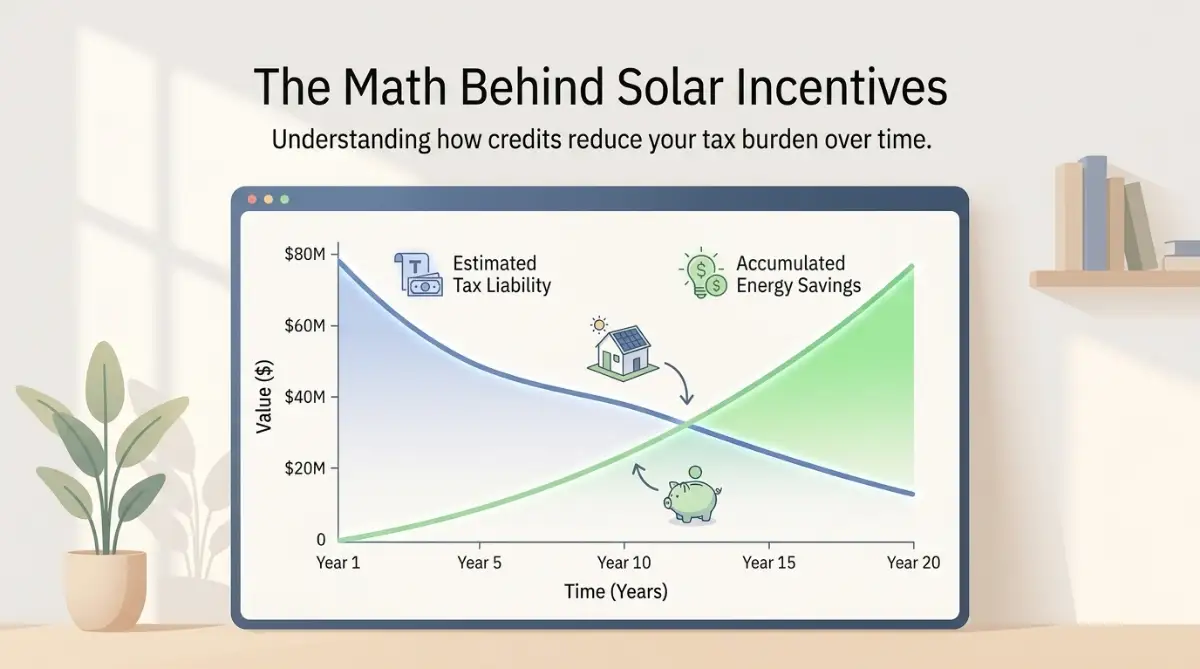
But here is the part that catches people off guard: it is usually a "non-refundable" credit. This means that if your tax bill is only two thousand dollars, but your credit is three thousand, you don't get a "check" for the extra thousand. You simply pay zero in taxes, and the rest of the credit often carries over to the next year.
Understanding this flow changes everything. It means you aren't just looking at this year's tax return; you are looking at a multi-year financial strategy. If your tax liability is low this year, you don't have to panic. You might be able to spread that credit out over time, keeping your tax burden lower for a longer period.
Defining Your Eligibility
Before you count your savings, you must confirm your eligibility. This is not about the solar panels themselves, but about your tax situation. Do you owe income tax? That is the big question. If you have no tax liability, you cannot utilize the credit.
This is why it pays to look at your income over a longer timeline. If you know you are having a low-income year, you might consider how that impacts your ability to use the credit. Planning your solar installation for a year when your tax liability is strong can be a hidden way to maximize your return.
Check these indicators to see where you stand:
- Income Stability: Are you expecting a steady tax bill for the next few years?
- Existing Credits: Do you have other tax credits that might conflict?
- Home Ownership: Are you the owner of the system? (Leased systems usually don't qualify the homeowner).
The Power of "Carry-Forward"
One of the most comforting things I learned during my own tax research was the carry-forward rule. I had worried that if I didn't use the full credit in the first year, I would lose it. That turned out to be a myth.
Most solar tax credit structures allow you to apply the unused portion of your credit to future tax years. This takes the pressure off you to have a massive tax bill in the single year you install your system. It turns the credit into a long-term asset that protects your income.
It’s like having a pre-paid credit for your future self. Knowing this helped me breathe much easier during tax season. It means the financial benefit is locked in, even if it takes a few years to fully realize the value.
Strategic Planning for Maximum Benefit
Now that you know the basics, let’s talk about strategy. Most people treat solar credits as an afterthought, but if you treat them like an investment strategy, you can get much better results.
Aligning Your Tax Liability
If you have the flexibility to choose when to install, consider your tax outlook. If you are planning to retire soon and expect your income—and thus your tax liability—to drop significantly, installing solar before that drop might be better. This allows you to use the credit while you still have a robust tax bill.
Conversely, if you expect your income to rise next year, you might choose to time your installation accordingly. This isn't about gaming the system; it’s about simple math. You want to use the credit when it provides the most "power" to reduce your tax bill.
Managing Your Home Energy Budget
Don't forget that the tax credit is only one part of the financial picture. The real long-term game is the reduction in your monthly energy bills. If you use the tax credit to pay down the principal on your solar loan, you effectively lower your monthly debt payments.
Consider this approach:
- Step 1: Get your tax credit.
- Step 2: Instead of spending it on a vacation, put it toward your solar loan principal.
- Step 3: Watch your monthly interest costs drop as your principal balance shrinks.
This "re-investment" strategy is how smart homeowners turn a simple tax credit into a powerful tool for building net worth. You are essentially using government incentives to accelerate your path to a debt-free solar system.
Documentation is Your Best Friend
I learned the hard way that missing a single document can delay or invalidate a claim. Keep a dedicated file. This should include your contract, the receipt of payment, and proof of the system's installation date.
Do not assume your installer will keep these records forever. You are the one responsible for proving your eligibility if an audit ever happens. Having a digital and physical copy of your documents is the best insurance policy you can have.
Keep these documents organized:
- Signed Installation Contract: Showing the total cost.
- Proof of Payment: Bank statements or loan documents.
- Equipment Certifications: Confirming the system meets the standards.
- Installation Completion Date: This is the magic date for your tax forms.
Why You Should Be Careful with "Free" Quotes
Sometimes, you will see ads for "free solar" or "zero down" programs. Often, these are leases or Power Purchase Agreements (PPAs). In these setups, you are renting the panels from a company.
Here is the kicker: You do not get the tax credit in a lease. The company that owns the panels gets it. While this might save you money on electricity, you lose the financial benefit of the tax credit. Always make sure you own the system if you want to claim the incentive.
Ask yourself these questions before signing:
- "Am I the owner of these panels?"
- "Do I hold the title to the solar equipment?"
- "Is the tax credit specifically written into my name in the contract?"
If the answer to any of these is "no," you need to stop and reconsider. You might be saving on your electric bill, but you are also passing up a potentially significant financial return.
The Pro-Level Realization: Think Like an Investor
I had a major "aha!" moment when I stopped looking at my solar panels as an appliance and started looking at them as a business. When you look at your home as a financial entity, the tax credit isn't just a "rebate"; it's a reduction in the "Cost of Goods Sold" for your energy production.
Pro Tip: I realized that I was so focused on the tax credit that I almost forgot about my annual maintenance. I took a portion of my tax savings and set it aside in a high-yield savings account as a "Solar Maintenance Fund." This way, if I ever need a repair in five or ten years, I have the money ready without touching my emergency savings. It was a small move, but it made me feel completely in control of my financial future.
If you don't do this, you might find yourself scrambling later when you need to replace an inverter. Don't let your "windfall" tax savings vanish into your daily expenses. Treat it with the respect that any investment return deserves.
Watch this video to get a clear breakdown of how to prepare your tax documents and what exactly to watch out for before the filing deadline:
Before you dive into the tax forms, make sure you understand the documentation requirements that could make or break your claim; watch this simple guide to get your paperwork in order.
This video simplifies the often-confusing language found in IRS publications. Most people avoid reading those long documents because they are dense and boring. This guide cuts through the noise and shows you the exact fields to look for on your tax returns.
Common Misconceptions That Cost You Money
There is so much noise online about solar incentives that it’s easy to get distracted by myths. Let’s clear up a few that keep coming up.
Myth 1: "It's a Refund Check"
Many people think the government sends you a check in the mail as soon as your solar is installed. They spend the money in their head before they’ve even filed. It’s a credit, not a refund. You must file your taxes to claim it.
Myth 2: "It Covers Everything"
People sometimes think the credit covers their roof repairs or new electrical wiring. Usually, the credit is strictly for the solar equipment and the labor to install it. If you had to get a new roof to support the panels, that roof cost often does not qualify.
Myth 3: "It’s Only for Rich People"
While you need to have a tax liability to use the credit, you don't need to be a millionaire. Millions of middle-class families use these credits every year. It’s designed to encourage adoption, not to be a tax loophole for the wealthy.
Myth 4: "I Can Claim It Multiple Times"
You get one shot per installation project on your primary residence. You can't keep claiming it every year for the same system. Once you’ve used the credit to its full extent, that’s it.
The Long-Term Financial Impact
When you successfully navigate these tax rules, you aren't just getting money back. You are reducing your total cost of ownership (TCO). This is a metric that businesses use, but homeowners should too.
If your system cost you twenty thousand dollars, but you got five thousand back in tax credits, your real cost is fifteen thousand. This lower number is what you should use to calculate your "break-even point." The shorter your break-even point, the faster your solar panels start paying you.
Every dollar you save on the front end through tax credits is a dollar that doesn't need to be recovered through energy savings. It shortens the time it takes for your system to be "profitable."
Building Home Equity
There is also an argument that a paid-for, highly efficient solar system adds value to your home. When you maximize your incentives and pay down the loan faster, you are building equity in your home much like you do with a mortgage.
Think about the long-term. In ten years, when you are still generating power for free, that investment will have paid for itself many times over. The tax credit was just the kick-start that made it all possible.
Staying Updated on Rules
Tax codes change. While the core benefits often stay stable for years, it is wise to keep an eye on federal announcements once a year. You don't need to be obsessive, but checking the official government energy website once every spring is a smart habit.
Don't rely on social media for tax advice. Stick to the official sources. Your financial health is too important to leave to random advice on the internet.
Final Thoughts for Your Future
You have taken a bold step by choosing to invest in solar energy. It is a decision that pays off in both environmental impact and financial stability. By taking the time to understand the tax credit process, you are protecting that investment.
I know the paperwork feels like a headache right now. But remember, every line you fill out correctly is money back in your pocket. It’s an exercise in patience that yields a high reward.
Be proud of the fact that you are handling this yourself. Many people hire expensive consultants to do what you are doing right now—figuring it out and taking charge. You are becoming an expert in your own financial life.
When you finish filing those forms, take a moment to celebrate. You’ve done the hard work, navigated the bureaucracy, and secured your benefit. That is a win worth celebrating.
Optimizing Your Tax Strategy for Long-Term Gain
Many people treat their tax filing like a chore they just want to get over with. When it comes to solar credits, that mindset is dangerous. You are not just filling out a form; you are managing a major financial asset. If you treat your tax credit as a one-time bonus, you miss the chance to build real wealth.
Matching Your Energy Investment with Your Tax Reality
One of the smartest moves you can make is aligning your solar installation with a year of high tax liability. If you have a year where you expect to earn more or pay more in taxes, that is your window. The credit is a tool, and tools work best when you have something to apply them to.
If your tax bill is usually tiny, the credit sits there, unused, waiting for a future year. While it does roll over, it does not earn interest. You want to clear that credit as efficiently as possible to free up your financial "headroom" for other investments.
Think about your solar system as part of your larger financial portfolio. When you save money on taxes, don't just put it back into your checking account to be spent on groceries. Take those savings and learn how to build wealth through smart dividend investing so that your tax return starts working for you.
Managing the "Carry-Forward" Logic
Most people are terrified of losing their credit. They think if they don't use it all right now, it vanishes into thin air. You should know that for federal solar credits, the unused portion rolls over to the next year.
This is a gift of flexibility. You don't need to force a change in your finances just to use it up in one go. Keep a clear spreadsheet of your carry-forward amounts. If you ever feel lost on how these gaps work in your broader financial picture, understanding the gap: how deductibles and out-of-pocket limits work can help you grasp the mechanics of balancing your financial obligations.
For more technical details on the specific laws regarding residential energy credits, you can check the official IRS instructions for Form 5695. This document is dry, but it is the source of truth for your eligibility. Reading the instructions directly helps you avoid the common mistakes that lead to audit flags.
The Relationship Between Solar Ownership and Insurance
Your tax eligibility depends on ownership. If you lease your system, you are not the owner, and you are not the one getting the credit. This is a point of contention for many who signed lease agreements without reading the fine print.
You should always verify your status before filing. If you are unsure, look at your contract. If the language says "lease" or "power purchase agreement," you likely need to shift your focus from tax credits to simple energy savings. It is a tough pill to swallow, but knowing the truth is better than claiming a credit you aren't entitled to.
This also ties into how you protect your property. If you own the system, it is an addition to your home. You need to make sure your insurance covers it properly, as why home insurance companies deny claims and how to stay protected is something every solar homeowner needs to understand.
Staying Calm During Market Swings
When you are managing tax incentives and home energy budgets, it is easy to get stressed by changes in the economy. You might worry about interest rates or inflation affecting your solar loan. Take a breath and remember that this is a long-term play.
Managing your personal finances requires a steady hand. Just like you would how to stay calm and invest wisely during market volatility, you should treat your solar energy investment with the same level-headed approach. Markets will shift, but your roof will keep generating power.

The Traps That Can Undo Your Financial Progress
We all make mistakes when dealing with complex government forms. But in the world of solar tax incentives, some mistakes are far costlier than others. These aren't just paperwork glitches; they are financial roadblocks that can set you back years.
The "Lease" Confusion
The biggest trap I see people fall into is thinking they are buying when they are actually renting. They get lured in by "zero-down" offers and sleek marketing. They don't realize that they have signed away their right to the federal tax credit.
If you don't own the equipment, you can't claim the incentive. This realization often hits people at tax time when their accountant asks for the purchase receipt. They then have to explain to their family that the expected "tax windfall" is not coming. This leads to a lot of unnecessary frustration.
Ignoring the Tax Liability Threshold
Some people assume the credit is a cash payout. They plan their year around receiving a check from the government. When they find out it is only a reduction of taxes owed, they are devastated.
If you don't owe taxes, you can't get the credit. It’s like trying to use a discount code at a store where everything is already free. You end up with a useless piece of paper. You must check your tax return from the previous year to gauge your liability.
Miscalculating the System Cost
You must be careful about what expenses you include in your claim. The credit is for the solar equipment and the installation labor. It is not for the new roof you decided to put on at the same time.
Some homeowners try to bundle all their home improvement costs into the solar project. This is a direct path to an audit. The IRS is very clear on what qualifies, and they have the records to prove it. Don't try to stretch the definition of "solar equipment" to cover your bathroom remodel.
Forgetting to Document the "In-Service" Date
The tax credit applies to the year the system is placed in service. If you signed the contract and paid a deposit, but the system wasn't turned on until the next year, you might have to wait to file.
People often get excited and try to file for the credit as soon as they sign the papers. This is a mistake. The clock starts when the system is installed, inspected, and functional. Filing too early can delay your claim and cause confusion with the tax authorities.
Relying on Incorrect Financial Advice
I have seen many people take tax advice from their neighbor or an online forum. While peer support is great, your neighbor's tax situation is not yours. They might have a different income level, different filing status, and different deductions.
You need to lean on documentation. If you are ever unsure, find a certified professional. Using the wrong advice can lead to penalties that cost much more than the credit itself.
Failing to Plan for Maintenance Costs
People often use the entire tax credit to pay off their solar loan. While that is a smart financial move, they sometimes forget about the future. Solar systems are durable, but they are not immortal.
If you don't set aside a small "emergency fund" for your solar system, you might be caught off guard if an inverter fails. Don't spend every penny of your tax savings immediately. Think about the life of the system and the potential repairs down the road.
A Path Forward for Your Energy Independence
You have the tools to handle this. It is not about being a tax expert; it is about being an organized and informed homeowner. You have navigated the installation, you have done your research, and now you have a handle on the tax implications.
Every step you take to understand your system brings you closer to true energy independence. Do not let the complexity of tax forms scare you away from the benefits of solar power. It is a solvable puzzle, and you are more than capable of completing it.
Think about the long-term impact. You are reducing your carbon footprint, lowering your reliance on the grid, and building value in your home. That is a significant achievement that goes far beyond a single tax credit.
Action Plan for Your Solar Future
If you want to feel secure in your financial decisions, take these steps starting today. First, gather all your documentation in a single, fire-proof folder. Second, sit down with your latest tax return and get a realistic view of your annual liability.
Third, look for ways to optimize your energy consumption so that you get the most out of every watt your system produces. Remember, solar is not just an appliance; it is an active investment in your future. If you feel like your current setup isn't providing the peace of mind you need, it might be time to look at solar battery storage and whether you can rely on your system when the sun goes away.
You are doing the right thing by asking these questions. Keep your eyes on the long-term goal. Your future self—the one who is paying less for power and enjoying the stability of a paid-off system—will thank you for the diligence you are showing today.
I have been exactly where you are, staring at forms and wondering if I did it right. My advice is to stay calm, check your facts, and don't rush the process. You have invested in your home and your planet, and that is something to be proud of every single day.
Common Questions About Solar Tax Credits
Can I claim the solar tax credit if I am retired and don't pay income tax?
Generally, no. Since the credit is non-refundable and applies to your income tax liability, you need to have a tax bill to reduce. If you have no federal income tax liability, you cannot utilize the credit, but you should speak with a tax professional about potential exemptions or local incentives.
Does the credit cover the cost of a new roof required for the solar panels?
Usually, it does not. The tax credit is strictly for the solar energy equipment and the labor for installation. Structural repairs or roof replacements are typically excluded, even if the solar panels cannot be installed without them.
What happens if I move before I use the full credit?
The credit is tied to your home and your tax return, not the solar equipment itself. If you sell the home, the credit cannot be transferred to the new owner, and you cannot claim it for a house you no longer own. You should consult a tax professional about how to handle the unused portion in the year of the sale.
Is there a deadline for claiming the solar tax credit?
You must claim the credit on your federal income tax return for the year the system was placed in service. While you can amend returns for past years if you missed a claim, it is always better to get it right the first time to avoid delays and potential penalties.
Can I claim the credit on my vacation home?
Yes, you can typically claim the federal solar tax credit on your second home or vacation home, provided you own the system. However, the home must be a residence where you live at least part of the time and is not primarily used as a rental property.
What should I do if my system is installed late in the year?
The "placed in service" date is what matters. If your system is inspected and turned on in December, it counts for that tax year. If it is not turned on until January, it counts for the following tax year, regardless of when you signed the contract or paid the deposit.
Disclaimer: The information provided in this article is for educational purposes only and does not constitute professional tax, financial, or legal advice. Tax laws can change, and regulations vary significantly based on individual circumstances, location, and specific tax filing status. Always consult with a certified public accountant or a tax advisor before making decisions based on this information. By implementing these strategies, you assume full responsibility for compliance with all applicable tax laws and regulations.