The Day I Stopped Following the Crowd
I remember sitting in my home office, staring at a flashing red screen on my laptop. It was a chaotic day, and the market had taken a sudden, sharp dive. My portfolio, which I had carefully built, was dropping in value by the minute. My heart was pounding, my palms were sweaty, and I felt this intense, overwhelming urge to hit the "sell" button. I thought I was losing everything.
I panicked. I convinced myself that if I didn't get out right then, I would be left with nothing. I thought I was being "smart" and "protective" of my money. But what I didn't understand then—what I was completely blind to—was that I was trading based on fear rather than understanding where we were in the cycle. I was acting like a gambler, not an investor.
I sold. And that was the biggest financial mistake of my life. The market bounced back within months, and I missed out on all the recovery because I let my short-term anxiety dictate my actions. That day taught me that market cycles are not random accidents. They are predictable patterns, and if you know how to look, you can stop being a victim of your own nerves.
You might be feeling that same knot in your stomach right now. You look at your accounts and worry about the drops, or you feel pressured to chase the next big thing because everyone else seems to be doing it. It is exhausting, isn't it? The constant news noise makes it hard to see the reality of the market's behavior.
But here is the truth: you don't need a crystal ball. You just need to learn the rhythm of the market. Once I stopped looking at my daily losses and started looking at the phases the market was going through, the anxiety vanished. You deserve that kind of peace, and it starts with learning how to identify the seasons of the economy.
It is normal to feel overwhelmed when charts start turning red. But the market isn't out to get you. It is just breathing. It expands and contracts, moves up and moves down. Your goal isn't to fight the tide, but to learn how to swim with it. Let's look at how you can do that without all the guesswork.
The Natural Rhythm of Market Movements
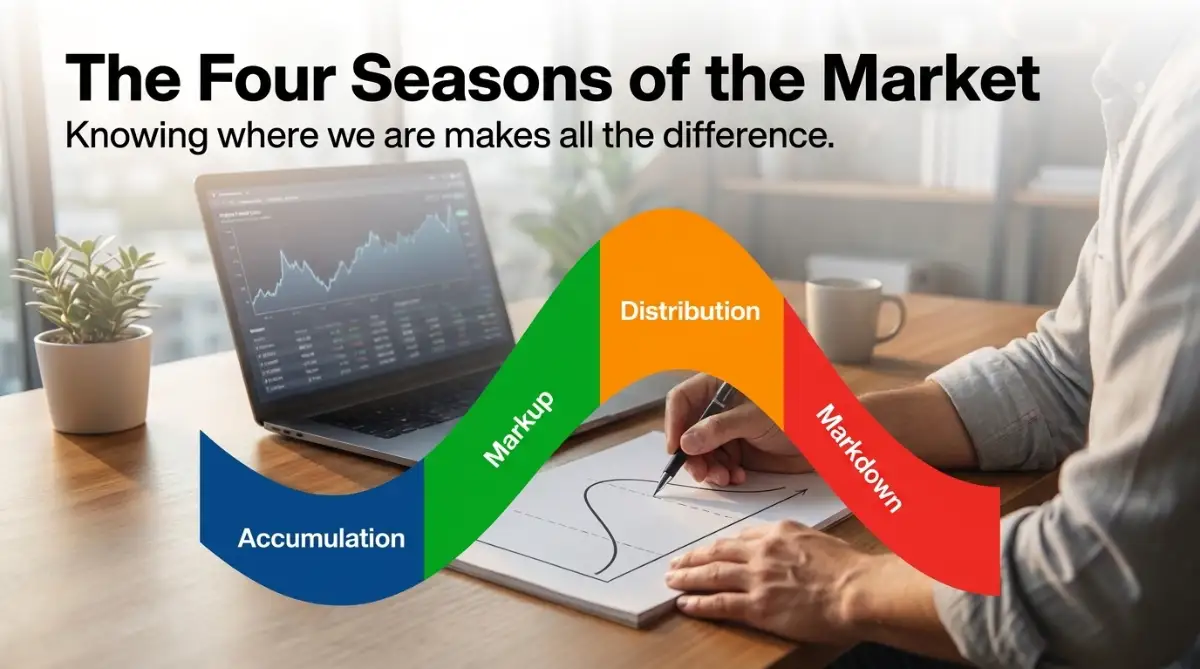
Think of the market like the seasons of the year. You have winter, spring, summer, and fall. Each phase has its own mood, its own weather, and its own set of rules. If you try to plant seeds in the dead of winter, you will fail. Similarly, if you try to harvest in the peak of summer, you are doing it wrong.
The Phase of Quiet Accumulation
This is the "winter" of the market. Everything seems dull. The news is quiet, or maybe the news is bad. This is when the "smart money" starts to buy assets while everyone else is ignoring them. Prices are low, and it feels like nothing will ever happen again.
The Phase of Aggressive Markup
This is the "spring" and "summer." Confidence starts to build. More people notice the prices going up. The news starts talking about it. Suddenly, everyone wants a piece of the action. It feels like money is easy to make, and the party will never end.
The Phase of Careful Distribution
This is the "late summer" or "early autumn." The smart money that bought during the accumulation phase is now selling. They are handing their assets off to the latecomers who are finally getting excited. It looks like things are still going up, but the foundation is starting to crack.
The Phase of Swift Markdown
This is the "late autumn" leading back to winter. Reality sets in. The optimism fades. Panic begins to take hold as people realize the party is over. Prices drop, sometimes quickly, and we return to the accumulation phase to start it all over again.
Pro Tip: I learned that trying to pick the absolute top or bottom is a fool's game. My realization? Don't aim for the peaks. Aim for the middle. By the time it is obvious to everyone that the market is in the "Markup" phase, you have already missed the start. By the time it is obvious the market is crashing, the panic is already baked into the price. Aim to participate in the trend, not to dominate it.
Reading the Signals: A Practical Walkthrough
How do you know which phase you are in? You don't need secret software or insider tips. You need to watch three things: volume, price action, and media sentiment.
Step 1: Analyzing Market Volume
Volume is simply the number of shares or assets being traded. If you see prices rising on low volume, that is a warning sign. It means there is no real conviction behind the move. If prices rise on high volume, it means there are many buyers and the trend is likely real.
Step 2: Understanding Price Action
Price action is the footprints the market leaves behind. Are the "highs" getting higher? Are the "lows" staying above previous levels? This indicates a strong trend. If the market starts failing to make new highs, the distribution phase might be starting.
Step 3: Gauging Media Sentiment
This is a contrarian indicator. When the news is filled with fear and headlines screaming about crashes, you are likely in the accumulation or early markup phase. When the news is filled with "easy money" stories and everyone at the dinner party is talking about investing, you are likely nearing the distribution phase.
This is a critical checkpoint.
If you want to see how the pros look at these patterns in real-time, watch this video:
This video breaks down how to look at price charts and volume without getting buried in complex technical jargon. It helps you see the "big picture" of where we are today.
Comparing the Phases: A Quick View
The Mental Hurdles of Market Phases
The biggest obstacle to success isn't the market; it is your brain. We are wired for "fight or flight." When we see danger, we want to run. In the financial world, "danger" is a red screen, and "running" means selling.
Why You Need a System
When you have a set system based on cycle phases, you remove the guesswork. If you are a long-term investor, a market crash during the "Markdown" phase is just a sale on assets you were going to buy anyway. If you are a short-term trader, you shouldn't be in the market during the transition to winter. The system dictates the action, not your feelings.
The Power of Consistency
Time works for you only if you work with it. If you keep changing your mind, jumping from one trend to another, you aren't giving your system time to play out. Consistency is the secret sauce. Set your rules, identify your phase, and stick to the plan.
Adjusting as You Go
Your place in the cycle isn't a static number. As the market moves, the phase changes. This means your behavior must change.
- The Early Phase: Focus on learning and patience. You can handle the slow build.
- The Middle Phase: Start balancing your growth with a bit of caution.
- The Late Phase: Focus on protection. You want to make sure your gains stay in your pocket.
Don't wait until the market is already screaming to change your approach. That transition should happen gradually as you observe the signs. It keeps you from having to make big, scary changes all at once.
A Final Thought on Market Clarity
Understanding the lifecycle of a market cycle is not about hitting a home run. It is about understanding the environment you are walking through. It is about realizing that your biggest ally is the ability to recognize the season.
Do not be afraid of the market. Be afraid of losing your focus. Your ability to read the cycle is your greatest strength. If you respect the phases, if you build a plan around them, and if you have the discipline to follow that plan, you will get where you need to go.
I want you to leave today knowing that you have control. You don't need to predict the future. You just need to plan for your own. Take a look at your investments tonight. Ask yourself: "Does this match the current season of the market?" If the answer is no, make the change. Your future self is waiting for you to get it right.
Common Questions About Market Cycles
How do I know if the "Markup" phase is over?
Look for divergence. If the market is hitting new highs but the number of stocks participating in that rally is shrinking, it means the strength is fading. That is often a sign of the distribution phase starting.
Is it ever okay to trade during the "Markdown" phase?
Yes, but only if you are a very experienced trader. For most people, it is much safer to move to the sidelines and wait for the accumulation phase to begin. Do not try to catch a falling knife.
How long does each phase last?
There is no fixed time. A phase can last for months or several years. The key is to watch the behavior of the market, not the calendar. Use the signals of price, volume, and sentiment.
What if I get the phase wrong?
Everyone gets it wrong sometimes. The key is to have a "stop-loss" or a plan for when you are wrong. If your thesis for being in the market is proven wrong by the charts, don't double down. Admit the mistake, take the small loss, and wait for a clearer signal.
Should I change my strategy for different cycles?
Yes. Your strategy should be flexible. During the accumulation phase, you look for value. During the markup phase, you look for trend following. Your tools should change to match the weather outside.
Sophisticated Methods for Identifying Market Turns
You have mastered the basics of reading a balance sheet and identifying simple cycle phases. Now, it is time to look at the factors that separate the average investor from the one who actually understands the shifting tides of the economy. When you evaluate an asset, you are not just looking at a price chart; you are trying to guess its future health. This is where advanced logic comes into play.
One of the most effective strategies is analyzing "Market Breadth." This is a term used to describe the number of stocks participating in a move. If the market is hitting new highs but only a few tech giants are driving the gains, the market is fragile. You want to see broad participation, where many sectors are moving in harmony.
You can learn more about how to navigate these turbulent waters by reading how to stay calm and invest wisely during market volatility. When the market swings, looking at breadth rather than just the index price is often what keeps a smart investor stable. Without that structural check, you are just looking at a price that could collapse at any moment.
Another secret involves watching the "Yield Curve." This is an external indicator that many professional traders use to predict economic turns. You can gain deeper insights by checking industry data on Federal Reserve Economic Data (FRED), which provides robust frameworks for understanding how interest rates influence the economy and market cycle shifts.
I also recommend looking at sector-specific metrics. If you are analyzing a tech stock, ignore the "brick and mortar" metrics like inventory turnover. Instead, look at "Churn Rate" or "Customer Acquisition Cost." These numbers tell you if the business is growing sustainably or if it is just burning through cash to fake growth.
Pro Tip: I once ignored the "customer acquisition cost" of a trendy app company. The product was great, but they were spending more money to get a single customer than that customer would ever pay them back. My realization? A great product with a broken business model is still a bad investment. Always check if the math makes sense on a per-user basis before you let the market cycle fool you.
You should also master the art of "Scenario Analysis." Instead of guessing one outcome, imagine three. What happens if the economy grows, stays flat, or hits a recession? If an asset only performs well in one perfect scenario, it is too fragile for your portfolio. You want assets that are resilient enough to survive all three environments.
Finally, do not underestimate the power of the "Dividend History." Even if you are not a dividend investor, a company that has paid and raised dividends for twenty years has a very disciplined management team. They know how to generate cash in good times and bad. You can find more on this approach by exploring how to build wealth through smart dividend investing to understand the difference between a sustainable payout and a trap.

The Danger Zones: Mistakes That Cost Investors Their Fortune
The most painful errors usually come from our own psychology, not from bad data. We want to be right so badly that we ignore the warning signs staring us in the face. It is a human trait, but in the market, it is an expensive one.
One of the biggest mistakes is "Confirmation Bias." This is when you decide you like a market trend, and then you only look for news that proves you are right. You ignore the negative reports and the warning signs from short-sellers. If you are only looking for reasons to buy, you are not analyzing; you are just seeking validation.
Another massive trap is ignoring the "Regulatory Landscape." Companies and markets operate within a framework of laws. If that framework shifts, the business model can become illegal or impossible to scale overnight. You can see how this plays out by looking at how institutional updates impact adoption. When the rules of the game change, the players who aren't ready will lose.
Do not ignore the "Hidden Debt" on the balance sheet. Some companies hide their liabilities in complex, hard-to-read footnotes. You must look at the "liabilities" section as closely as the "assets" section. If the debt is growing faster than the revenue, that is a flashing red light.
We also see people struggle with the "Shiny Object Syndrome." They feel bored with their stable, slow-growing assets and jump into highly speculative markets. If you are tempted by this, read are you wrong about bitcoin: the facts you need to know to get a balanced view before you put your money at risk. Speculation is not the same as market analysis.
Finally, avoid the mistake of "over-diversification." Holding one hundred different stocks means you are essentially buying an index fund but doing one hundred times the work. You cannot possibly keep up with the fundamental health of that many companies. It is better to own fifteen companies that you understand deeply than to own a messy basket of stocks you know nothing about.
A great resource for understanding these behavioral traps is provided by academic research on behavioral finance at the CFA Institute. Understanding why we make these mistakes is the first step to stopping them.
The Reality of Market Volatility
Many beginners think that fundamental analysis guarantees a profit. This is false. Even a perfectly analyzed company can drop in price due to broader market fear.
- The Trap: Selling a good company because the price dropped.
- The Fix: Remind yourself why you bought it. If the fundamentals haven't changed, the drop is just noise.
- The Emotional Cost: Selling in fear locks in your losses. It turns a "paper loss" into a real one.
A Strategy That Stands the Test of Time
You are now equipped with the mindset and the tools to look at assets differently. Remember that this is a journey, not a sprint. You are building a skill set that will serve you for your entire life, not just for the next trade.
Start by practicing. Pick one industry and analyze five companies within it. Don't buy anything. Just do the work. Track your thesis over six months. See what you got right and where you missed the mark. This feedback loop is the only way to become a truly great analyst.
Trust yourself. The "experts" on TV or social media are often just guessing with more confidence than the rest of us. They don't know your goals, your risk tolerance, or your financial situation. Only you do.
I have spent years doing this, and I still get it wrong sometimes. The key is that my "wrong" bets are small, and my "right" bets are well-researched and held with conviction. Keep your portfolio small enough to manage but big enough to grow.
Stay patient. The market rewards those who do the work and wait for the right opportunities. You are now the architect of your own financial future, and that is a powerful position to be in. Start today by looking at a balance sheet, and take ownership of your decisions.
Expert Insight: Protecting Your Mental Clarity
Financial research is demanding. If you are constantly stressed, you will make bad decisions. Your mind needs rest as much as your portfolio needs diversification. Remember that why mental health check-ups are just as essential as physical screenings applies to your investing health too. A clear mind is your best tool for spotting value.
Also, be aware of how your other accounts impact your overall standing. If you are going through personal life changes, financial planning becomes harder. For example, breaking down legal separation and divorce what you must know is something that can completely derail a long-term plan if you haven't prepared for it. Life happens, and your financial plan must be flexible enough to survive the storms.
Common Questions About Market Analysis
How do I know if I am being too conservative?
If your money is losing value after accounting for inflation, you are too conservative. You need your assets to grow faster than the cost of living. If your primary goal is twenty years away, having all your money in cash or low-interest bonds might actually be the riskiest choice you can make.
Is it okay to change my time horizon halfway through?
Life changes, and so do goals. If your goals shift—for example, if you decide you want to retire earlier than planned—you should adjust your horizon and your strategy accordingly. Just make sure you aren't changing your strategy simply because you are reacting to short-term market fears.
What if I have multiple goals with different time horizons?
This is very common. You might be saving for a house and retirement at the same time. You should treat these as separate "buckets" with different asset allocations. Don't mix your short-term house fund with your long-term aggressive growth stocks.
How often should I review my portfolio strategy?
An annual review is usually enough for most people. There is no need to look at it daily or even weekly. If your life circumstances change, such as a major salary increase or a family addition, that is a good time to re-evaluate your long-term plan.
Why does my risk tolerance change as I get older?
As you get closer to needing your money, you have less time to recover from a market crash. You want to prioritize protecting what you have already built over chasing high growth. It is a natural shift from "building" to "preserving."
How do I start fundamental analysis for the long term?
You can use resources like Investor.gov to find tools and calculators. Focus on the company’s ability to generate cash and its long-term competitive advantages. Do not worry about the daily price swings.
Disclaimer: This article is for informational purposes only and does not constitute professional legal, financial, or insurance advice. Every financial situation is unique, and you should consult with a qualified financial advisor before making any decisions regarding your retirement or investment strategy.