The Hidden Trap: Why My Early Days Felt Like a Never-Ending Battle
I still remember the late nights when I started my first website. I had read dozens of articles promising that if I just followed a simple blueprint, I would be making money while I slept. I bought the course, I picked a niche, and I started writing content. A month passed. Then three. Then six. My bank account showed exactly zero dollars. I kept staring at the analytics dashboard, hoping for a spike in traffic or a miraculous conversion. It never came. I felt exhausted, confused, and honestly, a bit foolish for believing that money could just appear without heavy, consistent lifting.
When you start your online journey, the weight of the "passive income" dream sits heavy on your shoulders. You wake up checking your phone, hoping for a notification. When that notification doesn’t arrive, the silence in the room feels loud. You look around at friends who have normal jobs with steady paychecks, and you start to doubt yourself. Your mental peace begins to erode because you are constantly chasing a ghost. You aren't just losing time; you are losing your confidence. It is a lonely path, and when you feel like you are doing everything "right" but still failing, the frustration turns into genuine anxiety.
You start questioning everything. Is it my content? Is it the niche? Is it me? The emotional toll of trying to monetize a platform without a clear strategy is often overlooked. You feel trapped in a cycle of constant action without any forward motion. This isn't just about money; it is about your sense of self-worth. Every failed experiment chips away at your drive. It makes you feel like an outsider looking in at a world of successful creators, wondering what secret they have that you are missing. But here is the truth: they don't have a secret. They just stopped looking for a shortcut.
It is physically and mentally draining to pour hours of work into a website or a channel, only to receive no feedback. You begin to suffer from "creator fatigue." Your sleep gets disrupted because your mind is constantly racing, thinking of keywords, social media posts, and algorithm updates. The stress of not knowing when (or if) the income will start is a heavy burden to carry. Your family might see you staring at a screen for hours and ask, "Is this actually working?" And having to say "not yet" is the most painful part of the entire process. You aren't lazy, and you aren't incapable. You are simply misinformed about how this game actually works.
I realized that the "passive" label is the most dangerous thing in this industry. It makes you think that the work happens upfront and then stops. But in reality, successful online revenue is built on a foundation of active, intentional, and evolving effort. When you stop viewing income as a "set it and forget it" mechanism, you gain the freedom to actually build something that lasts. You stop looking for hacks and start looking for sustainable systems. This shift in perspective is exactly what you need to break the cycle and find real, reliable success.
Rethinking Revenue: The Science of Sustainable Growth
Most beginners struggle because they treat their online project like a lottery ticket. They hope that if they publish enough content, the algorithm will pick them up and shower them with cash. This is mathematically and logically flawed. To scale revenue, you need to understand that your online asset acts more like a business than a magic wand. You need to stop asking "How can I make money?" and start asking "What problem am I solving for a specific group of people?"
The Anatomy of an Online Asset
Think of your website or your platform as a digital storefront. If you open a shop in a remote alley with no signs, nobody will walk in. That is the reality of the internet. You have to actively direct traffic. You have to convince people that your content is better than the hundreds of other options they have. This requires a shift from "content creation" to "content authority." You are not just writing to fill space. You are writing to build trust.
- The Trust Loop: People buy or engage when they trust you.
- The Authority Gap: If you write general content, nobody cares. If you write specialized content, people listen.
- The Scaling Formula: Traffic x Conversion = Revenue.
If your revenue is zero, one of these two variables is missing. Either nobody is seeing your content, or your content isn't compelling enough to make them act. You don't need a thousand hacks. You need to double down on these two simple points.
Breaking the "Passive" Myth
Let's be clear about what "passive" means in this context. Passive income is not "no work." Passive income is "deferred payment." You do the hard work today—researching, writing, optimizing, and building systems—so that the content pays you months or even years later. If you are not willing to do the heavy lifting now, you will never reach the point where the income becomes passive. This is the biggest hurdle for beginners. They want the outcome without the process.
Pro Tip: I remember when I first realized this. I was busy trying to launch a new product every week, thinking it would speed up my income. It actually did the opposite. It diluted my focus. I stopped everything and spent two weeks updating my old, existing content that was already getting a little bit of traffic. That small change doubled my revenue in a month. I learned that optimizing what you already have is often more powerful than constantly creating new things.
Why You Should Stop Chasing Trends
Beginners are often obsessed with "what's hot." They jump from one trend to another, hoping to catch a wave of traffic. But trends fade. When the trend dies, your traffic dies, and your income vanishes. To build a scalable business, you must focus on evergreen topics. These are subjects that people search for every single day, regardless of the season.
This is where the science of SEO (Search Engine Optimization) comes into play. It is not about tricking Google. It is about organizing your information so that it helps the user. If you answer questions better than anyone else, you win. It is that simple. You need to stop looking at SEO as a technical challenge and start seeing it as a way to provide the best service to your audience.
The Power of the Right Audience
You might think that millions of visitors are the key to success. That is a myth. You don't need millions. You need the right thousand people. If you have a thousand people who love what you do, who trust your advice, and who engage with your content, you can build a sustainable revenue stream. This is called the "1,000 True Fans" concept. Focus on depth, not breadth.
When you target a specific audience, you can tailor your message. You stop being a generic voice on the internet and start being a specific solution to a specific problem. That builds loyalty. Loyalty leads to repeat visits. Repeat visits lead to organic growth. And that is how you actually scale your online revenue.
How to Embed Your Content Strategy
The best way to solidify your authority is by using different media types. People consume information differently. Some like to read; others prefer to watch. By integrating video, you keep users on your page longer, which tells search engines that your content is valuable.
Want to see how I structure my content to keep users engaged for 5+ minutes at a time? Watch this breakdown below to understand the mechanics of high-converting content pages.
The Roadmap to Consistency
Now, let's talk about the practical steps you can take today to change your trajectory.
Step 1: Audit Your Current Output
Stop producing content for the sake of it. Look at what you have already posted. Which posts got the most comments or shares? Which ones did absolutely nothing? Identify the winners and stop wasting time on the losers.
Step 2: Narrow Your Niche
If you are writing about "making money," you are competing with everyone. If you are writing about "making money for freelance graphic designers," you are now a leader in a specific space. Narrowing your focus makes it easier to rank and easier to convert.
Step 3: Solve, Don't Just Describe
Most beginner content is descriptive. It says, "This is how you do X." High-converting content is prescriptive. It says, "Here is the problem, here is why it's frustrating, and here is exactly how to fix it." Be the expert who solves the headache.
Step 4: Build a Routine, Not a Sprint
You will not succeed in a week. You will succeed by showing up every single day for a year. Create a schedule that you can actually keep. If you can only write one high-quality piece of content per week, do that. Do not promise daily content if you cannot sustain it. Consistency is the only metric that matters in the long run.
Final Thoughts on Scaling
Scaling isn't about working harder; it is about working smarter on the things that actually move the needle. You have to let go of the idea that success should be instant. Embrace the fact that it takes time. Every successful person you admire started exactly where you are—feeling overwhelmed, checking their analytics, and wondering if it would ever work.
The difference between them and the people who quit? They didn't stop. They adjusted. They looked at the data, they listened to their audience, and they kept refining their process. You have the same tools at your disposal. The internet is a massive playing field, and there is more than enough room for you to carve out your own success. Stop looking for the "passive" shortcut. Start building your own "active" asset. Your future self will thank you for the hard work you put in today. Remember, the best time to start was yesterday, but the second best time is right now. Keep going, stay focused, and prioritize value above all else. Your revenue will follow the value you create.
Beyond the Basics: Expert Secrets for Real Growth
So, you have stopped chasing the mirage of "easy money." You have accepted that this is a long game. Now, how do you actually win? The answer lies in moving from a creator to a system builder. Most people stop at the creation phase. They write, publish, and wait. But the real revenue is found in the optimization phase.
You need to start looking at your content like a digital product line. If a specific piece of content is bringing in traffic, why aren't you maximizing it? One of the best ways to scale is to learn how to bridge the professional skill gap by mastering basic automation tools. When you automate the boring, repetitive tasks, you free up your mental energy to focus on strategy. This is what separates hobbyists from professionals.
Another secret is content repurposing. Do not just let a blog post sit there. Can you turn that post into a checklist? Can you create a summary for social media? Can you record a short audio clip or a video explanation? By moving your existing ideas into different formats, you reach different types of learners without having to reinvent the wheel.
You should also prioritize data-driven decisions over gut feelings. When you look at your analytics, don't just check the total view count. Look at time on page. If people are leaving your site after ten seconds, your headline might be great, but the content is failing to hook them. Google tracks these engagement metrics carefully. According to Google’s guidelines on creating helpful content, the focus must always be on the user's satisfaction. If you are not solving the user's problem, no amount of keyword stuffing will save you.
One massive mistake is trying to be everywhere at once. You don't need to be on every social media platform. Pick one that your target audience actually uses and master it. If your audience is professionals, focus on LinkedIn. If your audience is visual, focus on Pinterest or Instagram. Being great on one platform is a thousand times better than being mediocre on four.
Remember, your digital health is also part of your business security. You might think it’s not related to your content, but a secure system is a reliable system. It is wise to learn why you should stop granting unnecessary permissions to newly installed Android apps because a compromised account can destroy years of hard work in an instant. Protecting your digital infrastructure is an advanced tip that many beginners ignore until it is too late.
To keep your growth steady, you must embrace the concept of "compound interest" regarding your efforts. Just like learning how to build wealth through smart dividend investing, the work you put in today acts as a seed. It might not pay off this month, or even this year. But because you are building a library of high-quality, helpful content, the returns will eventually start to multiply.
Don't let the fear of market shifts discourage you. When things feel chaotic, it is your calm preparation that keeps you ahead. You can learn how to stay calm and invest wisely during market volatility to maintain that same mindset for your business ventures. Business, like investing, rewards those who stay the course when others panic and quit.
The Deadly Traps: Common Pitfalls That Destroy New Businesses
We have all been there. You start with so much energy. You have big plans. But then, reality hits, and you see others having "overnight success." You start comparing your day one to their day one thousand. This is the first trap. It is a mental shortcut that leads directly to burnout.
You see, comparison is the thief of progress. When you focus on what others are doing, you lose focus on your own unique value proposition. Every time you pivot your strategy because you saw someone else's "success story," you reset your progress. I see this all the time. Someone spends three months building a blog, sees someone else making money with a podcast, and quits the blog to start a podcast. Six months later, they start a YouTube channel. They never gain traction because they never give one project enough time to mature.
Another major issue is the lack of "deep work." We live in a world of constant distractions. You sit down to write, but you check your email, then your phone, then your site stats. You are working, but you are not producing. If you treat your business like a series of fragmented tasks, you will get fragmented results. You need to protect your focus.
Let's talk about the "Shiny Object Syndrome." You buy the course, the software, the hosting plan, and the theme. You spend hundreds of dollars before you have even made a single cent. You think the "tools" are the solution. But the tools are just tools. A carpenter does not blame the hammer for a bad house; he blames his own skill. If you are struggling, don't buy a new plugin. Improve your writing. Improve your understanding of your reader's pain.
There is also the risk of deceptive "get rich quick" promises. It is important to be aware of how some schemes operate, often disguised as legitimate business opportunities. The Federal Trade Commission provides clear guidance on what constitutes deceptive advertising, and it is a good reminder to always operate with complete transparency. If a business model sounds too good to be true, it almost always is.
Finally, do not underestimate the cost of poor learning habits. Many people try to "consume" information by reading everything and doing nothing. This is intellectual procrastination. You are gathering data, but you aren't turning it into wisdom. It is quite similar to why traditional study habits often fail to retain complex information. Passive reading is not active learning. You must engage with the material, test it, and fail at it to really understand it.
Stop looking for the magic button. There isn't one. The "pitfall" is the search for a shortcut. The moment you accept that the hard way is the only way, you become dangerous. You become a person who can solve problems, and that is exactly what the internet pays for.
Your Path Forward: Building Your Legacy One Step at a Time
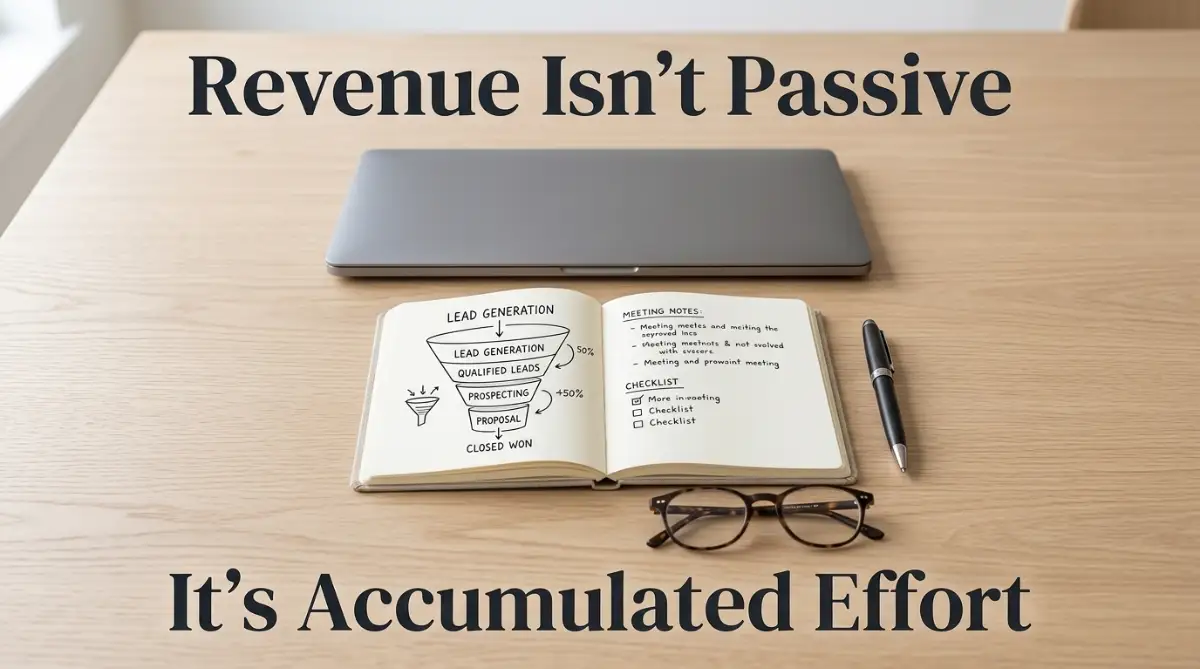
You have likely realized by now that the "passive" in passive income is a bit of a misnomer. It is really "compounded income." You front-load the effort so that the rewards can accumulate later. This is not a reason to quit; it is a reason to start with a realistic plan.
Think of your current project as an asset that you are crafting. Every paragraph you write, every problem you solve for your reader, and every link you fix is an investment. It is not just about today's view count. It is about creating a resource that will be useful to someone, somewhere, in the future.
When I started my first venture, I was obsessed with the result. I wanted the money, the freedom, and the success. But I found that I only started seeing growth when I stopped obsessing over the outcome and started obsessing over the quality. I wanted to be the best resource for the specific question my reader was asking. When you reach that level of care, the money starts to follow as a byproduct of the value you provided.
Don't wait for permission to succeed. Don't wait for your site to be "perfect" before you publish. The most important thing is to get your ideas out there. You will learn more from one published post than from reading fifty articles on how to publish. Perfection is a wall that stops you from starting. Progress, however, is a bridge that leads you to your destination.
I want to leave you with this final thought. It is okay to be tired. It is okay to feel confused. It is even okay to take a break. But do not give up on yourself. My own journey was filled with moments where I felt like quitting. I had days where nothing went right, and my numbers stayed flat for weeks. But I kept showing up because I believed that my work had value. If I can do it, you absolutely can too. Grab your notebook, pick one small thing to improve today, and just start. Your future self will look back at this exact moment and be grateful that you decided to keep going.
Common Questions About Scaling Online Revenue
How long does it really take to see results?
There is no set timeline because every niche and every creator is different. Some see small wins in a few months, while others take a year or more to gain real traction. Focus on consistent quality, and the timeline will take care of itself.
Should I quit my job to focus on this?
Please do not quit your job yet. This is a common mistake that adds unnecessary financial stress, which kills creativity. Treat your online business as a side project until it consistently generates enough income to cover your expenses and savings.
Do I need a huge budget to start?
Not at all. The barrier to entry is lower than ever. You need a domain, reliable hosting, and your own knowledge. You don't need expensive software or paid ads to start seeing growth if your content is genuinely helpful.
How do I know if my content is good enough?
The best metric is not your own opinion; it is user engagement. If people read, comment, share, or return to your site, you are doing something right. If they leave immediately, go back to the drawing board and focus on making your content more useful.
Is it too late to start a website?
The internet is constantly evolving, and there is always room for a new voice that provides fresh, accurate, and helpful information. If you solve problems that people are searching for, you will always have an audience.
Disclaimer: This content is for educational and informational purposes only and does not constitute financial or business advice. The strategies discussed reflect general best practices in digital content creation and online business management. Always perform your own research and consult with professionals before making significant financial decisions or business investments.