
The Paycheck Panic: My Early Days of Financial Fog
"You are earning more than ever, yet your bank account seems to hit zero before the month actually ends. It is the classic early-career trap where lifestyle inflation steals your raises before you can save a dime. You don't need a massive salary to build wealth; you need a system that stops you from living paycheck to paycheck. Let’s build a financial roadmap that puts you in control today."
I felt like I was running on a treadmill that kept speeding up. No matter how many hours I put in at the office, I was not getting ahead. I was just reacting to life. Every expense felt like a surprise attack on my peace of mind. I spent nights lying awake, staring at the ceiling, wondering if this was what adulthood was supposed to feel like. It was a cycle of working, spending, and worrying, with no actual plan for the future.
The pressure is real. You look around and see friends posting about their vacations or their new cars, and you wonder what you are doing wrong. You feel guilty for wanting to enjoy your life, but you also feel guilty for not saving enough. It is a heavy mental load that drains your energy. You want to breathe easier, but you don't know how to stop the financial bleeding.
I kept thinking that if I just waited until I got a raise, everything would fix itself. But that raise came, and the spending just expanded to match it. That is when I realized that income alone is not the answer. The answer was in the structure. I needed a map. I needed a way to organize my money so it worked for me, not against me. If you are feeling that same weight, I want you to know you are not alone, and you can break this cycle.
What You’ll Master in This Guide:
- The Foundation: Why auditing your spending is the first step to freedom.
- The Buffer: How a small emergency fund changes your mindset.
- The Growth: Why diversification is your best tool against market ups and downs.
- The Habit: How automation stops you from overspending your paycheck.
Laying Your Financial Foundation
You cannot build a house on a shaky foundation, and you certainly cannot build wealth on a shaky financial base. Before you think about big investments or complex strategies, you have to get the basics right. This is about knowing exactly where you stand. You need to stop guessing and start measuring.
Unmasking Your Real Cash Flow
The first step is a brutal audit. I used to hate looking at my bank statements because I knew what I would find. But ignoring them is exactly why I stayed broke. You need to download your last three months of bank statements. Look at every single charge. Yes, even that five-dollar coffee you grab every morning.
When you see the data, it changes your brain. You stop viewing money as an abstract number and start seeing it as a finite resource. Group your spending into "Needs" and "Wants." You will likely find that your "Wants" are much higher than you ever imagined. This isn't about cutting out every joy in your life. It is about awareness. You cannot manage what you do not track.

The Emergency Buffer Concept
Once you have clarity, you need a safety net. Life is unpredictable. Your car will break down. You might get sick. You might lose your job. If you do not have cash ready for these moments, you will end up using credit cards. That is how you get stuck in a high-interest debt trap.
Aim for a small starter fund first. Even one thousand dollars is a great goal to start. Keep this money in a high-yield savings account that you do not touch. This money is your "don't panic" fund. It allows you to breathe when a surprise bill lands on your lap. It shifts your mindset from "I am trapped" to "I have options."
Eliminating High-Interest Anchors
If you have credit card debt, that is an anchor dragging your ship down. The interest rates are often so high that you are essentially paying for things you bought years ago. Focus your extra energy on paying these off before you put significant money into long-term investments. The math simply does not work in your favor if you are paying twenty percent interest while earning seven percent in the market.
The Logic of Diversified Growth
Once your foundation is solid, you can start looking at the horizon. Diversification sounds like a complex term used by fancy brokers in suits. In reality, it is a simple concept: do not put all your eggs in one basket. If you invest only in one stock, and that company fails, you lose everything. If you spread your money across different assets, you protect yourself.
Investing for Your Future Self
Think of your future self as a different person. You are doing this for the person you will be in ten or twenty years. Start with simple, low-cost index funds. These funds allow you to own a tiny piece of the entire market. It is the most effective way to grow your money without needing to be an expert stock picker.
The Power of Compound Interest
Time is your greatest asset right now. If you start investing small amounts early, they have years to double and triple. A hundred dollars invested in your twenties is worth way more than a hundred dollars invested in your forties. This is the magic of math working in your favor. You don't need a huge lump sum to start. You just need consistency.
Want to see how the experts handle early career financial planning? Watch this guide to prepare for your journey.
Pro Tip: My Realization on Lifestyle Creep
I remember when I finally got that big promotion I had been working toward. I wanted to celebrate by upgrading my apartment and buying a newer car. Then I stopped. I asked myself, "Does this actually make me happier, or am I just doing it because I can?" I decided to keep living like I was making my old salary for one more year. I took the difference and threw it into an investment account. That one decision bought me more freedom than any car ever could. I learned that true wealth is not about what you spend, but about what you keep.
Structuring Your Financial Roadmap
You don't need a hundred different accounts to manage your money. You need a system that flows. Think of your money like water. It should flow into the right reservoirs automatically. If you have to manually move money around every month, you will eventually get lazy and stop doing it.
Automate the Boring Stuff
Set up automatic transfers. As soon as your paycheck hits, move a percentage into your savings and a percentage into your investment account. Do this before you even see the money in your spending account. If the money isn't there, you won't spend it. This is the "pay yourself first" principle. It is the most reliable way to build wealth without having to rely on willpower every single month.
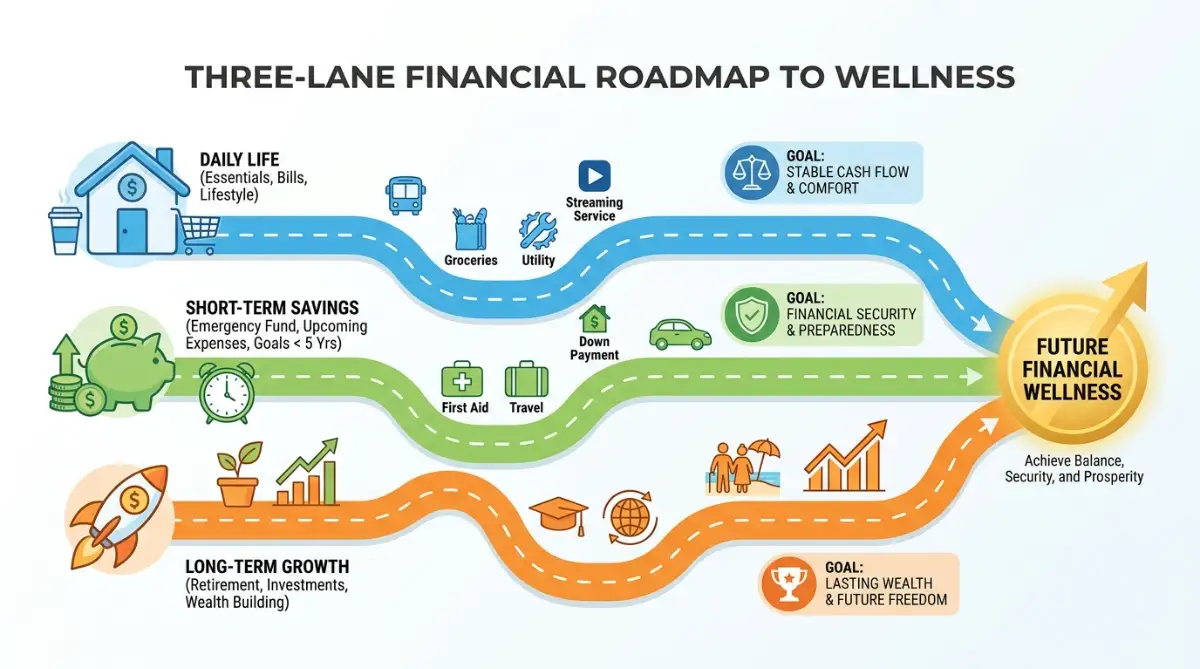
The Three-Bucket Strategy
I like to visualize my money in three buckets.
- Bucket One: Daily life (Checking account). This covers your rent, utilities, and groceries.
- Bucket Two: Short-term goals (High-yield savings). This is for your emergency fund, your next vacation, or that wedding you need to save for.
- Bucket Three: Long-term growth (Investment accounts). This is your retirement and your "freedom fund."
- By separating these, you remove the temptation to use your future money for today’s coffee. You treat each bucket with respect.
Debunking Common Financial Myths
People often tell you things about money that sound smart but keep you broke. Let’s look at a few of them.
Assessing Your Risk Tolerance
Early in your career, you can afford to take more risks because you have time to recover from mistakes. Don't be afraid of the market. The biggest risk is actually being too conservative and letting inflation erode your purchasing power over the next forty years. Diversification helps you manage that risk while still capturing growth.
The Long-Term Vision
Building a financial roadmap is not a sprint; it is a marathon. There will be months when you feel like you aren't making progress. That is normal. The progress happens in the background, day by day, as you build the habit of discipline.
You are laying tracks for a train that is going to carry you to freedom. It doesn't matter how fast the train starts moving, as long as it is on the right tracks. Keep your focus on the system, not the daily fluctuations. You are doing this for the person you will become. Keep showing up. Keep automating. Keep tracking. You are building something lasting, and that is a major achievement in itself.
Stay patient with the process. You are gaining skills that most people never bother to learn. You are taking responsibility for your own life. That is not just a financial victory; it is a personal one. Start small, stay consistent, and remember that every dollar you manage well today is a brick in the foundation of your future freedom. You have the power to change your trajectory right now. Go for it.
Leveling Up Your Financial Game: Beyond the Basics
Once you have your automated savings and your initial budget in place, you might feel like you are on autopilot. That is a great feeling, but successful wealth building requires you to take a more active role periodically. You need to transition from "set it and forget it" to "monitor and adjust." Think of it like maintaining your car. You don't just change the oil once and assume the engine will run perfectly for twenty years without looking at the tires or the brakes.
Mastering the Art of Portfolio Rebalancing
Most people think that if they choose a good mix of stocks and bonds, they can leave it alone forever. That is a mistake. Over time, some of your investments will grow faster than others. If you started with a 70/30 split between stocks and bonds, a good year in the market might turn that into an 80/20 split without you even trying.
This means you are now taking more risk than you originally intended. Rebalancing is simply the act of selling a bit of the high-performing asset and buying the lower-performing one to get back to your target. It forces you to sell high and buy low, which is the golden rule of investing. It prevents you from getting overexposed to one sector. If you want to dive deeper into how different assets behave, Investopedia offers a great overview on tax-efficient investing to help you understand how to keep more of your returns.
The Tax Strategy You Shouldn't Ignore
I used to think taxes were just something you dealt with in April. I was wrong. The type of account you use matters as much as the investment itself. You have tax-deferred accounts and tax-free accounts. Knowing how to use them is a secret weapon.
If you are just putting money into a regular brokerage account, you are paying taxes on your gains every single year. By using accounts specifically designed for retirement or long-term growth, you can shield your money from the annual tax drag. This might sound minor, but over twenty years, the difference adds up to tens of thousands of dollars. Always check the IRS guidelines on tax basis so you understand how your investments are treated. It helps you make smarter decisions about what to hold and what to sell.
Guarding Your Digital Assets
In our modern world, your financial security isn't just about your bank account balance; it is about your identity. I learned the hard way that one small security slip can wipe out years of hard work. You should practice the same caution with your financial accounts as you do with your physical wallet. For a detailed guide on how to stay ahead of bad actors, check out my tips on keeping your online bank accounts safe from hackers. It is a simple step that saves you immense stress.
The Automator’s Secret to Wealth
You might have already automated your savings, but are you automating your debt management? If you are paying monthly bills, you can actually use that to your advantage. It is possible to turn your monthly bills into a higher credit score. When you have a solid credit history, you get access to better interest rates, which saves you money every time you need to borrow for a big purchase.
Pitfalls That Keep Professionals Stuck in a Rut
We all want to see our bank accounts grow, but sometimes our own behaviors hold us back. I see friends making the same mistakes over and over because they believe they are "playing it safe." Here are the traps you need to watch out for.
The "Get Rich Quick" Distraction
Every few months, someone will tell you about a new crypto token or a hot stock that is going to the moon. They will show you screenshots of massive gains. It is tempting to jump in. But remember, for every person who hits a jackpot, there are dozens who lost their hard-earned money. If you are getting started with digital wallets or crypto, treat it as play money, not your retirement fund.
Paying High Fees for "Expert" Help
There are funds that promise to beat the market for you. They charge high management fees to do it. The problem is that study after study shows that these active funds rarely beat simple, low-cost index funds over the long run. You are paying them for the privilege of likely underperforming the market. Before you invest, always look at the expense ratio. The SEC provides resources on investment fees that can help you understand how even a one-percent difference in fees eats your returns over a decade.
Ignoring the Mortgage Fine Print
When you eventually buy a home, do not just look at the monthly payment. You need to look at the total cost of the loan. I have seen people jump into loans without decoding their mortgage disclosure forms first. You need to know about points, origination fees, and escrow requirements. If you ignore these, you might find yourself with thousands of dollars in surprise costs at closing.
The Passive Income Fallacy
We hear a lot about "passive income" online. People claim you can just buy a course or an app and money will flow in while you sleep. The truth is, almost all passive income requires active work upfront. Falling for the passive income fallacy can lead you to spend money on schemes that don't pay off. If it sounds too easy, it usually is.
Neglecting the Emergency Buffer
I have met people who have a great investment portfolio but not a single dollar in an emergency fund. When their car breaks down, they have to sell their stocks at a loss to pay for repairs. That destroys their long-term growth plan.
Your Path to Financial Freedom
Building wealth is not about being a genius. It is about being consistent. You don't need to predict where the stock market will be next week. You just need to show up and stay the course.
Action Plan for Tomorrow
- Review your current allocations: Check if your portfolio has drifted away from your target.
- Audit your fees: Look at your investment accounts and see what the expense ratios are.
- Check your credit: Pull your report from AnnualCreditReport.com to ensure there are no errors dragging your score down.
- Set a date: Pick a day every three months to look at your "big picture" numbers, not just your daily spending.
I have found that the more I look at my money, the less anxious I feel about it. It stops being a monster under the bed and starts being a tool I control. I want you to feel that same sense of control. Start small, stay disciplined, and trust the process. You are doing this for the person you will be ten years from now, and that future version of you will be so thankful you started today.
Common Questions About Your Financial Future
How much should I actually be saving every month?
A good rule of thumb is to aim for 20% of your income. If that feels impossible right now, start with 5% and increase it by 1% every few months. The key is to make it automatic so you don't have to think about it.
Does inflation hurt my long-term savings?
Yes, inflation is the silent killer of cash. If you keep all your money in a standard checking account, it loses value over time. That is why investing in assets that grow, like index funds, is so important. You need your money to grow faster than the rising cost of living.
Is it too late to start if I'm already in my thirties?
Absolutely not. You have a long runway ahead of you. The best time to start was ten years ago, but the second-best time is today. Your contributions now will still compound significantly over the next few decades.
How do I know if I'm diversified enough?
Diversification means owning a mix of different types of assets. If you own a total stock market index fund, you are already diversified across thousands of companies. You don't need to overcomplicate it by trying to pick individual stocks to feel "diversified."
Disclaimer: This content is for educational purposes only and does not constitute financial, legal, or tax advice. I am not a financial advisor. All financial decisions involve risk, and you should perform your own research or consult with a qualified professional before making any investment choices based on your specific situation.